Which Shuttle Bus Is Right for Your Operation?
When you're looking at shuttle buses for sale, the right configuration depends on your route profile, passenger count, driver licensing situation, and whether your funding source requires ADA compliance. Shuttle buses serve more commercial use cases than any other bus class — from daily employee runs to hotel airport loops to federally funded medical transport. Here's how the main buyer types compare.
Shuttle bus buyer-fit matrix by use case
| Buyer Type |
Recommended Capacity |
Typical Budget (Used) |
Key Consideration |
| Corporate / employee shuttle |
20–35 passengers |
$20,000 – $45,000 |
Passenger comfort and professional interior matter for employee perception. CDL Class B required above 26,000 lbs GVWR; confirm before your driver roster is set. High annual mileage makes diesel the practical engine choice. |
| Hotel & airport transfer |
12–24 passengers |
$15,000 – $35,000 |
Cycle count is high — multiple daily runs add up fast. Prioritize chassis condition and transmission serviceability over cosmetics. Luggage storage capacity is as important as seat count for airport routes. |
| Medical & senior transport |
12–20 passengers, ADA-equipped |
$20,000 – $50,000 |
ADA lift (minimum 600 lb capacity) and Q'Straint or Sure-Lok securement are typically required. If you receive Medicaid or federal funding, verify compliance specs with your program before purchase — not all lift-equipped units qualify. |
| Church & nonprofit |
12–20 passengers |
$12,000 – $28,000 |
Non-CDL operability is the priority — keep GVWR under 26,001 lbs and passenger count at 15 or fewer. Clean interior and reliable mechanicals matter; budget for a pre-purchase inspection on any unit over 100,000 miles. |
| Tour & charter operator |
24–45 passengers |
$30,000 – $65,000 |
Passenger amenities — reclining seats, climate control, USB charging, Wi-Fi — drive customer ratings. CDL Class B + P endorsement required. Consider mid-size coach if your routes consistently run 35+ passengers. |
Shuttle Bus Size Classes and Specifications
Unlike school buses, shuttle buses don't carry a federal type classification — your size decision comes down to passenger count, route requirements, and gross vehicle weight rating (GVWR — the maximum safe loaded weight). The GVWR you choose determines whether your drivers need a CDL, which shapes your hiring and operations from day one.
Shuttle bus size classes: capacity, length, GVWR, CDL requirement, and used price range
| Size Class |
Passenger Capacity |
Typical Length |
GVWR Class |
CDL Required? |
Used Price Range |
| Small shuttle bus |
12 – 20 passengers |
20 – 26 ft |
Under 26,000 lbs (Class 4–5) |
No CDL if ≤15 passengers and <26,001 lbs GVWR — verify per vehicle |
$12,000 – $28,000 |
| Mid-size shuttle bus |
21 – 35 passengers |
26 – 35 ft |
26,001 – 33,000 lbs (Class 6) |
CDL Class B + P endorsement required |
$22,000 – $45,000 |
| Full-size shuttle bus |
36 – 45 passengers |
35 – 40 ft |
Over 33,000 lbs (Class 7) |
CDL Class B + P endorsement required |
$35,000 – $65,000 |
CDL rules vary by state and by whether you're transporting passengers for compensation. Confirm requirements with your state DMV before finalizing your purchase. ADA-equipped units in any size class typically add $6,000–$15,000 to your budget.
Common Shuttle Bus Makes and Models
When you're comparing used shuttle buses for sale, most units you'll encounter are body-on-chassis builds — a purpose-built passenger body mounted on a Ford, Chevrolet, or Mercedes commercial chassis. Here are the makes you'll see most often and what each suits best.
Starcraft Starlite & Allstar
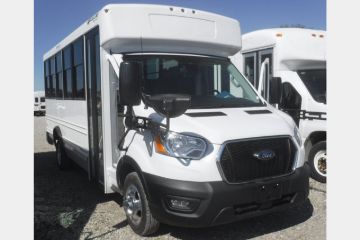
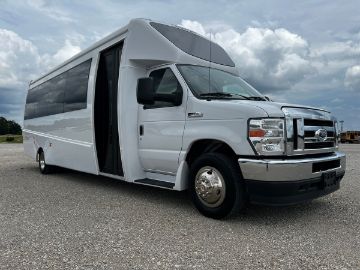
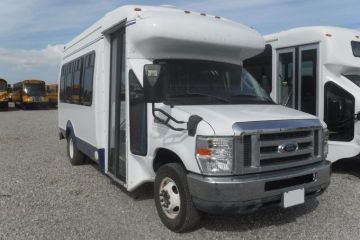
The most common shuttle bus body in used inventory. Starcraft builds on Ford E450, E350, Ford Transit, and Chevrolet 4500 chassis, seating 12–28 passengers. The Allstar is the workhorse mid-capacity model; the Starlite runs a more refined interior suited to corporate and hotel work. Ford-chassis versions stay under the CDL threshold in most configurations. Best for: corporate shuttles, hotel transfers, church transport.
ElDorado Aerotech
ElDorado National's Aerotech is a body-on-chassis shuttle running primarily on Ford E450 and Ford F550 platforms, seating 20–28 passengers. It's a proven fleet workhorse with a straightforward interior, good headroom, and wide availability in the 2010–2020 model year range. ADA lift-equipped versions are common in used inventory. Best for: medical and senior transport operators, corporate fleets, airport hotel shuttles.
Glaval Universal & Concorde II
Glaval builds on Ford E450 and Chevrolet 4500 chassis, seating 14–24 passengers. The Universal is the standard-capacity model; the Concorde II steps up with a more coach-like interior. Both are well-regarded for build quality relative to their price point, and ADA-equipped versions are available in used inventory. Best for: corporate shuttles, tour operators, senior transport programs.
Mercedes-Benz Sprinter
The Sprinter is a unibody van-conversion — which means a smoother ride and car-like handling, but a lower ceiling on durability under heavy daily cycling. You get 12–15 passengers in standard configuration and strong diesel fuel economy. Repair costs run higher than Ford chassis equivalents when things go wrong. Best for: premium hotel transfers, executive shuttles, and low-mileage routes where presentation matters more than cycle count.
Ford Transit Passenger Van
The Ford Transit seats 10–15 passengers — sitting right at the line between a passenger van and a purpose-built shuttle. You get non-CDL operation in most configurations, low acquisition cost, and easy service anywhere. It's not suited to heavy daily cycling or ADA lift retrofits. Best for: churches and nonprofits, small corporate shuttles, and routes where non-CDL operation is non-negotiable.
Collins & Turtle Top
Collins and Turtle Top build activity and shuttle bus bodies on Ford and Chevrolet cutaway chassis, seating 14–30 passengers. Collins is dominant in the school activity and crossover shuttle market; Turtle Top covers hotel, corporate, and tour applications with higher interior finish options. Both offer ADA-equipped variants. Best for: multi-use operators, church and camp programs, hotel and resort transport.
Shuttle Bus Use Cases
Corporate & Employee Shuttle. Employee shuttles run fixed routes on tight schedules, often multiple times a day. Your priority is reliability and interior comfort — employees notice a tired interior and a rough ride. A 20–35 passenger mid-size shuttle on a Ford E450 or Chevrolet 4500 chassis is the standard fit for this use case. High annual mileage makes diesel the practical engine choice, and your drivers will need a CDL Class B with P endorsement above 26,000 lbs GVWR. Budget $20,000–$45,000 for a solid used unit.
Hotel & Airport Transfer. Airport shuttles run short, high-frequency loops with heavy loading and unloading cycles. You need a durable chassis, a wide entry door, and enough luggage storage to handle checked-bag volume — underfloor or rear compartment storage is a significant spec difference between models. When you're evaluating used shuttle buses for sale in this segment, pay more for low-mileage drivetrain and transmission condition than for cosmetics. Starcraft Allstar and ElDorado Aerotech are the dominant models here.
Medical & Senior Transport. If you're operating non-emergency medical transport (NEMT) or senior mobility programs, ADA compliance isn't optional — it's typically a funding condition. Your unit needs a wheelchair lift rated at minimum 600 lbs, Q'Straint or Sure-Lok four-point securement, and adequate maneuvering clearance inside the cabin. Low-floor transit-style bodies reduce boarding time for ambulatory seniors. Before you purchase, confirm your lift and securement specs against your state Medicaid or program requirements. See the ADA-compliant bus buying guide for a full compliance checklist.
Church & Nonprofit. Your budget and non-CDL operability define this purchase. A 12–20 passenger small shuttle under 26,001 lbs GVWR avoids the CDL requirement in most states, opening up your volunteer driver pool. Presentation matters — your vehicle shows up at events and reflects on your organization. Prioritize clean body condition and a reliable service history over low mileage, and always budget for a pre-purchase inspection on any unit over 100,000 miles.
Tour & Charter Operator. Charter work puts passengers in the vehicle for longer periods — your amenities directly affect reviews and repeat business. Look for reclining seats, individual climate control, USB charging, and Wi-Fi capability in any unit you're putting in front of paying customers. Full-size shuttles seating 24–45 passengers require CDL Class B with P endorsement. If your routes regularly fill 35+ seats, compare mid-size coach buses before you commit — the step up in amenities and passenger experience may justify the cost difference.
Frequently Asked Questions
How much does a used shuttle bus cost?
Used shuttle bus prices range from $12,000 for older small-capacity cutaways to $65,000 for late-model full-size units with ADA lifts and premium interiors. If you're shopping for a mid-size 20–28 passenger unit in the 2015–2020 range, expect to pay $22,000–$40,000 for a solid used shuttle bus. ADA-equipped units add $6,000–$15,000 to your budget for the lift and securement system.
Do I need a CDL to drive a shuttle bus?
It depends on the vehicle. If your shuttle bus has a GVWR under 26,001 lbs and carries 15 or fewer passengers, most states don't require a CDL. Above either threshold, you'll need a CDL Class B with a Passenger (P) endorsement. If you're running compensated transport, state rules vary — confirm with your DMV before you build your driver roster around a specific vehicle.
Is diesel, gas, or electric better for a shuttle bus?
Diesel is the standard for operators running over 30,000 miles annually — better fuel economy, longer engine life, and stronger resale value. Gas (typically Ford V10 or Chevy 6.0L) costs less upfront and is easier to service in most markets. Electric shuttle buses are entering the used market now — lower fuel and maintenance costs over time, but higher purchase price and charging infrastructure are real considerations. See our zero-emission fleet guide if you're evaluating an electric transition.
What ADA equipment do I need on a shuttle bus?
For ADA-compliant passenger transport, your shuttle needs a wheelchair lift rated at a minimum 600 lbs, at least two Q'Straint or Sure-Lok four-point securement positions, adequate maneuvering clearance inside the cabin, and kneeling suspension if your operation involves ambulatory passengers with mobility limitations. If your funding source is federal or Medicaid, confirm exact specs before purchase — program requirements vary.
How often does a shuttle bus need maintenance?
A standard diesel shuttle bus on a commercial chassis needs an oil change every 10,000–15,000 miles, transmission service every 30,000–60,000 miles, and a full brake inspection annually. High-cycle operations — airport loops, employee shuttles — accelerate brake and tire wear significantly. Budget $3,000–$6,000 per vehicle annually for scheduled maintenance on a mid-size unit running 30,000–50,000 miles per year.
Is buying a used shuttle bus better than buying new?
For most operators, yes. A three-to-five year old shuttle bus in the 50,000–120,000 mile range delivers most of its useful life at 40–60% of the new price. New makes sense when you need a warranty program, specific ADA specs unavailable used, or your operation demands consistent branding across a fleet. For single-unit buyers or small fleets, the used shuttle bus market offers far better ROI at current new-vehicle pricing.