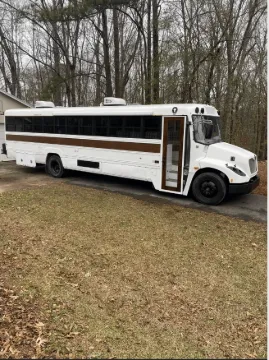
Commercial Bus Conversion Guide
A skoolie conversion can also be planned as a commercial bus conversion when the vehicle supports a business, service route, outreach program, classroom, studio, or brand activation. Use the listings above to compare buses by size, access, mileage, layout, HVAC, lift options, and buildout requirements.
Commercial conversion buyer fit by use case| Use Case | Recommended Bus Type | Why It Fits | Key Qualification Question |
|---|
| Mobile pet grooming | Short school bus, activity bus, or shuttle bus | Compact footprint, enough room for tub/equipment, easier neighborhood access | Do you already know your water, power, and grooming-station layout? |
| Mobile barber / salon | Short bus, shuttle bus, or activity bus | Good standing room, manageable parking, flexible interior buildout | How many chairs or service stations will the build need? |
| Food, coffee, or pizza concept | Activity bus or full-size school bus | More room for prep, refrigeration, ventilation, and point-of-sale flow | Have you confirmed local health, fire, and ventilation requirements? |
| Podcast / recording studio | Shuttle bus, activity bus, or full-size school bus | Interior length supports acoustic treatment, desk/studio zones, and equipment storage | Do you need quiet HVAC, shore power, generator power, or both? |
| Mobile retail / boutique | Shuttle bus or activity bus | Walk-through layout supports merchandising, checkout, and event parking | Will customers enter the vehicle, or will sales happen through an exterior service window? |
| Event / brand activation | Full-size school bus, coach, or shuttle bus | Strong visual presence, room for displays, sampling, storage, and staff | Will the bus travel city-to-city, stay regional, or serve as a stationary event asset? |
The best bus for a commercial conversion is the one that fits the business model, equipment plan, and operating environment. Start with route, parking, customer flow, equipment, power, HVAC, and build budget.
Short school buses and activity buses. Strong fit for mobile grooming, barber/salon, retail, outreach, and training uses. They are easier to park than full-size buses while still giving a builder enough wall and floor space for commercial equipment. Confirm standing height, rear-door access, and GVWR before committing.
Shuttle buses. Strong fit for service businesses that need a finished passenger-style interior, wider entry, ADA lift options, or a professional appearance from day one. Shuttle buses can work well for grooming, mobile office, small clinic, retail, and studio concepts when the dimensions match the build plan.
Full-size school and activity buses. Strong fit for food concepts, mobile classrooms, nonprofit outreach, training, large retail activations, and builds that need separated work zones. The tradeoff is parking, fuel cost, maneuverability, and a higher build budget.
Commercial Conversion Planning Checklist
A strong commercial conversion plan connects the vehicle to a defined service, realistic budget, local requirements, and a build timeline. Review these checkpoints before choosing a bus for a mobile business or organization-serving vehicle.
Commercial conversion planning checkpoints| Planning Area | What to Confirm | Why It Matters |
|---|
| Use case | Mobile business, outreach, event, studio, training, or service vehicle | The use case determines floor plan, access, equipment, and operating needs |
| Budget | Bus purchase, buildout, equipment, inspection, insurance, and local permits | The lowest-priced bus is not always the lowest-cost conversion platform |
| Timeline | Purchase window, builder availability, permitting, and launch date | Commercial builds often depend on inspection and equipment lead times |
| Vehicle details | Dimensions, layout, HVAC, mileage, lift, power, and service history | These details affect build feasibility, compliance, and operating cost |
Commercial Bus Conversion FAQs
Can a skoolie conversion support a business use case?
Yes. A skoolie conversion can support business or organization use when the bus is planned around the service model, equipment, customer access, power, HVAC, storage, and local operating requirements.
What is the best bus for a mobile business conversion?
Short school buses, activity buses, and shuttle buses are often the strongest starting points because they balance interior space with parking and operating cost. Full-size school buses can work when the business needs separate work zones, equipment storage, or a larger customer-facing footprint.
What should I know before buying a bus for a commercial conversion?
Know the business use case, interior layout, required power, HVAC, water, lift or door needs, parking constraints, local permitting requirements, and build budget before you choose the bus. The right platform depends on the business plan as much as the vehicle.
Should I buy a bus before talking to a builder?
For commercial conversions, it is usually better to confirm core dimensions and system requirements with a builder before buying. A bus that looks inexpensive can become the wrong platform if the build needs more standing height, a wider aisle, a lift, special ventilation, or more electrical capacity.