

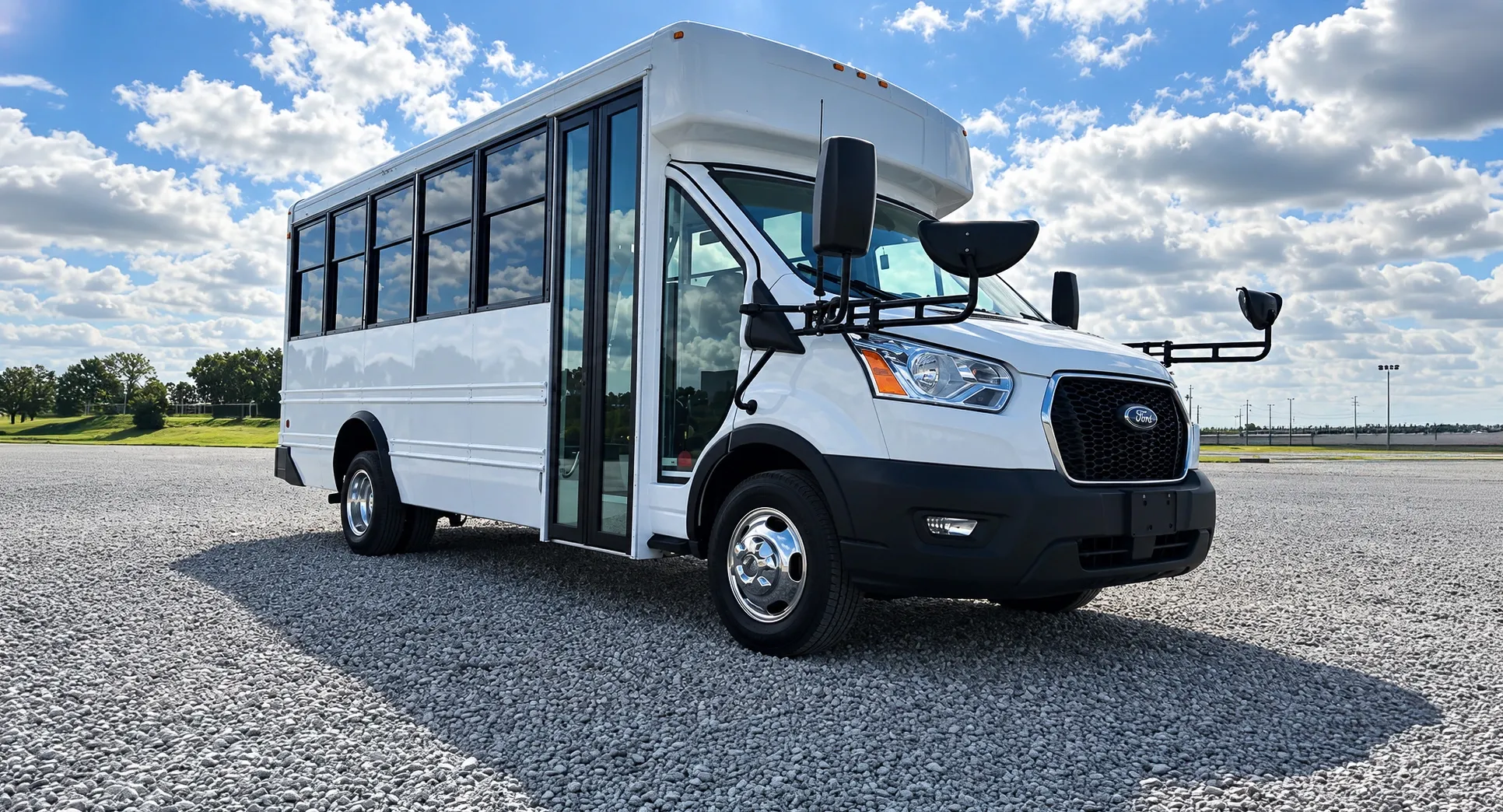
 Used Ford buses
Ford Buses for Sale
Ford supplies E-Series cutaway chassis used by independent manufacturers to build Type A school buses and commercial shuttles. Transit passenger vans and converted Transit vehicles serve smaller groups. On a used Ford-based bus, check the chassis model and year as well as the body manufacturer, seating layout and installed equipment.
Why choose a Ford bus
- ✓
The deepest used supply on the site, most of it E-Series cutaway shuttles.
- ✓
Ford's range includes Transit vans, E-Series cutaways and F-Series chassis used by bus builders. Check the model and body configuration of each vehicle.
- ✓
Ford's commercial dealer network and the large number of bus builders using Ford chassis make parts and service easy to find.
- ✓
Wheelchair-accessible layouts are common, with ADA lifts and securements on many E-Series and Transit units.
Ford bus specifications and capacity
| Model Family | Typical Capacity | Primary Use | Engine Options | CDL Required? |
|---|---|---|---|---|
| Transit Passenger Van (factory-built by Ford) | 8 - 15 Passengers | Church, Vanpool, Staff Transport | Gas (3.5L V6); 3.2L Diesel on 2015–2019 units | Depends on Size |
| Transit and E-Transit conversions (built by independent upfitters) | Varies by upfitter | Shuttle, Paratransit, Accessible Van | Gas (Transit), Electric (E-Transit) | Depends on Size |
| E-350 / E-450 Cutaway (Starcraft, Glaval, ElDorado, Collins, Turtle Top) | 12 - 28 Passengers | Hotel, Airport, Paratransit, Type A School | 7.3L Gas (2021 and newer), 6.8L V10 or 5.4L V8 Gas (earlier) | Depends on Size |
| F-550 / F-650 (Allstar XL, Glaval, Grech, Turtle Top Odyssey XL) | 25 - 45 Passengers | Airport Parking, Tour, Executive Shuttle | Diesel (most), Gas on some units | Yes (Usually) |
Find the right Ford for your operation
Best for Hotels & Airports
E-450 and F-550 shuttles with rear luggage racks suit hotel and airport loops with frequent stops.
Best for Senior Living & Paratransit
Many Ford listings mention ADA equipment such as wheelchair lifts and securement positions.
Best for Churches & Nonprofits
Transit vans and smaller E-350 shuttles can suit weekly ministry transport and may not need a CDL, depending on designed seating (including the driver), GVWR, use and state rules.
Best for Schools, Daycares & Camps
Type A school buses and MFSABs from Collins, Micro Bird and others are built on Ford E-Series and Transit chassis.
About Ford Buses
Table of Contents
About Ford Motor Company Buses
Ford Motor Company, based in Dearborn, Michigan, doesn't build bus bodies itself. It supplies the cutaway and stripped chassis that body builders turn into shuttles, school buses and limo buses. The E-Series (originally the Econoline, introduced in 1961) is still sold as a cutaway, while the Transit replaced the E-Series passenger van in the US for the 2015 model year.
What Buyers Look for in Used Ford Buses
Buyers usually compare the body builder and floorplan, the chassis and GVWR (Gross Vehicle Weight Rating, the maximum loaded weight), engine (the 6.8L V10 on older E-Series, the 7.3L V8 on newer ones, and diesel on most F-550 and F-650 buses), lift and securement condition on ADA units, and seat count against their drivers' licensing.
How to Shop Ford Inventory on BusesForSale.com
Filter by year, mileage, fuel type and seating, and search by body brand (Starcraft, Glaval, ElDorado, Collins) as well as "Ford." As of October 2026, priced single-unit Ford listings on BusesForSale.com ranged from about $10,900 for a 2009 E-350 Champion Challenger to $227,000 for a nearly new 2023 F-650 mid-size bus.
Did you know?
Starcraft is the most common body on Ford chassis on BusesForSale.com. Searching "Starcraft" or "Allstar" alongside "Ford" turns up the widest choice of shuttles.
Browse by Model Family
Featured Ford inventory
View All Ford Inventory →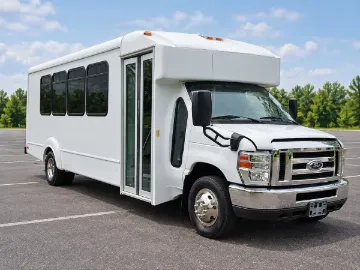
2016 Ford E-450 Goshen 25P
Discover the 2016 Ford E-450 Goshen 25-Passenger Shuttle Bus with very low original miles. This bus has excellent amenities, including dedicated rear luggage, overhead parcel racks, upgraded high-back seating, rear air conditioning, power entry door, arm rests, seat belts and more. With under 13,000 miles and a robust gasoline engine paired to an automatic transmission, this shuttle is ready to serve shuttle fleet operators, retirement communities, hospitals and event coordinators seeking reliable, efficient, and maneuverable group transportation. The spacious interior comfortably seats up to 25 passengers, making it ideal for airplane travelers, tourists, hotel guests, community residents, and employees who demand both comfort and convenience.
This Goshen Coach build features a large rear luggage storage that is perfect for airport runs and luggage-intensive trips.
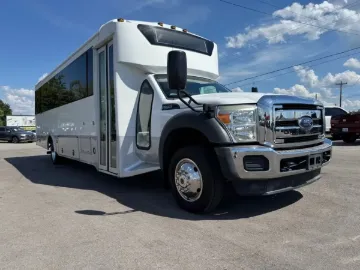
2015 Ford F-550 Glaval 28P ADA
2015 Ford F-550 Glaval 28-Passenger ADA Accessible Shuttle Bus with very low miles. This bus has upgraded high-back seats with arm rests, overhead strorage racks, a power entry door, rear door for easy loading, power rear air conditioning, under-floor luggage storage on entry side, upgraded windows for premium look and more.. Designed to accommodate up to 28 passengers, this bus prioritizes accessibility with its integrated wheelchair lift and comfortable, spacious seating. The robust 6.8L Triton V10 gasoline engine paired with an automatic transmission ensures reliable performance for all routes, making it ideal for shuttle fleet operators, retirement communities, assisted living centers, hospitals, hotels, airport transfers, churches, and event coordinators.
Built on the legendary Ford Super Duty platform, this model is recognized for its commercial-grade durability and smooth ride quality. Ford delivers proven dependability and industry-leading support, making it a top choice for organizations that demand reliable transport solutions.
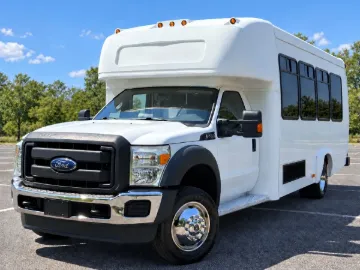
2014 Ford F-450 Diesel 4X4 16P
Very Rate 4 Wheel Drive Shuttle Bus with extremely low original miles. PowerStroke Diesel powered 2014 Ford F-450 16-Passenger Shuttle Bus with dedicated rear luggage storage, overhead parcel racks, upgraded high back seating, 3 point seat belts and more. With capacity for up to 16 passengers, this fleet-ready vehicle is built to deliver seamless transportation for airport travelers, hotel guests, community residents, and more. The carpeted luggage compartment ensures guest belongings are handled with care, while package shelves provide organized storage for travel essentials. An electric entry door streamlines boarding, enhancing both safety and efficiency for your shuttle operations. The rare 4x4 capability provides added confidence and control, making it ideal for a variety of terrain and weather conditions.
Ford is renowned for its robust engineering and lasting durability, making it a trusted choice for professional transport. The Super Duty F-450 model is synonymous with strength, comfort, and proven performance.
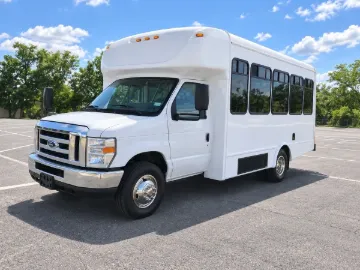
2018 Ford E-350 Starcraft 14P ADA
2018 Ford E-350 Starcraft Allstar 14-Passenger ADA Accessible Shuttle Bus with low original miles. This vehicle is church owned in the Southern part of the USA and has been properly maintained. This unit has seating for 12 passengers plus 2 wheel chair positions or 14 passengers with no wheel chairs on board. It has front and rear air conditioning, a power entry door, tinted glass, audio system and more. It is powered by the 5.4L gasoline V8 and has an automatic transmission. Perfect for any church, community center, hotel, retirement community or any fleet operator interested in providing ADA wheelchair accessible transportation options.
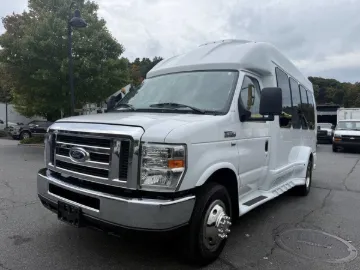
2016 Ford E-350 Turtle Top Van Terra 14P
2016 Ford E-350 Turtle Top VanTerra 14-Passenger Luxury Shuttle Bus with only 7,500 miles. The powerful Triton 5.4L gasoline V8 engine delivers excellent performance. This bus is exceptionally clean and has had only one owner, ensuring a meticulously cared-for interior and exterior. Passengers will enjoy a spacious and comfortable ride, making each journey enjoyable and efficient. The E-Series is renowned for its durability and reliability, making it a top choice for fleet buyers who demand consistent performance. Experience the combination of strength, safety, and comfort that makes the Ford E-Series a standout in passenger transportation.
Ford is recognized for building robust vehicles that excel in reliability and long-term value. The E-Series continues this legacy with proven performance and enduring quality.
Financing and leasing options
Need a payment structure that matches your operation? We help buyers compare financing and leasing options that support faster approvals and predictable monthly costs.

Commercial Financing
Competitive rates for qualified buyers, with terms built for church, senior living, hotel, school, and fleet shuttle acquisitions.

Leasing Programs
Flexible lease structures for organizations that need predictable monthly costs and regular fleet refresh cycles.
Common Questions
Ford bus FAQs
The questions our team hears most about buying a used Ford, answered in full.
Who owns Blue Bird school buses?
Blue Bird is owned by its public shareholders as Blue Bird Corporation, listed on Nasdaq under the ticker BLBD since February 2015. The Luce family ran Blue Bird until 1992, after which it passed to Merrill Lynch, Henlys Group and Volvo. Following a 2006 prepackaged bankruptcy, funds affiliated with Cerberus Capital Management took control, and Blue Bird went public in 2015 through a merger with Hennessy Capital Acquisition Corp.
How does Blue Bird compare with Thomas Built Buses and IC Bus?
Blue Bird, Thomas Built Buses and IC Bus are the three major US school bus makers. Thomas Built belongs to Daimler Truck North America, and IC Bus belongs to Navistar, owned by Traton since 2021. Blue Bird is independent and sold 9,025 buses in fiscal 2025, 82% of them Type C, and is a leading seller of propane and electric school buses.
What older Blue Bird bus models will buyers find on the used market?
Older Blue Bird buses on the used market are mainly the All American, TC/2000 and Blue Bird Conventional, alongside early Vision models. The flat-front All American was introduced in 1948 and is still built today. The lower-cost TC/2000 transit-style bus ran from the 1988 model year to 2003. The Blue Bird Conventional used outside chassis, and its last version stayed in production into the 2008 model year, after the Vision arrived in 2003.
Are Blue Bird buses made by International?
No, Blue Bird builds its own buses, but older Blue Bird Conventional school buses used chassis from International (Navistar), as well as Ford and GM. Blue Bird stopped using GM chassis in 2002, and the International-based Conventional, renamed SBCV for 2005, ended with the 2008 model year. The Blue Bird Vision, launched in 2003, was the first conventional school bus on a proprietary chassis not shared with a medium-duty truck.
How much does a Blue Bird school bus cost?
Kentucky's 2025 school bus purchasing guide listed new diesel Blue Bird Type C buses at about $129,000 to $137,500 on state contract. Final prices depend on capacity, options and grants. Used Blue Bird buses cost far less: on BusesForSale.com, priced 72-passenger Visions from the early 2010s have been listed at roughly $10,000 to $19,000, and priced All American buses from about $18,000 for 2013 models to $168,000 for a 2026 All American FE. Used prices are October 2026 asking prices of priced listings; listings quoted on request are excluded.
Does Chevrolet make buses?
Chevrolet does not build complete buses; it supplies Express cutaway chassis and passenger vans that independent body builders turn into school buses and shuttles. The Express 3500 cutaway is rated up to 12,300 lb GVWR and the Express 4500 at 14,200 lb. Since 2017, GM has had Navistar build its commercial cutaway chassis at Springfield, Ohio. Starcraft, Collins, Thomas Built Buses and Micro Bird all build bodies on Chevrolet chassis.
How do Chevrolet and Ford compare as shuttle bus chassis?
Chevrolet and Ford cutaways are close rivals for small shuttle buses, with similar weight ratings and gasoline V8 power. The Chevrolet Express 4500 is rated at 14,200 lb GVWR with a 6.6L V8 on 159- or 177-inch wheelbases. The Ford E-450 is rated at about 14,000 to 14,500 lb with a 7.3L V8. For larger buses Ford also offers F-550 and F-650 chassis, while Chevrolet's cutaway range stops at the Express 4500.
What older Chevrolet chassis were used for buses?
Older Chevrolet buses were mainly built on the Chevy Van G-series, such as the G30, and on Kodiak medium-duty trucks. The Express replaced the G-series van for the 1996 model year. Kodiak C4500 and C5500 chassis carried larger shuttles until General Motors left the medium-duty market in 2009, with the last truck built in Flint, Michigan, on July 31, 2009. Chevrolet returned to medium duty in 2019 with Silverado 4500HD to 6500HD trucks developed with Navistar.
Do Chevrolet buses need a CDL?
Whether a Chevrolet bus needs a CDL depends on its designed seating, because nearly all Chevrolet-based buses are under the 26,001 lb GVWR threshold. Under federal rules, a vehicle designed for 16 or more people including the driver needs a CDL with a passenger endorsement. Express passenger vans with 12 or 15 seats usually do not. Express 4500 buses with 14 passenger seats usually do not, while 20- to 30-passenger layouts do. State and school bus rules can be stricter.
Does Chevrolet offer an electric bus chassis?
Chevrolet does not sell a factory electric Express cutaway; electric buses on Chevrolet chassis use battery drivetrains added by other companies. Collins, for example, has offered an electric Type A school bus on the GM 4500 cutaway, listed with a 120 kWh battery and about 130 miles of range. Most Chevrolet-based buses on the market use gasoline V8 engines, with a Duramax diesel found on some older units.
When was Collins Bus founded?
Collins Bus traces back to 1967, when Don Collins started E-CON-O Conversion in Kansas City, Missouri, building small van-based school buses. The company was renamed Collins Industries in 1971 and moved to Hutchinson, Kansas, in 1972. Collins is credited with an early wheelchair-lift school bus in the mid-1970s, rebuilt after a 1979 plant fire, and today builds its buses in South Hutchinson, Kansas.
How does Collins compare with other Type A school bus makers?
Collins is one of several major Type A school bus builders, competing mainly with Blue Bird's Micro Bird, Thomas Built Buses' Minotour and Trans Tech. Collins builds on Chevrolet/GMC and Ford E-Series cutaways as well as the Ford Transit, in single- and dual-rear-wheel versions. Collins is part of Forest River, which also owns the Starcraft and Glaval bus brands, so dealer and parts support often runs through Forest River's bus network.
Does Collins make electric school buses?
Yes, Collins offers electric Type A school buses, including a model on the Ford E-Transit with a 68 kWh battery and about 100 miles of range. Collins has also offered an electric version on the GM 4500 cutaway, listed with a 120 kWh battery and about 130 miles of range. Around 2018, Collins built an earlier electric Type A on Motiv's Ford E-450-based chassis with up to about 75 miles of range.
Do Collins buses need a CDL?
Most Collins buses do not need a CDL under federal rules if they seat fewer than 16 people including the driver. Every Collins Type A chassis is well under the 26,001 lb GVWR threshold, so seating decides it: a 14-passenger Collins usually needs no CDL, while 20- to 30-passenger Collins buses need a CDL with a passenger endorsement. Many states also require school bus endorsements or certificates for any bus carrying students.
Where can I get parts and service for a Collins bus?
Collins bus service is split between the chassis maker and the Collins body dealer network. Engines, transmissions and brakes on Chevrolet, GMC and Ford chassis can be serviced at those brands' commercial dealers. Body parts such as doors, seating, lifts and electrical components are supplied through authorized Collins dealers, including large bus dealers such as Rush Bus Centers and Model 1. Recording the bus's serial number and floorplan speeds up parts matching.
Does Dodge still make buses or passenger vans?
No, Dodge does not currently sell a bus or passenger van; its former commercial and passenger vans now come from Ram and Chrysler. The full-size Ram ProMaster is a Ram product, and the minivans once sold as the Dodge Grand Caravan continue as the Chrysler Pacifica and Chrysler Voyager. Mobility converters such as BraunAbility now build wheelchair minivans on the Pacifica and Voyager, with side-entry or rear-entry ramps.
Did Dodge make school buses?
Dodge never built school bus bodies, but other companies built small school buses on Dodge van chassis. The Wayne Busette, a Type A school bus produced until 1990, was offered on Dodge Tradesman and Ram Van platforms. Dodge ended Ram Van and Ram Wagon production after the 2003 model year and replaced them with the Dodge Sprinter, so any Dodge-based school bus is now more than 20 years old.
Who converts Dodge and Ram vans into passenger and wheelchair vans?
Dodge and Ram passenger and wheelchair vans are built by independent upfitters, because Ram has never sold a factory passenger version of the ProMaster. Upfitters include Meridian Specialty Vehicles, Waldoch, TCI Mobility, BraunAbility, Driverge, New England Wheels and Forest River's van division. Their ProMaster conversions range from 15-passenger vans to ADA shuttles with ramps. Each conversion carries the upfitter's label, which states final seating and GVWR.
Is there an electric Dodge or Ram van?
Dodge has no electric van, but Ram offers the ProMaster EV, a battery-electric commercial van launched in 2024. Ram rates its 110 kWh battery at about 162 miles of city driving range, with DC fast charging up to 150 kW. Ram launched it in Delivery and Cargo versions for fleets, so a passenger or wheelchair version would require an upfitter conversion, and few have reached the used market so far.
How much do Dodge passenger and wheelchair vans cost?
Dodge-listed passenger and wheelchair vans, mostly Ram ProMaster conversions, usually cost far more than standard vans because of the conversion work. On BusesForSale.com, 2023 ProMaster ADA and luxury conversions have been listed at roughly $86,000 to $89,000, and 2025 ProMaster passenger and shuttle builds at roughly $131,000 to $148,000. Older Dodge Grand Caravan wheelchair minivans cost less. Prices depend on ramp type, wheelchair positions, roof height and mileage. These are October 2026 asking prices of priced BusesForSale.com listings; listings quoted on request are excluded.
Does Ford still make school bus chassis?
Ford still supplies chassis for small Type A school buses, but it stopped making full-size conventional school bus chassis after the 1998 model year. Ford's B-series cowled bus chassis, including the B700 and B800, was built from 1948 to 1998 and phased out when Ford sold its heavy-truck line to Freightliner. Today, Ford E-Series cutaways and Transit vans carry Type A bodies from builders such as Collins and Micro Bird.
How do Ford and Chevrolet compare for shuttle buses?
Ford and Chevrolet offer similar small shuttle chassis, but Ford covers more sizes, from the Transit van to F-650 mid-size buses. The Ford E-450 cutaway is rated at about 14,000 to 14,500 lb GVWR with a 7.3L V8, close to the Chevrolet Express 4500 at 14,200 lb with a 6.6L V8. Chevrolet's cutaway line stops at the 4500, while Ford adds F-550 and F-650 chassis for larger buses.
Does Ford make an electric bus chassis?
Ford's electric option for small buses is the E-Transit, since Ford does not offer an electric E-Series cutaway. From the 2025 model year, the E-Transit comes only with an 89 kWh battery, rated up to about 159 miles in cargo form, replacing the earlier 68 kWh pack rated around 126 miles. Bus builders use it for electric vehicles such as the Collins Type A school bus and Forest River passenger vans.
How much do Ford buses cost?
Ford-based buses range from under $20,000 for older shuttles to over $200,000 for nearly new mid-size buses, with the chassis and body builder setting the price. On BusesForSale.com, 2014 to 2016 Ford E-450 shuttles have commonly been listed at roughly $35,000 to $65,000, and 2012 to 2013 Ford F-550 shuttles at about $50,000 to $55,000. ADA lifts, low mileage and newer 7.3L engines raise prices. These are October 2026 asking prices of priced BusesForSale.com listings; listings quoted on request are excluded.
Do Ford buses need a CDL?
Whether a Ford bus needs a CDL depends on its seating and weight rating, so the answer changes across Ford's range. Federal rules require a CDL for vehicles designed for 16 or more people including the driver, or rated at 26,001 lb GVWR or more. A 15-passenger Ford Transit usually does not. An E-450 with 14 passenger seats usually does not, while larger E-450 layouts do. Many F-650 buses need a CDL on both counts.
Are Forest River buses good?
Forest River Bus is one of North America's largest shuttle bus builders and calls itself the continent's largest shuttle bus and van manufacturer. Its brands, including Starcraft, Glaval, StarTrans, Champion, ElDorado and Collins, build on Ford, Chevrolet and Freightliner chassis. Quality and finish vary by brand, floorplan and model year, so buyers usually judge a Forest River bus on its chassis, body condition and service records rather than the badge.
Where are Forest River buses built?
Forest River buses are built mainly in northern Indiana, with Collins school buses built in Kansas. Forest River Bus operates a large plant in Goshen, Indiana, which a 2016 expansion brought to about 230,000 square feet, and Glaval is based in nearby Elkhart, Indiana. Collins builds its Type A school buses in a 94,000-square-foot facility in South Hutchinson, Kansas.
Does Forest River make electric buses?
Yes, Forest River offers electric passenger vehicles, mainly vans and small school buses built on the Ford E-Transit. Forest River Van and MobilityTRANS build E-Transit passenger and wheelchair vans, typically for 9 to 12 passengers. Collins, a Forest River brand, offers an E-Transit Type A school bus listed with a 68 kWh battery and about 100 miles of range. Around 2019, Forest River also worked with Phoenix Motorcars on electric Starcraft shuttles.
Do Forest River buses need a CDL?
Whether a Forest River bus needs a CDL depends on its seating and GVWR, so it varies across the range. Federal rules require a CDL for vehicles designed for 16 or more people including the driver, or rated at 26,001 lb GVWR or more. A Forest River van or 14-passenger Starcraft usually needs none. Larger Starcraft, Glaval and StarTrans buses need a passenger endorsement, and heavy diesel models may need a Class B license.
Does Forest River build full-size tour coaches?
No, Forest River builds body-on-chassis shuttles, mid-size buses and school buses, not full-size motorcoaches. Its largest Forest River buses, such as the Starcraft Allstar XL, Glaval Legacy and StarTrans President on Ford F-550, Ford F-650, International or Freightliner S2C chassis, seat up to about 45 passengers. For long-distance touring with under-floor luggage bays and 50 or more seats, buyers usually look at coach builders such as MCI or Prevost.
What bus chassis does Freightliner make?
Freightliner makes bus chassis rather than complete buses, with school, shuttle and coach bodies added by other builders. Its lineup has included the FS-65 school bus chassis (1997 to 2006), the C2/B2 chassis under Thomas Saf-T-Liner C2 school buses, the M2 106 for shuttles and party buses, and the S2C from Freightliner Custom Chassis. Freightliner also sold a badged Sprinter van in the US through 2021.
How do Freightliner and International compare for school buses?
Freightliner and International each supply chassis to a sister school bus brand: Freightliner to Thomas Built Buses and International to IC Bus. Freightliner and Thomas both belong to Daimler Truck North America, while International and IC Bus belong to Navistar, owned by Traton since July 2021.
Does Freightliner still sell passenger vans?
No, Freightliner stopped selling vans after the 2021 model year, when its badged Sprinter, mechanically identical to the Mercedes-Benz Sprinter, was discontinued in the US. Freightliner had sold the Sprinter under its own badge since 2001, and Mercedes-Benz now sells the van under its own name. Dodge also sold the van from 2003 to 2009. Freightliner Sprinters share powertrains and most parts with Mercedes-Benz models, so Mercedes-Benz van dealers can service them.
Do Freightliner buses need a CDL?
Most Freightliner buses need a CDL, because they are usually designed for 16 or more people including the driver. Freightliner M2 106 party buses and shuttles and S2C shuttles typically seat about 24 to 40, which requires a passenger endorsement under federal rules. A bus rated at 26,001 lb GVWR or more also needs a Class B license. Freightliner Sprinter vans with 15 or fewer seats are the main exception. State rules vary.
Does Freightliner make an electric school bus?
Freightliner's electric school bus option is the Thomas Saf-T-Liner C2 Jouley, the battery-electric version of the Thomas C2 built on Freightliner's C2 platform. First-generation Jouleys from 2017 and 2018 had 100 to 160 kWh of battery and a baseline range of about 100 miles. Later Proterra-powered Jouleys use a 226 kWh battery rated for up to about 135 miles.
Who owns Gillig, and where are Gillig buses built?
Gillig is privately owned by Henry Crown and Company through its CC Industries unit, which bought Gillig in 2008, and all Gillig buses are built in California. Gillig moved production from Hayward, its home for more than 80 years, to a larger plant in Livermore in 2017. The company reports about 1,100 employees, all in the US, and is the only one of North America's three heavy-duty transit bus makers that originated in the US.
How does Gillig compare with New Flyer?
Gillig is the second-largest transit bus manufacturer in North America by volume, behind New Flyer, and both build low-floor transit buses for public agencies. Gillig held about 31 percent of the US and Canadian heavy-duty transit bus market in 2013, the most recent widely cited figure. New Flyer, based in Winnipeg and owned by NFI Group, also builds 60-foot articulated buses, while Gillig concentrates on 29-, 35- and 40-foot buses; listings often describe the shortest as 28-foot.
How much does a Gillig bus cost?
A new 40-foot Gillig bus typically costs from about $550,000 to more than $900,000, depending on fuel type and equipment. Recent public purchases include Gillig's 2022 Pittsburgh Regional Transit bid at about $554,000 per diesel bus, Gold Coast Transit District's 2021 order at about $587,000 per CNG bus, and Fresno's 2024 purchase of 11 CNG buses for $10.26 million. Battery-electric Gillig buses cost more than diesel or CNG versions.
What fuel and power options does Gillig offer?
Gillig builds transit buses with diesel, hybrid-electric, CNG and battery-electric powertrains, and it is adding a hydrogen fuel cell model. In April 2024 Gillig announced a fuel cell electric bus developed with BAE Systems and Ballard Power Systems, with production reported for 2026. Zero-emission versions are heavier: Gillig's 40-foot battery-electric bus carries a gross vehicle weight rating of about 48,200 pounds, compared with roughly 39,600 to 41,600 pounds for diesel and CNG buses.
Did Gillig ever make school buses?
Yes, Gillig built yellow school buses for decades before it switched to transit buses. Its Transit Coach school bus was produced until 1982, and Gillig later sold a school bus version of the Phantom from 1986 to 1993, ending it after poor sales. Since then Gillig has built only transit buses, so a Gillig school bus on the market today is a vintage unit or a transit bus repainted for school or activity use.
Who owns IC Bus, and where are IC buses built?
IC Bus is the school bus brand of International Motors, formerly Navistar, which has been part of Germany's TRATON Group since 2021. IC Bus builds its buses in a plant of about 1 million square feet at Tulsa International Airport in Oklahoma, which it describes as the world's leading school bus factory. In 2020, IC Bus and the City of Tulsa signed a 20-year agreement to keep production there.
How does IC Bus compare with Blue Bird and Thomas Built Buses?
IC Bus, Blue Bird and Thomas Built Buses are the three main US makers of full-size school buses, and each offers diesel and battery-electric models. Blue Bird is an independent, publicly traded company based in Fort Valley, Georgia. Thomas Built is owned by Daimler Truck and builds in High Point, North Carolina, while IC Bus belongs to International Motors and builds in Tulsa. Reliable brand market shares are not published consistently.
Where can you get IC Bus parts and service?
IC Bus parts and service come through the International dealer network, which sells and supports both International trucks and IC buses. Rush Enterprises, the largest commercial vehicle dealer group in the US, represents both brands. For aftermarket parts, International's Fleetrite brand covers trucks and buses of all makes and had 31 retail locations through International and IC Bus dealers in 2022. IC Bus dealers also offer technician training.
What types of buses does IC Bus make?
IC Bus focuses on the CE Series, a Type C conventional school bus offered with diesel, gasoline or battery-electric power and seating for up to about 83 passengers. IC Bus redesigned the CE in 2023 with a sloped hood for better visibility and a Cummins B6.7 diesel option. IC Bus previously built the rear-engine RE Series, a Type D bus retired after 2024 production, and the smaller BE Series. Activity-bus versions of the CE serve team and group travel.
Does IC Bus make electric school buses?
Yes, IC Bus builds a battery-electric version of its CE Series school bus. The IC Bus Electric CE offers a 210 kWh battery rated at about 135 miles per charge or a 315 kWh battery rated at more than 200 miles, with peak motor output of 255 kW, about 342 horsepower. Real-world range falls in cold weather and with heavy heating or air-conditioning use, so compare rated range with the longest daily route.
Who makes International school buses today?
International school buses are built by IC Bus, the bus division of International Motors, at its plant in Tulsa, Oklahoma. International Motors, known as Navistar until 2024, is owned by Germany's TRATON Group. Older buses listed as International may instead pair an International chassis with a body from another builder, such as AmTran, Blue Bird or Thomas Built, so check the body maker's plate as well as the chassis VIN.
Why are some Blue Bird and Thomas school buses called International?
Many older Blue Bird and Thomas Built conventional school buses ride on International truck chassis, so listings name both the body maker and International. Thomas Built used International chassis for its conventional buses from 1979, including the International 3800 from 1989 to 2002, and began moving to Freightliner chassis in 1997. Blue Bird also used International chassis. On these buses the engine and drivetrain are International, while body parts come from Blue Bird or Thomas.
What types of buses has International built?
International has supplied school buses and bus chassis for most passenger segments. Its range has included Type C conventional school buses such as the CE Series, Type D rear-engine school buses such as the RE Series, which ended after 2024, and medium-duty chassis that bodybuilders such as Krystal and Starcraft turn into shuttle, limo and party buses. Older International school buses date back to the International Harvester era.
How much does an International school bus weigh?
A full-size International or IC conventional school bus typically has a gross vehicle weight rating between about 26,001 and 33,000 pounds, which places it in Class 7. Overall height is usually about 10 to 10.5 feet, body width is 96 inches, and full-size units commonly measure about 36 to 40 feet long. Rear-engine models and buses with roof-mounted air conditioning can be heavier or taller, so check each bus's door-pillar weight label.
Do International buses need a CDL?
Most International buses need a CDL, because full-size International school buses are designed for 16 or more occupants and usually exceed 26,000 pounds GVWR. Drivers carrying students also need passenger (P) and school bus (S) endorsements, and air-brake buses require the air-brake test. A smaller International-chassis limo or party bus may not need a CDL if it is built for 15 or fewer occupants and rated at 26,000 pounds or less.
Who is Irizar, and where are Irizar buses built?
Irizar is a Spanish bus and coach manufacturer founded in 1889 in Ormaiztegi, in the Basque Country, and it is owned by its workers as a cooperative. The Irizar Group builds buses and coaches in plants in Spain, Mexico, Brazil, Morocco and South Africa and sells in more than 90 countries. Irizar's Mexican plant in Querétaro opened in 1999, and its electric bus plant in Aduna, Spain, opened in 2018.
What types of buses does Irizar make?
Irizar makes intercity coaches, commuter buses and zero-emission city buses. Its coach range includes the i4 for commuter, school and company service, the i6 and newer i6S, and the flagship i8, named Spanish Coach of the Year for 2016. The Irizar ie bus electric city bus comes in lengths from 10.8 to 18 meters, alongside the tram-styled ie tram. North American buyers mainly see the 45-foot Irizar i6.
How do Irizar coaches compare with MCI and Prevost?
Irizar is a low-volume import in North America, while MCI and Prevost are the dominant motorcoach brands with much larger parts and service networks. MCI is owned by NFI Group and builds in Manitoba and North Dakota; Prevost is owned by the Volvo Group and builds in Quebec. The US-market Irizar i6 is a Spanish integral coach, but it uses a Cummins diesel and Allison automatic, drivetrain brands familiar to North American coach shops.
Who sells and services Irizar coaches in the United States?
Irizar coaches entered the US through INA Bus Sales of Las Vegas, Nevada, Irizar's exclusive US distributor for sales and aftersales. Irizar USA has since been listed as the authorized i6 dealership. At launch, authorized Irizar service centers were named in Burlingame, California; Orlando, Florida; Las Vegas; Dallas; Faribault, Minnesota; and Pine Brook, New Jersey. These arrangements date from the late 2010s, so confirm current contacts.
How much does an Irizar coach cost?
Irizar does not publish US list prices, and used Irizar coaches are listed too rarely to set a stable market price. Pricing depends on model year, mileage, ADA lift equipment and service history. A practical benchmark is other 45-foot coaches of the same age: on BusesForSale.com, 2016 MCI J4500 coaches have typically been listed at about $265,000 to $305,000. Compare any Irizar with similar-year coaches from other brands. These are October 2026 asking prices of priced BusesForSale.com listings; listings quoted on request are excluded.
Who is Motor Coach Industries (MCI)?
Motor Coach Industries (MCI) is a North American motorcoach manufacturer that delivered its first coach in 1933 and is now owned by NFI Group, the parent of New Flyer. MCI was founded in Winnipeg, Manitoba, by Harry Zoltok and has US headquarters in Des Plaines, Illinois. MCI coaches serve charter, tour, commuter and intercity operators across the US and Canada, and many retired MCI coaches become motorhome conversions.
How does MCI compare with Prevost?
MCI and Prevost are the two leading North American motorcoach brands, and both build 45-foot coaches for charter, tour and commuter work. MCI is owned by NFI Group and builds in Manitoba and North Dakota, while Prevost is owned by the Volvo Group and builds in Quebec. Prevost has traditionally positioned its H3-45 and X3-45 at the premium end, while the MCI J4500 has been a high-volume charter coach.
Where can you get MCI parts and service?
MCI parts are sold through NFI Parts, the combined parts business for MCI and New Flyer, and service comes from MCI's company-owned sales and service centers. These centers operate across North America. MCI says its parts operation carries the industry's largest inventory of MCI and other coach parts. In 2025 MCI opened a full-service center in Torrance, California, offering body and paint work, refurbishment, fire restoration and general repairs.
What types of coaches does MCI make?
MCI's current lineup centers on the J-Series and D-Series coaches. The 45-foot J4500 and 35-foot J3500 serve charter and tour operators, the D45 CRT LE is a low-entry commuter coach for accessible service, and MCI offers battery-electric CHARGE versions for zero-emission fleets. Earlier MCI models include the MC-5 through MC-9 and MC-12, the 102 Series, the D4000, D4500 and D4505, and the E4500.
Do you need a CDL to drive an MCI coach or MCI conversion?
You need a CDL to drive an MCI coach used as a bus, but a privately owned MCI motorhome conversion is generally exempt from the federal CDL requirement. Every MCI coach is designed for 16 or more occupants and exceeds 26,000 pounds, so passenger use requires a CDL, typically Class B with a passenger endorsement. After retitling as a motorhome, state rules apply; California requires a non-commercial Class B license for housecars over 40 feet.
Does Mercedes-Benz make buses?
Yes, Mercedes-Benz makes buses through Daimler Buses, part of Daimler Truck, which sells city buses and coaches under the Mercedes-Benz and Setra brands. In Europe the Mercedes-Benz range includes the Citaro and battery-electric eCitaro city buses and the Tourismo coach. Mercedes-Benz Sprinter vans come from a separate van business and serve as the base for many shuttles, limos and party buses built by independent upfitters.
Which Mercedes-Benz coaches are sold in North America?
The Mercedes-Benz coach sold new in North America is the 45-foot Tourrider, offered in Business and Premium versions by Daimler Coaches North America. The Tourrider replaced Daimler's Setra coaches in the region and is built at Daimler's Hoşdere plant in Istanbul, Turkey, with an Allison automatic and, per Daimler, an OM 471 diesel. The Tourismo is Daimler's European coach; used European Tourismos list from about 59,000 to 289,000 euros before VAT.
Are Mercedes party buses built by Mercedes-Benz?
No, Mercedes party buses are built by independent upfitters on the Mercedes-Benz Sprinter van rather than by Mercedes-Benz itself. Converters add perimeter seating, lighting, sound systems and bar cabinets, usually to Sprinter 2500, 3500 or 3500XD vans, and many layouts carry up to 14 passengers. Because each conversion differs, check the upfitter, the seating and seat-belt installation, the added electrical system and whether the loaded weight stays within the van's GVWR.
How much does a Mercedes party bus cost?
Mercedes Sprinter limo and party buses on BusesForSale.com have been listed from about $75,000 to about $168,000, depending largely on age. Examples include a 2016 Mercedes-Benz 3500 limo bus at $75,000, two 2021 Sprinter 3500 and 3500XD limo and party buses at $129,000, and 2025 Sprinter limos at about $163,000 to $167,000. Price also depends on mileage, the upfitter's reputation and interior features. These are October 2026 asking prices of priced BusesForSale.com listings; listings quoted on request are excluded.
Do Mercedes-Benz buses need a CDL?
It depends on the vehicle: most Mercedes-Benz Sprinter vans and Sprinter-based limos do not require a CDL, while the Tourrider motorcoach does. In the US, a CDL is required for vehicles designed to carry 16 or more people including the driver, or with a GVWR of 26,001 pounds or more. Sprinters are rated well below that weight, but Sprinter shuttles configured for 16 or more occupants including the driver need a CDL, as does the 45-foot Tourrider.
Does Nissan still make passenger vans or buses for the US?
No, Nissan stopped building its US commercial vans, including the NV Passenger, NV Cargo and NV200, in mid-2021. Nissan said it would focus its US commercial vehicle business on core products, leaving it without a passenger van or bus in the US lineup. Used Nissan NV3500 HD passenger vans and NV200s remain on the market, and buyers usually compare them with Ford, Chevrolet and Mercedes-Benz passenger vans.
Does Nissan make minibuses?
Yes, but only outside the US. Nissan's best-known minibus is the Civilian, a Japanese-market bus seating about 26 passengers in short-wheelbase form or 30 in long-wheelbase form, built from 1971 until 2021. Nissan also sells the Urvan, a van-based passenger vehicle, in Asian and other export markets. Neither model was certified for US sale, so prices for a Nissan minibus in the US are set by private importers.
Can you import a Nissan bus into the US?
Generally only if the bus is at least 25 years old, because Nissan never certified its minibuses for US sale. Vehicles not built to US federal safety standards can be imported under the 25-year exemption, counted from the manufacture date, so a late-model Nissan Civilian or Urvan cannot simply be imported for road use. Work with a licensed importer, confirm eligibility with NHTSA and check state titling rules before buying overseas.
Did Nissan ever make full-size buses?
Yes, Nissan built full-size buses through Nissan Diesel, but not for the US market. Nissan Diesel made city buses, coaches and bus chassis for Japan and other markets, such as the UA single-decker built from 1973 to 2005. The Volvo Group took over Nissan Diesel in 2007 and renamed it UD Trucks in 2010, and UD Trucks has been part of Isuzu since 2021.
Is Nissan related to Blue Bird buses?
No, Nissan has no connection to Blue Bird buses; the Nissan Bluebird is a Japanese passenger car line. Blue Bird school buses are built by Blue Bird Corporation, an independent US manufacturer founded in 1932 and based in Fort Valley, Georgia, which builds school buses including electric models. The similar names cause confusion in searches such as "Nissan Bluebird bus," so look under Blue Bird for yellow school and activity buses.
How much does a Prevost bus cost?
A used Prevost can cost from under $50,000 to well over $500,000, depending mostly on whether it is a seated coach or a motorhome conversion. Seated Prevost H3-45 and X3-45 coaches are priced on age, mileage and ADA equipment, while conversions carry a large premium for the interior. On BusesForSale.com, a 2008 seated Prevost H3-45 has listed near $64,000, while 2008 Marathon and Millennium H3-45 conversions have listed near $600,000. These are October 2026 asking prices of priced BusesForSale.com listings; listings quoted on request are excluded.
What is a Prevost bus conversion?
A Prevost bus conversion is a Prevost coach shell finished by an independent converter as a luxury motorhome or entertainer coach. Prevost sells H3-45 VIP and X3-45 VIP shells with minimal interiors, and companies such as Marathon Coach, Liberty Coach and Millennium Luxury Coaches build the living space. Because each converter designs the floorplan, slide-outs and onboard systems, two Prevost conversions of the same year can differ greatly in layout and value.
Do Prevost buses need a CDL?
Seated Prevost passenger coaches need a CDL, but privately owned Prevost motorhome conversions usually do not under federal rules. A Prevost H3-45 carries far more than 16 people and is rated at about 53,000 lb GVWR, so drivers need a Class B CDL with a passenger endorsement, or Class A when towing over 10,000 lb. FMCSA lets states extend licensing rules to motorhomes, so Prevost conversion owners should check their state DMV.
How does Prevost compare with MCI?
Prevost and MCI are North America's two main motorcoach builders, and Prevost is usually seen as the premium brand of the two. Prevost belongs to the Volvo Group and builds the H3-45 and X3-45 in Quebec, with the Volvo D13 as its standard H-Series engine since 2011. MCI, owned by Winnipeg-based NFI Group since 2015, builds the J4500, J3500 and D45 CRT LE; recent J4500 listings show Cummins X12 or Detroit engines.
Is Prevost making an electric coach?
Yes, Prevost is developing a battery-electric motorcoach under an electrification program it announced in April 2022. That five-year program, supported by Quebec government funding, covers a fully electric Prevost coach with about 400 km of range and a retrofit kit for converting diesel coaches. In 2023 Prevost's president said the company planned to introduce an electric motorcoach in North America in 2026, using Volvo Group batteries built in Sweden.
Does Ram make buses?
No, Ram does not build complete buses; it supplies ProMaster vans that independent upfitters convert into passenger vans, ADA vans and shuttle buses. Upfitters seen in BusesForSale.com listings include BraunAbility, Driverge, Frontrunner Bus Group, Forest River and L.A. West, which add seating, ramps or lifts, lowered floors and rear climate systems. A Ram-based bus therefore has two sets of records: Ram's chassis history and the upfitter's conversion documentation.
Where are Ram ProMaster vans built?
Ram ProMaster vans are built at the Saltillo Van Assembly Plant in Coahuila, Mexico, which started ProMaster production in July 2013. The ProMaster is derived from the Fiat Ducato, a European van produced for more than three decades, with changes for North American emissions rules. Ram sells the ProMaster in the US, Canada and Mexico, and many Ram passenger vans and shuttles start as Saltillo-built ProMasters.
How does Ram compare with Ford and Mercedes-Benz for passenger vans?
Ram's ProMaster is the only front-wheel-drive van among the three main US full-size van platforms, while the Ford Transit and Mercedes-Benz Sprinter use rear- or all-wheel drive. Current ProMasters use a 3.6L gas V6, the Transit offers 3.5L V6 gas engines including an EcoBoost version, and the Sprinter uses a 2.0L four-cylinder diesel. All-wheel drive is offered on the Transit and Sprinter but not the ProMaster.
Can Ram passenger vans be used to transport students?
Ram passenger vans generally cannot be bought new by schools for regular student transport unless they meet federal school bus standards. Federal law bars schools from buying or leasing new vans that seat 10 to 14 passengers plus the driver, which covers typical 12- and 15-passenger Ram ProMaster builds, for significant student transport unless certified as school buses. Vans with 10 or fewer seating positions fall outside that rule. The federal rule covers the sale and lease of new vans; each state sets its own rules for using vans, including used vans, to carry students.
Does Ram offer an electric passenger van?
Ram's only electric van, the ProMaster EV, is sold as a cargo and delivery van, so an electric Ram passenger shuttle would have to be an upfitter conversion. The ProMaster EV launched for the 2024 model year with a 110 kWh battery, about 162 to 164 miles of rated range depending on configuration, and DC fast charging up to 150 kW. Most Ram passenger vans and shuttles in service use the 3.6L V6 gasoline engine.
Who makes Setra buses?
Setra buses are made by Daimler Buses, the bus division of Daimler Truck that also builds Mercedes-Benz buses. Setra began in 1951 at Karl Kässbohrer Fahrzeugwerke in Ulm, Germany, and its name comes from the German word selbsttragend, meaning self-supporting, describing its integral body. In 1995 Kässbohrer's bus business merged with Daimler-Benz's under EvoBus, which now operates as part of Daimler Buses.
What bus models does Setra make?
Setra builds touring, intercity and double-deck coaches mainly for Europe, while its North American lineup centered on two 45-foot coaches. European ranges include the ComfortClass, TopClass and MultiClass families plus double-deck models. For the US and Canada, Setra sold the S 417 TopClass coach from 2003 and the S 407 ComfortClass commuter coach, both built to a 102-inch width.
Do Setra buses need a CDL?
Yes, Setra coaches sold in North America need a commercial driver's license, because they are 45-foot motorcoaches that typically seat about 46 to 56 passengers. Both the Setra S 417 and S 407 exceed the federal thresholds of 16 occupants and 26,001 lb GVWR, so drivers need a Class B CDL with a passenger (P) endorsement, or Class A when towing over 10,000 lb. For-hire operators also need FMCSA operating authority and drug and alcohol testing.
How does Setra compare with Prevost?
Used Setra coaches often cost less than Prevost coaches of the same year, partly because Setra no longer sells new coaches in North America while Prevost still does. On BusesForSale.com, a 2015 Setra S 417 TC has listed around $230,000, compared with roughly $270,000 to $290,000 for 2015 Prevost H3-45 coaches. Prevost coaches use Volvo engines and Prevost's own network, while Setra support runs through Daimler's coach organization. These are October 2026 asking prices of priced BusesForSale.com listings; listings quoted on request are excluded.
Are Setra double-decker buses sold in the US?
No, Setra double-deck coaches are built for European and other non-US markets and were not part of Setra's North American lineup. Buses sold in the US must meet federal motor vehicle safety (FMVSS) and EPA emissions standards, which is why Setra adapted the S 417 for North America in 2003. Vehicles not certified for the US can generally be imported only under narrow exceptions, such as NHTSA's rule for vehicles at least 25 years old.
Is Starcraft Bus the same company as Starcraft RVs?
No, Starcraft Bus and the Starcraft RV brand are separate businesses that share a name and roots in Goshen, Indiana. Starcraft Corp. sold its RV division to Jayco in 1991, and Starcraft travel trailers remain a Jayco brand within Thor Industries. The original company's bus and mobility business went to Forest River in 2001, after Starcraft had entered the shuttle market in 1998 with the Allstar.
How does Starcraft compare with other Forest River bus brands?
Starcraft is one of several Forest River bus brands, and it focuses on cutaway shuttle buses such as the Allstar, Allstar XL and Starlite. Forest River Bus & Van also sells StarTrans, Glaval, ElDorado, Champion and Collins school buses, among others. Forest River bought Starcraft and Glaval in 2001, ElDorado and Champion from REV Group in 2020, and Collins in 2024, so shoppers should compare chassis, floorplan and dealer support across these badges.
Do Starcraft buses need a CDL?
Some Starcraft buses need a CDL and some do not, depending mainly on designed seating capacity. Starcraft Allstar shuttles are rated at roughly 12,300 lb GVWR on Chevrolet 3500 and Ford E-350 chassis and about 14,500 lb on E-450 or 4500 chassis, far below the 26,001 lb threshold, so a CDL with passenger endorsement applies when the bus is designed for 16 or more people including the driver. Allstar XL buses, which seat well over 16, always need one.
Can Starcraft buses be used to transport students?
Starcraft buses sold new for student transport must be certified for school use, and many Starcraft school models are multifunction school activity buses (MFSABs) rather than full school buses. Under NHTSA rules, an MFSAB meets federal school bus safety standards except for flashing lights and a stop arm. It is built and sold for field trips, athletics and events rather than home-to-school routes. Starcraft's Prodigy has been sold in MFSAB form, and each state sets its own rules for how school vehicles are used.
Where can Starcraft bus owners get parts and service?
Starcraft bus owners usually get chassis work from the chassis maker's commercial dealers and body parts through Forest River Bus dealers or the component makers. The engine, transmission, brakes and suspension belong to the Ford or Chevrolet cutaway chassis, or on some larger Allstar XL buses an International or Freightliner chassis, while entry doors, seating, rear A/C and wheelchair lifts are Starcraft body items. Have the Starcraft body serial number and chassis VIN ready when ordering parts.
Who owns TEMSA?
Turkey's Sabancı Holding and Škoda Transportation, part of the Czech PPF Group, became TEMSA's main shareholders in 2020, each taking a 50% stake. Sabancı had sold TEMSA in 2019 to True Value Capital Partners, after which production stopped. Sabancı and PPF then bought the company back, a bank-led financial restructuring followed, and production resumed at TEMSA's plant in Adana.
What types of buses does TEMSA make?
TEMSA makes motorcoaches, intercity buses, midibuses and city buses, though its North American lineup is built around three coach lengths. In the US and Canada, TEMSA sells the 30-foot TS 30, 35-foot TS 35 and 45-foot TS 45, plus the battery-electric TS 45 E. In other markets, TEMSA also builds models such as the LD SB intercity bus and the Avenue Electron and MD9 electriCITY electric city buses.
Do TEMSA coaches need a CDL?
Yes, every TEMSA coach sold in North America requires a CDL, because even the smallest model exceeds both federal thresholds. The TEMSA TS 30 seats 34 passengers plus the driver and is rated at about 28,439 lb GVWR, above the 16-occupant and 26,001 lb limits, so drivers need a Class B CDL with a passenger (P) endorsement. The TS 35 and TS 45 are larger still.
Does TEMSA make electric buses?
Yes, TEMSA builds battery-electric buses, including the TS 45 E motorcoach it launched for the US market in 2020. Current North American specifications for the TS 45 E list a 560 kWh battery, up from 528 kWh at launch, CCS1 charging up to 150 kW and a 372 kW motor, and buyers can choose the pack size. TEMSA has also begun producing battery packs at its Adana plant in Turkey.
What engines and transmissions do TEMSA coaches use?
Later TEMSA coaches for North America use Cummins diesel engines with automatic transmissions from Allison or, on some units, Eaton. A 2019 TEMSA TS 30 listed on BusesForSale.com pairs a Cummins engine with an Allison automatic, matching TEMSA's current TS 30 brochure, although TEMSA's 2019 launch of the redesigned TS 30 cited an Eaton Procision dual-clutch automatic. Confirm the gearbox on any used TEMSA, since Eaton and Allison units need different service expertise.
Is Thomas Built Buses better than Blue Bird?
Neither brand is clearly better: Thomas Built Buses and Blue Bird both build full school bus lineups, and the choice usually depends on chassis support and drivetrain preference. Thomas, owned by Daimler Truck, builds its Saf-T-Liner C2 on a Freightliner chassis with Cummins B6.7 or, on many recent buses, Detroit DD5 diesel power. Blue Bird, a publicly traded company in Fort Valley, Georgia, builds its Vision on its own chassis with Cummins diesel or Ford 7.3L gas and propane options.
Who are the largest school bus manufacturers in the US besides Thomas Built Buses?
Thomas Built Buses is one of three dominant US school bus manufacturers, alongside Blue Bird and IC Bus. Thomas belongs to Daimler Truck, IC Bus belongs to Navistar, which is now part of Volkswagen's Traton truck group, and Blue Bird is an independent public company. Smaller builders include Collins, owned by Forest River since 2024, and Micro Bird for Type A buses. Reliable public figures on each brand's exact market share are limited.
How much does a Thomas school bus weigh?
Thomas school buses are rated from about 10,000 lb to 36,200 lb gross vehicle weight (GVWR), depending on the model. Thomas's 2019 spec sheet lists the Minotour Type A at roughly 10,000 to 14,500 lb GVWR, the Saf-T-Liner C2 Type C is rated up to 33,000 lb, and the Type D Saf-T-Liner HDX2 and EFX2 are rated up to 36,200 lb. Empty weight is lower, so check the data plate.
How much does a Thomas school bus cost?
Used Thomas school bus prices depend mainly on bus type, age and equipment, with wheelchair lifts and air conditioning adding the most value. On BusesForSale.com, Thomas Saf-T-Liner C2 activity buses from around 2012 have listed near $20,000, 2017 to 2018 C2 buses with wheelchair lifts about $40,000 to $69,000, and a 2020 Thomas Minotour Type A near $72,000. A 2020 Thomas HDX rear-engine bus has listed near $125,000. These are October 2026 asking prices of priced BusesForSale.com listings; listings quoted on request are excluded.
Does Thomas Built Buses make electric school buses?
Yes, Thomas Built Buses makes the battery-electric Saf-T-Liner C2 Jouley and has announced the Type D Thomas Wattson. Thomas rates second-generation Jouley buses at a 246 kWh battery and up to 150 miles of range, and says they charge in two to three hours on a DC charger of at least 60 kW. Thomas announced the Wattson, built on the HDX2 platform, in October 2025, with first deliveries planned for late 2026.
Does Thor still make buses?
No, Thor Industries has not built buses since October 2013, when it sold its bus business to Allied Specialty Vehicles, later renamed REV Group, for about $100 million. The sale included Champion Bus, General Coach America, Goshen Coach, ElDorado National Kansas and ElDorado National California. Thor vehicles sold since then, including Thor Motor Coach models, are recreational vehicles rather than passenger buses.
Who owns the former Thor bus brands today?
Forest River, a Berkshire Hathaway company, now owns most of the cutaway shuttle brands Thor once owned, including ElDorado, Champion and Goshen Coach. After Thor sold them to Allied Specialty Vehicles in 2013, that company became REV Group, which sold its shuttle bus brands to Forest River in May 2020. Owners of older Thor-era ElDorado or Champion shuttles can look to Forest River Bus dealers for body parts.
What types of motorhomes does Thor Motor Coach build?
Thor Motor Coach builds Class A, Class B, Class C and Super C motorhomes in gas and diesel versions. Its Class A range includes gas models such as the A.C.E. and Challenger and diesel pushers such as the Aria and Tuscany on Freightliner chassis. Class C models include the Four Winds, Chateau and Quantum, Super C models include the Magnitude and Omni, and Class B vans include the Sequence, Tellaro and Sanctuary.
Do you need a CDL to drive a Thor motorhome?
Usually not, because federal CDL rules apply to commercial vehicles and a privately used Thor motorhome generally is not one. That holds even for heavy Thor diesel pushers; an Aria 3901 is rated at about 35,320 lb GVWR, above the 26,001 lb commercial threshold. FMCSA allows states to extend licensing rules to recreational vehicles, and some require a non-commercial Class A or B license for heavy motorhomes. Check your state DMV.
How does a Thor motorhome compare with a Prevost bus conversion?
A Thor diesel pusher usually costs less than a Prevost conversion, while a Prevost offers a heavier, commercial-grade coach shell built for very high mileage. Thor's Aria and Palazzo ride on Freightliner motorhome chassis with 6.7L Cummins engines and can be serviced at Freightliner and Cummins dealers. Prevost conversions start as 40- or 45-foot integral coach shells, with the 12.8L Volvo D13 standard on H-Series coaches since 2011.
What types of motorhomes does Tiffin make?
Tiffin Motorhomes builds Class A diesel pushers, Class A gas coaches and smaller Class B and Class C motorhomes. Its diesel range runs from the Allegro Breeze and Allegro RED through the Phaeton and Allegro Bus to the flagship Zephyr. The Open Road Allegro is Tiffin's gas Class A on a Ford F-53 chassis with a 7.3-liter V8, while the Wayfarer is a Class C and the Cahaba a Class B.
How much do Tiffin motorhomes cost?
New Tiffin motorhomes range from roughly $200,000 to more than $900,000 MSRP, depending on the model line, floorplan and options. The Class C Wayfarer and Class B Cahaba sit near the bottom at about $200,000, the gas Open Road Allegro has carried MSRPs of about $250,000 to $311,000, and a top-specification Zephyr diesel pusher can exceed $900,000. Dealer prices often fall well below MSRP, and used Tiffin coaches cost considerably less.
What chassis do Tiffin motorhomes use?
Tiffin motorhomes use three main chassis: Tiffin's own PowerGlide, Freightliner and Ford. The PowerGlide rear-engine diesel chassis underpins models such as the Allegro Bus, Zephyr and Allegro Breeze, while the Allegro RED uses a Freightliner XC-series diesel chassis and the Open Road Allegro uses the Ford F-53 gas chassis. Some Phaeton model years appear on both Freightliner and PowerGlide chassis, so confirm the chassis from the VIN and build sheet.
Do you need a CDL to drive a Tiffin motorhome?
Most US states do not require a CDL to drive a Tiffin motorhome for private, non-commercial use, but heavier Tiffin diesel pushers can trigger special state license classes. Tiffin weights vary widely: the Allegro RED is rated around 28,000 lb GVWR, while recent Allegro Bus floorplans run about 42,000 to 52,000 lb. Several states require a non-commercial Class A or Class B license for motorhomes over 26,000 lb or over a set length.
How do you check recalls on a Tiffin motorhome?
Check recalls on a Tiffin motorhome by entering its 17-character VIN in NHTSA's recall lookup and by checking with each major component maker. Tiffin issues recalls for the coach body and its PowerGlide chassis, but Ford, Freightliner, Cummins and Allison can issue separate recalls for chassis, engines and transmissions they supply. Recall notices covering 2026 and 2027 Tiffin models span the Zephyr, Phaeton, Allegro Bus, Allegro RED, Open Road Allegro and Wayfarer lines.
Does Toyota make buses?
Yes, Toyota makes buses, but mainly for markets outside the United States. Its best-known bus is the Coaster minibus, which typically seats about 21 to 30 people depending on market and layout, and its HiAce vans serve as commuter minibuses in many countries. In Japan, Toyota also builds the Sora, a hydrogen fuel cell city bus that went on sale in 2018 and uses technology from the Mirai.
Can you buy a Toyota bus in the United States?
Toyota does not sell buses new in the United States, so Toyota buses rarely appear on the US market. Coaster and HiAce models built for other countries generally can be imported only once they are at least 25 years old, under the federal exemption for vehicles that do not meet US safety standards. In the US, Toyota's group-transport presence is mostly the Sienna minivan, often converted for wheelchair access by independent upfitters.
How much does a Toyota mini bus cost?
Toyota mini bus prices vary widely by country, because Coaster and HiAce models are sold and taxed differently in each market. For example, the Coaster 23-seater was announced in South Africa at R899,900. Prices quoted for Nigeria, India, Jamaica or Papua New Guinea reflect local taxes, import duties and specifications, so they do not transfer to other countries, and new Toyota buses are not sold in the US.
How many passengers do Toyota buses carry?
Toyota buses carry from about 21 to roughly 79 people, depending on the model. The Coaster minibus usually seats about 21 to 30 people, including 22- and 23-seat versions that count the driver. The Sora fuel cell city bus is rated for about 79 occupants, with 22 seated, 56 standing and the driver. In the US, Toyota's Sienna minivan seats up to eight.
Does Toyota make a school bus?
Toyota does not sell a school bus in the United States. Under federal rules, new vehicles sold to carry students must meet school bus standards only when designed for 11 or more people, including the driver. A Toyota Sienna seats fewer than 11, so it falls outside that requirement and some schools and daycares use one. States and districts can still set their own rules for vehicles that carry students.
What types of buses does Trans Tech make?
Trans Tech builds small Type A school buses and Multi-Function School Activity Buses (MFSABs). Its lineup has included the SST school bus and its CST activity-bus version, the Ford Transit-based Trans Star, the ST Aero and Roadstar, and the eTrans electric bus. Trans Tech buses typically seat about 14 to 34 passengers, and many are built on Ford Transit or Chevrolet Express cutaway chassis.
Do you need a CDL to drive a Trans Tech bus?
Whether a Trans Tech bus needs a CDL depends on its seating and weight. Federally, a CDL is required for vehicles designed for 16 or more people including the driver, or rated at 26,001 lb GVWR or more. School bus drivers who need a CDL also need passenger and school bus endorsements. Smaller 14-passenger Trans Tech units can fall below the federal threshold, but many states require a CDL for anyone driving students.
Does Trans Tech make electric school buses?
Yes, Trans Tech has built electric Type A school buses since about 2014. Its first was the SST-e, developed with Motiv Power Systems on a Ford E-450 chassis and offered with 80- or 100-mile range options. Eleven 2016 SST-e buses in Sacramento-area districts averaged about 46 miles a day with Level 2 depot charging of 5 to 7 hours. Trans Tech later marketed the eTrans electric model.
Where do you get Trans Tech buses serviced?
Trans Tech buses are serviced in two parts: the chassis at Ford or Chevrolet dealers, and the body through Trans Tech's school bus dealer network. Engines, transmissions and brakes come from the Ford Transit or Chevrolet Express chassis, so any franchised dealer for that brand can handle powertrain work and recalls. Body items such as seating, lifts, entry doors and warning lights are sourced through Trans Tech dealers, such as Model 1 or National Bus Sales.
Can a Trans Tech school bus be used for a church, camp or daycare?
Yes, but a retired Trans Tech school bus usually needs changes before it is used for non-school work. Many states require owners to cover the school bus lettering, repaint the yellow body and disable the stop arm and flashing lights. Trans Tech's activity-bus models, such as the CST, avoid most of that because they are built without route warning equipment. An MFSAB is built for activity trips rather than home-to-school routes. Check your state's rules for its permitted use.
Who makes Turtle Top buses, and where are they built?
Turtle Top buses are built by Turtle Top in New Paris, Indiana, at its plant on State Road 15. The company has been converting raised-roof vans since 1962 and now builds shuttle buses, executive coaches and specialty vehicles. Its parent company, Independent Protection Company, reacquired the commercial bus business in October 2017, and ABC Companies is among the dealers that sell new Turtle Top shuttles.
What types of vehicles does Turtle Top build?
Turtle Top builds raised-roof passenger vans, cutaway shuttle buses, mid-size transit-style buses and specialty vehicles. The range includes the Van Terra and VT3 vans, Odyssey shuttles, Terra Transit buses in LD, MD and HD sizes, and the Odyssey XL on Ford F-550, Freightliner and International chassis. Turtle Top also builds mobile health and dental clinics, prisoner transport buses and command posts for government and healthcare buyers.
Do Turtle Top buses need a CDL?
Some Turtle Top buses need a CDL and some do not, depending on designed seating and weight. Smaller Van Terra vans with 15 or fewer seats including the driver usually do not require a federal CDL. Terra Transit MD and HD buses, seating about 26 to 41, and Odyssey XL buses, often listed with 24 to 36 seats, require a CDL with a passenger endorsement. State rules can add requirements.
Where can you get Turtle Top parts and service?
Turtle Top parts and service are split between the chassis maker and Turtle Top's body network. Engines, transmissions, brakes and chassis recalls are handled by Ford, Chevrolet, Freightliner or International dealers, depending on the bus. Body components such as fiberglass roof caps, windows, doors, lifts and interior trim come from Turtle Top in New Paris, Indiana, or through dealers such as ABC Companies. Have the VIN ready when ordering.
Is Turtle Top owned by Forest River?
No, Turtle Top's commercial bus business is not owned by Forest River today. Forest River acquired certain Turtle Top assets in June 2017, but Turtle Top's parent, Independent Protection Company, reacquired the commercial bus division later that year and returned production to New Paris, Indiana. Some online summaries still describe Turtle Top as a Forest River brand, which reflects that brief 2017 ownership.
Does Van Hool still make buses?
Van Hool coaches are still built, but under VDL Groep ownership after the Belgian company went bankrupt in April 2024. A court in Mechelen declared Van Hool bankrupt on 8 April 2024. VDL took over the bus and coach business, while GRW, a Schmitz Cargobull partner, took the trailer business. Coach production was to move to Van Hool's plant in Skopje, North Macedonia, with development staying in Belgium.
How much does a Van Hool double decker bus cost?
On BusesForSale.com, used Van Hool double decker buses have typically listed for about $150,000 to $195,000 for 2012 to 2015 TD925 models. Price depends on year, mileage, seating and whether the bus has an ADA lift. Used prices are October 2026 asking prices of priced listings; listings quoted on request are excluded. New Van Hool double-deck pricing is not published; in North America, quotes come through ABC Companies, the exclusive distributor, and depend on specification and current VDL production.
What types of buses has Van Hool built?
Van Hool has built highway coaches, double-deck coaches and transit buses. For North America, its coaches include the CX35 and CX45, the earlier C2045, and the T2145 and TX45. Its double deckers include the TD925 Astromega, which the TDX series replaced in North America around 2015. Van Hool also built low-floor transit buses, including fuel cell buses for AC Transit in Oakland, California.
Does Van Hool make electric or hydrogen buses?
Yes, Van Hool has built battery-electric coaches and hydrogen fuel cell buses. The CX45E electric coach first shipped to the US around the end of 2020, and the TDX25E is a battery-electric double-deck coach with 69 seats and a 676 kWh Proterra battery. Both use Proterra batteries and Siemens drivetrains. Earlier, Van Hool supplied hydrogen fuel cell transit buses to AC Transit in Oakland, California.
Do you need a CDL to drive a Van Hool coach?
Yes, for commercial use. A Van Hool coach operated commercially requires a commercial driver's license with a passenger endorsement, because Van Hool CX35, CX45 and double-deck coaches are designed for well over 16 people and exceed 26,001 lb GVWR. A Class B CDL covers a single vehicle of this size, and because Van Hool coaches use air brakes, the license must not carry an air brake restriction. For-hire interstate charter work also needs FMCSA operating authority. A privately owned motorhome conversion falls under state licensing rules instead.
Where are Volvo buses for North America built?
Volvo coaches for the United States and Canada are built at Volvo Buses' plant in Mexico. Volvo launched the 9700 in North America in 2009, sold and supported through Prevost, which Volvo Group also owns. The Tultitlán, Mexico, plant also builds Volvo's 9800 coaches and B8R, B11R and B13R chassis for Latin America, and is set to supply 9700 coaches to Europe from late 2026.
What types of buses does Volvo make?
Volvo Buses makes highway coaches, city buses and bare bus chassis that other companies body. Its coaches include the 9700 sold in North America and the 9800 and 9800 DD double-decker built in Mexico. Volvo also supplies B-series chassis such as the B8R, B11R and B13R, and in Europe it sells electric city buses. Model names and specifications differ by market, so a non-US Volvo bus will not match US specifications.
How much does a Volvo double decker bus cost?
Volvo double decker buses are rare on the US market; a 2000 Volvo B7 double decker converted to open-top in 2012 has listed on BusesForSale.com for about $65,000. New Volvo double-deck coaches, such as the 63-passenger 9800 DD with a 500 hp D13 engine, are built in Mexico for Latin American operators and are not sold new in the US. Prices quoted for India reflect local models and taxes. These are October 2026 asking prices of priced BusesForSale.com listings; listings quoted on request are excluded.
Does Volvo make electric buses for North America?
Volvo Group builds battery-electric transit buses for Canada through Nova Bus, whose LFSe+ is built in Quebec, but it no longer sells new transit buses in the US. In June 2023, Nova Bus announced it would end US bus production, close its Plattsburgh, New York, plant and keep parts and service support for US customers. Volvo's own coach for the US and Canada, the 9700, is diesel.
Does Volvo make school buses in the US?
No, Volvo does not build school buses for the US market. Volvo's North American bus business has centered on the 9700 highway coach, sold through Prevost, plus transit buses from Volvo Group's Nova Bus. US school buses come from builders such as Blue Bird, Thomas Built Buses, IC Bus, Collins and Trans Tech. A Volvo coach can carry school groups on charter trips but is not a yellow school bus.
What does Winnebago Industries make?
Winnebago Industries makes motorhomes, towable RVs, boats and specialty commercial vehicles. Its brands are Winnebago, Grand Design, Newmar, Chris-Craft and Barletta, and it bought battery maker Lithionics in 2023. The RV side covers Class A, B and C motorhomes, travel trailers and fifth wheels, while the commercial side builds community outreach vehicles such as mobile clinics. Winnebago Industries is headquartered in Eden Prairie, Minnesota, and has major manufacturing operations in Forest City, Iowa.
Does Winnebago make a bus-style motorhome?
Yes, Winnebago's bus-style motorhomes are its Class A diesel pushers, which have a flat front and a rear engine like a coach. The Winnebago Horizon, sold in the late 2010s and early 2020s, used Cummins diesels of about 400 to 450 hp in floorplans of roughly 41 to 43 feet. Winnebago Industries' Newmar brand also builds luxury diesel coaches, sold under the Newmar name.
What happened to Itasca, the older Winnebago brand?
Itasca was Winnebago Industries' sister motorhome brand, and Winnebago stopped producing it. Itasca coaches were built alongside Winnebago models and were often close relatives with different styling. The Horizon name, once Itasca's flagship diesel pusher, moved to the Winnebago lineup. Owners of older Itasca coaches usually get chassis and engine service from Freightliner, Cummins or Ford dealers and body parts through Winnebago service channels.
Do you need a CDL to drive a Winnebago?
Most Winnebago motorhomes do not require a CDL when used privately. Federal CDL rules apply to commercial vehicles of 26,001 lb GVWR or more, or designed for 16 or more people including the driver, so Winnebago specialty vehicles used for business are judged against those thresholds. For private motorhomes, each state sets licensing: larger Winnebago diesel pushers can exceed 26,000 lb, and several states then require a special non-commercial license. Check the GVWR label.
What commercial vehicles has Winnebago built?
Winnebago has built commercial vehicles such as mobile medical clinics, imaging units, bloodmobiles, bookmobiles, mobile preschools and command centers. Its specialty vehicles division supplied units for Colorado's mobile opioid treatment program and the Community Care in Reach clinic in Boston, and in 2019 it introduced an all-electric platform developed with Motiv Power Systems. Winnebago Industries still lists community outreach vehicles among its products.
Not sure which Ford fits your route?
Tell us your passenger count, route profile and budget. We will shortlist the Ford stock that matches and tell you what is realistic.