When there’s a disaster, the most important vehicle in town is the one nobody notices
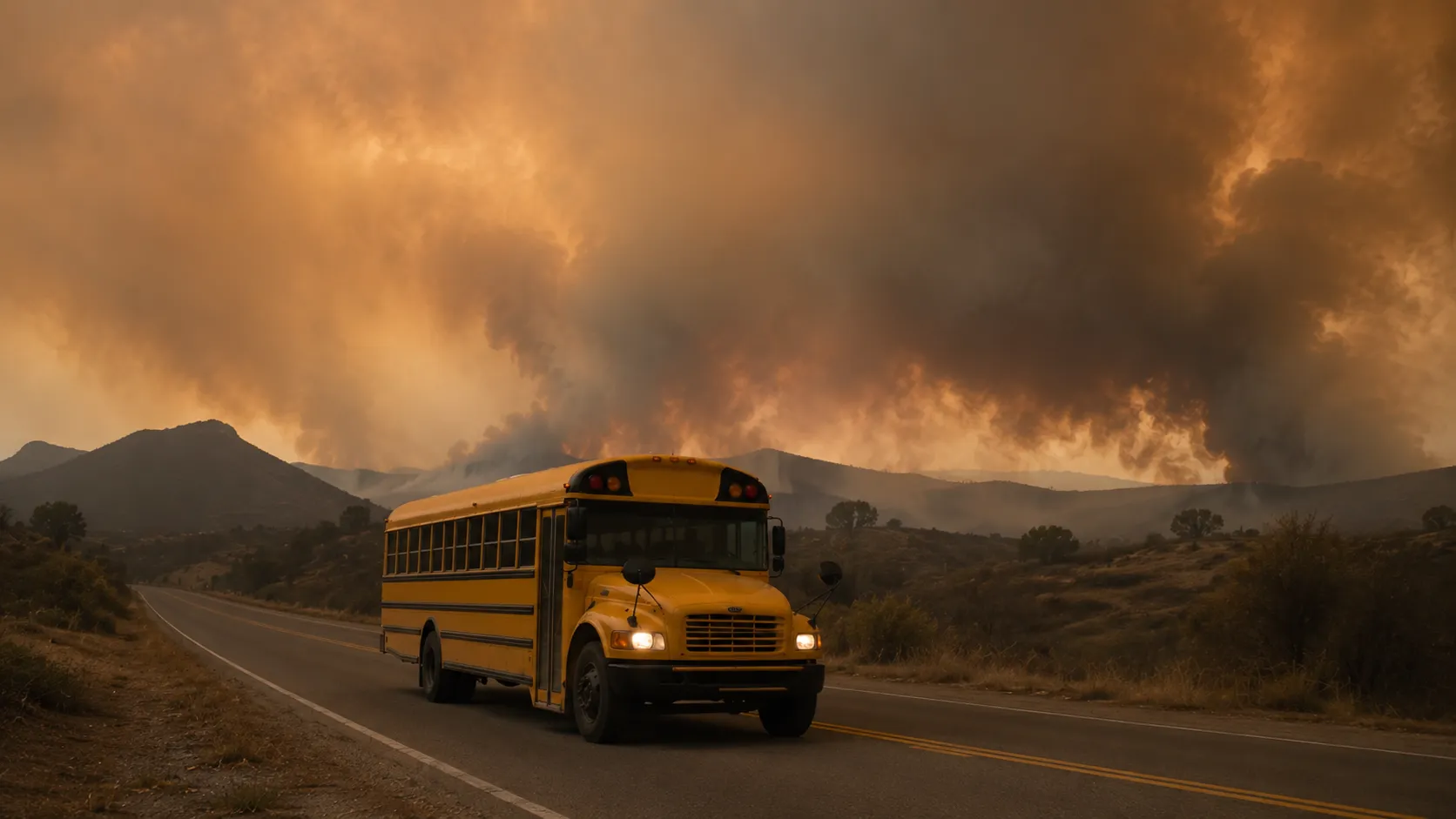
On the morning of November 8, 2018, a school bus driver named Kevin McKay pointed bus number 963 out of Paradise, California. It wasn’t a normal route. This day, he had 22 elementary students and two teachers aboard, and was in a wildfire that would kill 85 people.
On any other day, this drive would take half an hour. Today? It took about five hours through gridlock and smoke thick enough to fill the cabin. When the kids started to choke, McKay tore up his own shirt, the teachers wet the strips, and they showed the children how to breathe through the cloth. Everyone on that bus lived.
The bus company engineers never designed that bus to drive through fire. It was built to carry kids to school and back at 45 miles an hour. But all over the world, when the worst day arrives, the plain yellow bus can turn into something else. And the places and people who understand this move others while the places that don't leave them standing on the curb.
In the Batman movie, “The Dark Knight,” The Joker understood how easily a bus fits in by using it as a very effective getaway vehicle that blended in with other buses. The American school bus fleet is easy to miss because it’s the largest form of mass transportation in the country. We’re so accustomed to seeing them because more than 480,000 buses are carrying over 25 million kids twice a day. That is a standing fleet of high-capacity vehicles with trained drivers sitting in every town in America. On a normal Tuesday it is invisible. But, when an evacuation is necessary, it’s the cavalry.
What happened in the aftermath of Hurricane Katrina?
Katrina is the case study everyone half-remembers and mostly gets wrong. The famous image is a lot of school buses drowned to their rooftops in a New Orleans yard, and the story that grew around it was that a few hundred buses sat idle because government officials forgot to use them. Snopes has picked that apart.
If you take Kevin McKay in Paradise as an example, a thought out pre-storm bus evacuation needs drivers who are willing to stay. But there’s much more to it than a brave driver. For evacuations the size ofNew Orleans, a pre-disaster plan would need fuel, staging, somewhere to take people, and roads that are still open. And the plan would have to be successfully activated within a few hours notice.
Michael Martin ran the national pupil transportation association at the time and said what a lot of people were thinking when he saw the submerged fleet. "My first thought was, why aren't they being used in evacuation?" That’s what happens when a city has no system ready before the water rises.
Look at what the buses did after the storm to see what a plan can do. In the Katrina aftermath, Louisiana used nearly 700 school buses to pull more than 15,700 people out of flooded neighborhoods. Houston's school district sent a convoy of 142 air-conditioned buses and 350 of its own employees who traveled 350 miles east. And over 36 hours they hauled evacuees to shelters and hospital patients to the airport.
FEMA eventually had the federal transportation department assemble a fleet of more than 1,100 buses to clear the Superdome. So, the buses weren’t a problem but the pre-Katrina plan for using them was.
One of the Houston drivers, Phillip Smith, came back from the run and described moving people through blacked-out streets with helicopters overhead. "We were really in a war zone," he said.
Mississippi, a state that treated buses as emergency equipment, pre-positioned 120 buses ahead of Katrina's landfall and ran two to three hundred more afterward, and its school-safety director summed up the difference in four words by saying, "Everything went as planned."
South Carolina has it figured out when disaster comes to their state. Currently, South Carolina is the only state that owns and maintains it school bus fleet. Officials keep a live list of every vehicle, that has the bus location, number of seats the bus has, and who can drive it. They even have a plan on when to call the National Guard for more drivers. Although there's a bill in the legislature called the South Carolina School Bus Privatization Act of 2025 (H.3242) that would end state ownership, their current setup is the bar for what readiness looks like.
Who Decides Who Gets Evacuated?
If you don’t own a car, like roughly one in four New Orleans households pre-Katrina, there’s a problem with most evacuation maps. They’re made for people who have cars. But in New Orleans during Katrina, 54 percent of poor households and 65 percent of poor elderly households were with no car, truck, or van. Telling those families to drive inland is telling them nothing. And even today, for those without a car, the bus is the plan, or there is no plan.
The Government Accountability Office, post-Katrina, checked how ready the country was to move people who cannot move themselves. It found that only about 10 percent of states and 12 percent of major urban areas had acceptable evacuation plans for those without cars. That was the finding two decades ago, so what about today? Today, in New Orleans the no-vehicle rate for Black households is close to double the citywide figure, so the exact people the buses exist to move are still disproportionately without a car.
To assist, there’s now a system that exist for the big events. It runs on a phone tree more than a standing reserve because FEMA doesn’t keep a fixed fleet of evacuation buses. The next time a major hurricane comes, FEMA will work the phones. And groups like the American Bus Association relay the request to private motorcoach operators, asking each how many buses, including wheelchair-equipped ones, they can send for a few days. For the most part, when there’s time, it works.
The recent storms show the lesson is being learned. For Hurricanes Ian, Helene, and Milton, Florida transit agencies ran fare-free buses to shelters. And priority was given to residents who signed up in advance. Of course, that doesn’t make the news, which is the point. Buses that move hundreds of people out of a hurricane flood zone before landfall isn’t a sensational news event. And a non-event is exactly what everybody wanted.
The vehicle that does the most in a disaster is the one that looks least dramatic on a boring day, Whether it saves anyone comes down to a questions asked long before the sky turns. It’s an example of the saying, “Luck favors the prepared.” Does the town know where its buses are, and who will drive them? Kevin McKay knew where his was, but not every town can say the same.