
Airport shuttle companies don’t survive on slogans. They survive on uptime, predictable schedules, and the ability to move people without drama at hours when most transportation options fall apart. If you’re thinking about entering the airport shuttle market or expanding an existing fleet, you need a plan that covers licensing, permits, operations, staffing, vehicles, pricing, and technology. The operators who make money here follow a disciplined structure. The ones who don’t burn cash through delays, breakdowns, and fines.
This guide walks through what the strongest operators do.
1. Know the Airport’s Rules Before You Spend a Dollar
Every major airport has its own ground transportation requirements. These rules govern everything from pickup zones to insurance minimums. If you skip this step, you will either lose your operating slot or never get one.
Depending on your business model, there will be different requirements
Common requirements across U.S. airports:
- Ground transportation permit
- Airport-specific decals or RFID tags
- Commercial auto liability above state minimums
- Higher workers’ comp requirements for 24-hour operations
- Fees per pickup, per month, or per route
- Approved staging areas
Start with the “Ground Transportation” or “Landside Operations” page on an airports website, that should have everything you need to know.
See this example from Los Angeles World Airports. Most airports publish permit packets online with application fees, safety rules, and insurance thresholds. Some airports also restrict vehicle size during peak periods, so match your fleet plan to the airport’s infrastructure, not the other way around.
2. Choosing the Right Business Model
Airport shuttle companies fall into a few categories. Your model determines your vehicles, your staffing, and your cash flow structure. You’ll also want to gauge the need for the type of services you’re interested in offering. If there are already 20 private airport transport services, it’s probably a good idea to look into another business model.
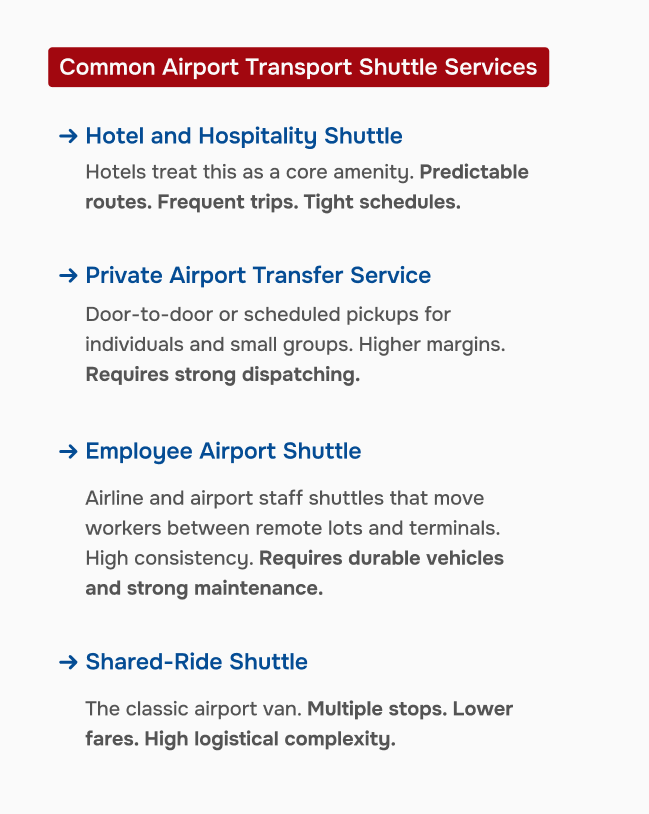
Each model affects your insurance costs, driver qualifications, peak hours, and maintenance plan.
3. Vehicle Selection for 24/7 Airport Operations
Airport shuttles take more abuse than most commercial vehicles. They idle longer, load more often, and run early mornings and late nights. Choose for durability and ease of service.
Key vehicle categories:
1. Non-CDL Shuttle (14 passengers or fewer)
Advantages: simpler hiring, lower insurance, quicker onboarding.
Best for: hotels, private transfers, and shared-ride services.
2. Mid-Size Shuttle (20–30 passengers, CDL required)
Advantages: high passenger throughput, stronger revenue per route.
Best for: employee shuttles, hotel clusters, campus-to-airport loops.
Advantages: ideal for high-volume events and large workforce routes.
Costs rise fast: insurance, maintenance, and fuel.
Fuel choices:
- Diesel: Best for heavy, long, or 24/7 routes.
- Gasoline: Lower upfront cost, strong fit for hotel loops and short airport runs.
- Propane: Lower operating cost, smoother idling, and quieter. Popular in high-stop environments.
- Electric: Range varies widely. Most airports work on EV master plans but are not ready for widespread adoption yet.
Browse available airport-ready shuttles here.
4. Permits, Licensing, and Legal Requirements
Airport operations sit under federal, state, and airport authority layers. Miss a requirement, and you risk losing access to the terminal.
Federal
- USDOT number for interstate operations or vehicles over 10,001 lbs GVWR
- FMCSA regulations for for-hire carriers
- Drug and alcohol testing for CDL drivers
State
- Intrastate authority (varies)
- Business licensing
- Vehicle registration under commercial use
Airport-Level
- Ground transportation permit
- Airport decal or transponder
- Approved inspection
- Fee schedule compliance
Insurance
Airports often require higher limits than state minimums. Liability can range from one to five million depending on vehicle size and contract terms.
For a full insurance breakdown, see our guide here.
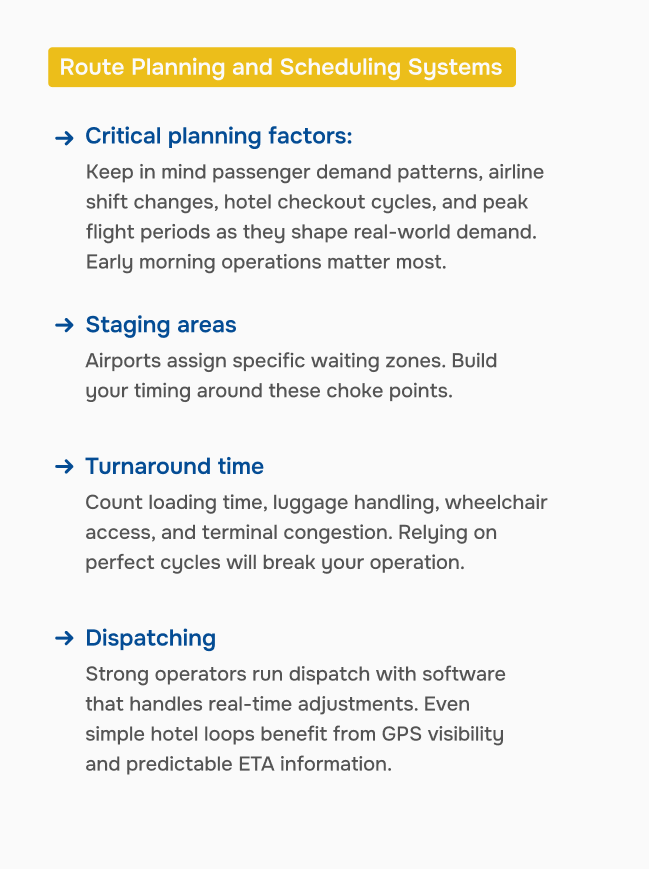
5. Route Planning and Scheduling Systems
Airport routes need a tight balance between frequency, capacity, and travel time. The best operators build schedules that absorb delays without breaking the rest of the day.
6. Booking and Dispatch Technology
Airport travelers expect on-time performance. Operators that fail here lose business.
Core tools:
- Online booking system
- Mobile responsiveness
- Real-time shuttle tracking
- Text-based ETA updates
- Automated confirmations
- API-friendly dispatch platform
Platforms like Limo Anywhere, Circuit, Routematch, and Ecolane appear often in operator surveys. Pick based on your model, not the feature list.
7. Pricing Models That Work
Airport shuttle pricing depends on distance, demand, vehicle size, and labor costs. Common models:
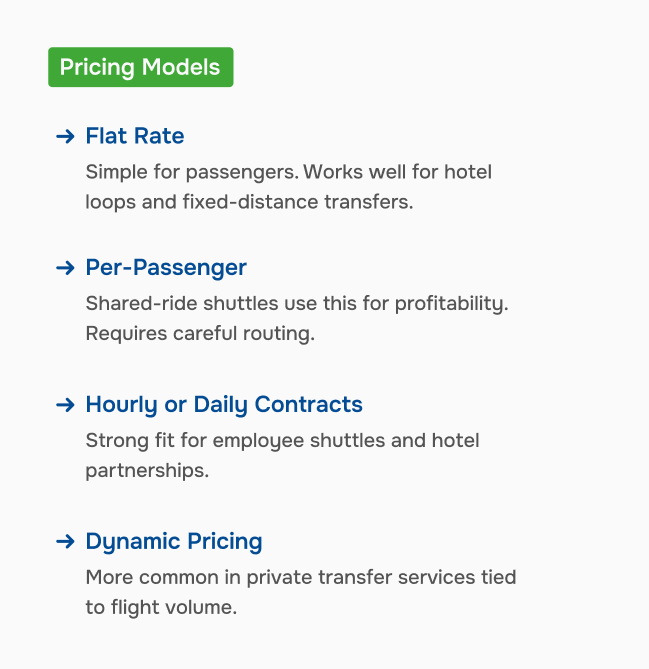
Your price has to cover:
- Driver wages
- Fuel
- Insurance
- Airport fees
- Maintenance
- Software
- Administrative overhead
- Reserve for breakdowns
8. Competition Analysis
The airport transportation market includes:
- Rideshare
- Taxis
- Hotel shuttles
- Private vans
- Public transit
- Parking lot operators
- Peer-to-peer van services
Your job is to find the gap. THis can include providing offerings that offer:
- Late-night reliability
- Group movement
- Family and luggage volume
- ADA accessibility
- Corporate agreements
- Hotel partnerships
- Airline staff contracts
Many operators make their best money through exclusive agreements with hotels or airlines rather than individual airport riders.
9. Staffing and Training
Airport shuttle drivers deal with luggage, family travelers, confusing terminals, and tight timing. Hire for patience and consistency.Training backbone:
- Route familiarity
- Terminal layout
- ADA securement
- Loading safety
- Customer handling
- Basic emergency procedures
- Daily pre-trip inspections
CDL drivers also require drug testing, medical certifications, and ongoing record checks.
10. Maintenance Strategy for 24/7 Operations
Airport environments are hard on vehicles. Constant stopping, heat cycles, and heavy luggage loads produce faster wear.
Key maintenance priorities:
- Brake inspections
- Cooling system checks
- Electrical load testing
- Tire replacement cycles
- High-idle impact assessments
- HVAC performance
Your uptime target should approach 95 percent if you want steady contracts.
For deeper guidance, check out our Complete Bus Maintenance Guide.
11. Scaling an Airport Shuttle Operation
Grow when:
- You secure long-term route contracts
- You add hotel clusters
- Airline staff schedules increase
- Rider volume exceeds your peak capacity
- You can afford a backup unit to protect reliability
Expansion paths:
- Add non-CDL units for hotel and short loops
- Add mid-size CDL shuttles for staff routes
- Add coaches for convention traffic
- Diversify into private transfers to stabilize revenue
How to Be the Best Airport Shuttle Company
Airport shuttle work is predictable if you build around real demand and strict operational discipline. The best operators keep clean safety files, stable driver shifts, dependable vehicles, and booking tools that reduce friction for the traveler.Once you understand the airport’s rules and your real cost structure, the business becomes manageable and scalable.
If you want help selecting airport-ready shuttles or planning the fleet mix for your routes, we can walk you through options that match your operation and budget.