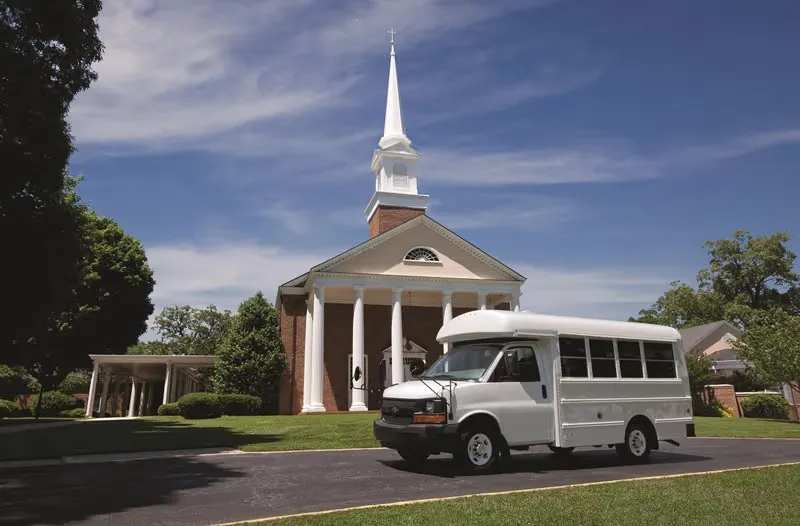
The Short Version The 15-passenger van is a liability problem. A used church bus for sale in the $10,000–$40,000 range is usually the smarter stewardship decision. The CDL threshold (16+ passengers including the driver) is the single most important number in this purchase. Know it before you shop. Service records matter more than mileage. And the insurance conversation happens before the purchase, not after. |
According to the 2020 U.S. Religion Census, there are more than 350,000 religious congregations in the United States. A significant number of them move people in 15-passenger vans. NHTSA has issued multiple safety advisories on those vans since 2001. The problem is the same every time: they roll over at a rate that makes insurers nervous. Many carriers have pulled back from covering them for passenger transport. Some won’t write those policies at all.
If your congregation is shopping for a used church bus for sale, this guide starts where most others don’t — with the van question. That’s the first real decision a church administrator faces, and the one most guides skip straight past.
This is for the administrator with the spreadsheet, not the deacon with opinions about it.
Section 1: Van or Bus — Settle This First
Most church transportation guides assume you’ve already decided on a bus. That’s a bad assumption. Many churches replace a van with another van because it’s familiar, cheaper upfront, and someone drove the last one for six years without incident.
Here is what the comparison actually looks like when you run the numbers.
A 15-passenger van is built on a pickup truck platform. It was not engineered for loaded passenger transport. When fully loaded, NHTSA research shows the rollover risk is about five times greater than with only the driver. The agency has issued that warning in consumer advisories since 2001.
A bus is built from the ground up to carry people. Federal Motor Vehicle Safety Standards (FMVSS) govern the structural requirements in ways that don’t apply to vans. When a bus is in an accident, the engineering works for the occupants. That is not always true of a van.
On fuel, the math surprises people. A 15-passenger van gets roughly the same miles per gallon as a 25-passenger bus. You need three vans to move 75 people. One bus carries them all. The fuel cost per person is often lower on a bus.
The CDL threshold is the practical pivot point. Any vehicle carrying 16 or more passengers — including the driver — requires a Class B Commercial Driver’s License with a passenger endorsement. Under 15 passengers, anyone with a standard license can drive. That is why a 14-passenger cutaway bus has become one of the most popular vehicles for smaller congregations. You get the safety engineering of a bus without the CDL requirement.
For a plain-language breakdown of bus types and classifications, see the school bus types guide on BusesForSale.com.
Vehicle | Rollover Risk | CDL Required? | Passengers |
15-passenger van | 5x higher when loaded (NHTSA) | No | Up to 15 |
14-passenger cutaway bus | Bus-grade FMVSS standards | No | Up to 14 |
25-passenger shuttle bus | Bus-grade FMVSS standards | Yes (16+ incl. driver) | Up to 25 |
Full-size school bus | Bus-grade FMVSS standards | Yes | 48–72+ |
Section 2: How Much Bus Do You Actually Need
Buying the wrong size is one of the most common mistakes churches make. It cuts both ways. Buy too small and you’re back shopping in six months. Buy too large and you spend years overpaying for fuel and parking something mostly empty.
Before you look at a single listing, answer these questions.
How many people are you moving on the average trip — not the biggest trip you’ll ever take? Sunday morning pickup routes are different from youth retreats, which are different from senior day trips. If your honest average is 18 people, you don’t need a 72-passenger bus. A 25-passenger shuttle gives you headroom without the overhead.
What is your primary use case? Youth ministry and congregational transport often pull in different directions. Youth groups want space. Seniors want easy access and smooth rides. Outreach programs need versatility. If you are trying to serve all three with one vehicle, a mid-size bus in the 25–35 passenger range is usually the right compromise. The 7 Steps to Choose the Right Church Bus guide on BusesForSale.com walks through the full sizing decision.
The CDL math matters. If you buy a vehicle that carries 16 or more passengers including the driver, every operator needs a CDL with a passenger endorsement. If your church relies on volunteer drivers, that requirement eliminates most of them. Two smaller mini buses — both under the CDL threshold — sometimes make more operational sense than one large bus, even if they cost more upfront.
ADA accessibility is worth considering before you need it. If your congregation includes members with mobility limitations, look at buses with wheelchair lifts rather than ramps. Lifts handle a wider range of mobility devices and are easier to operate. Verify the lift is functional, maintained, and comes with service records. A broken lift on an ADA-equipped bus is a liability exposure, not a feature.
Section 3: New vs. Used — The Stewardship Question
Churches think about money differently than businesses do, and rightly so. The word that comes up most often in these conversations is stewardship. A new bus is appealing. It’s clean, warrantied, and starts from zero. But stewardship is not about buying new. It is about getting the most responsible use from the resources you have.
A well-maintained used church bus with full service documentation is almost always the smarter stewardship decision. Here’s why.
School districts replace their buses on a 12 to 15-year cycle. When they retire a fleet bus, it typically has years of operational life remaining. These vehicles were maintained on strict fleet schedules, often with Cummins diesel engines built to run hundreds of thousands of miles with proper care. A used church bus coming off a school district fleet at 150,000 miles — with clean records and no frame damage — can serve a congregation for another decade.
The price range for a used bus that fits most church needs runs from $10,000 to $40,000 depending on size, age, and condition. A comparable new vehicle in the same passenger range starts at $60,000 and goes up quickly. The depreciation on a used bus that has already passed its steepest drop is much flatter than on a new one.
What matters more than mileage is documentation. A used church bus with 150,000 miles and complete Cummins service records is a better buy than one with 90,000 miles and no paperwork. Mileage tells you how far it has gone. Service records tell you how it was treated on the way. Ask for records first. If the seller can’t produce them, that is your answer.
New makes sense when your congregation has the budget, plans to use the bus heavily and consistently, needs specific configuration options unavailable in the used market, or has a multi-year financing arrangement that works with a new purchase. For most churches buying their first or second bus, used is the more responsible call.
The used school bus cost guide on BusesForSale.com breaks down total cost of ownership across a range of scenarios.
Section 4: Church Bus CDL Requirements — Who’s Driving This Thing
This section saves churches from expensive mistakes. Church bus CDL requirements are confusing, vary by state, and are widely misunderstood by volunteers who have been driving the church van for years and assume the rules are the same for a bus.
They are not.
The federal rule is clear. Any vehicle carrying 16 or more passengers — including the driver — requires a Class B CDL with a passenger (P) endorsement. The driver must pass a knowledge test, a skills test, and maintain a clean driving record. This requirement comes from the Federal Motor Carrier Safety Administration (FMCSA) and is not optional.
State rules add complexity. Some states require a school bus (S) endorsement for any vehicle that keeps the original yellow school bus markings, stop arms, or school bus classification — even for private ministry use. If you buy a retired yellow school bus and plan to use it without repainting, check your state’s requirements before anyone gets behind the wheel.
The practical implication is significant. If your bus requires a CDL, your driver pool narrows to whoever in your congregation has one, is willing to get one, or can be hired. Many volunteer-heavy church transportation programs have discovered this the hard way — after the purchase.
Solutions exist. Choose a vehicle that carries 15 passengers or fewer including the driver. Budget for CDL training for one or two designated drivers. Hire a part-time driver for regular routes and use volunteers for occasional trips. None of these are complicated. They just require thinking it through before you buy.
One thing that often gets overlooked: an annual DOT inspection costs about $150 and is not legally required for private church use in most states. Do it anyway. It creates a documented maintenance record, catches problems before they become breakdowns, and shows intent to operate safely. If your bus is ever involved in an incident, that record matters.
For a detailed walkthrough of the licensing process, BusesForSale.com has a complete CDL licensing guide that covers every step.
Section 5: Insurance — What Your Property Policy Doesn’t Cover
Ministry transportation carries real liability. Most churches assume their existing insurance carrier handles a bus automatically. Sometimes that’s true. Often it isn’t. The gap becomes visible at the worst possible moment.
Before you sign anything on a bus purchase, call your insurance carrier. Not the assistant. The actual agent. Ask specifically whether a commercial passenger vehicle used for ministry transport is covered under your existing policy. Ask what the liability limits are. Ask what changes if volunteers are driving.
Title the bus under the organization, not an individual. This is non-negotiable. A bus titled under a deacon’s personal name creates personal liability for that person and potential coverage gaps for the church. The vehicle must be a church asset, insured as a church asset, from day one.
If volunteers will drive the bus, make sure your policy includes non-owned and hired auto coverage. Without it, a volunteer driving the church bus may create liability the church’s policy does not cover.
Ask about umbrella coverage. Most church bus operations should carry an umbrella policy on top of the vehicle’s basic liability coverage. The underlying policy covers the first layer of a claim. The umbrella handles what exceeds it. You are carrying passengers. The exposure is real.
One distinction that trips people up: ministry use and for-hire transport are different categories in most insurance frameworks. If your church charges fees for bus rides — to camps, retreats, events — you may cross into for-hire territory. That changes what coverage you need. Discuss your specific use case with your carrier and get the answer in writing. See BusesForSale.com’s bus insurance guide for a full breakdown of coverage types.
Section 6: What to Inspect Before You Buy
You would not buy a house without a home inspection. A used bus deserves the same discipline. The visual condition of a bus tells you almost nothing about its mechanical condition. A clean-looking vehicle can have significant problems underneath.
Here is what to check before any money changes hands.
Service Records First
This is the non-negotiable starting point. Ask for complete maintenance documentation — oil changes, engine service intervals, brake work, transmission service, air system maintenance. On Blue Bird, Thomas Built, and IC Bus school buses — the three most common brands in used church bus inventory — Cummins diesel service records and Allison transmission logs are the specific documents to request. If the seller cannot produce them, move on.
Check the Oil
Pull the dipstick and look at what’s on it. Milky or frothy oil means coolant is mixing with engine oil. That indicates a head gasket problem or worse. Dark but clean oil is normal. Sludge means chronic neglect.
Build Air Pressure and Watch It Hold
Full-size school buses use air brakes. Start the engine and let the air system build to full pressure. Shut it off and watch the gauge. A working air system holds pressure at rest with minimal drop. If it bleeds down within minutes, there is a leak somewhere in the system.
Frame and Undercarriage
Rust geography matters. Buses from Great Lakes states or the Gulf Coast are more likely to have frame corrosion from road salt and humidity. Northeast fleet buses tend to be in better shape. BusesForSale.com’s facility in Pedricktown, NJ puts their inventory close to some of the most well-maintained retired fleet buses on the East Coast.
Cold Start
The first start of the day tells you more than a warm engine does. A Cummins diesel that has been sitting overnight should start without excessive smoke, knock, or warning lights. Let it warm up and listen. Blue smoke on startup can indicate oil burning. Black smoke under load suggests fuel system issues. White smoke on a cold morning is normal condensation — it clears quickly.
Test Drive
Air brake engagement should feel progressive and firm. Steering should not wander. The Allison automatic transmission — standard on most fleet buses — should shift cleanly without slipping or hunting between gears. If something feels wrong during the test drive, trust that feeling.
BusesForSale.com’s team is available at 877-287-7253 from 8AM to 6PM EST to walk buyers through inspection specifics for any vehicle in inventory.
Section 7: Financing and Fundraising — How Churches Actually Pay for This
Churches pay for buses in a few predictable ways. Some of those ways work better than others.
Avoid the Lease Trap
Leasing sounds attractive because the monthly payment is lower. But at the end of a lease, you have no equity. You’ve paid for transportation the whole time. If you need to exit early, you may owe the remainder of the contract. For a bus a church will use for many years, buying is almost always the better decision.
Donor Campaigns Work
People give to things they can see. A ministry transportation campaign with a specific vehicle, a specific dollar amount, and a specific mission — picking up seniors, running youth group transport, serving the community — gives donors something concrete to attach to. Transparency about what you’re buying and why builds confidence. Let the congregation see the need and the plan.
If You’re Financing Through a Lender
Know what they need before you apply. Most lenders require proof of insurance before they fund the loan. Have your carrier ready to issue a binder. Get a title search done to confirm there are no liens on the vehicle. Ask about early payoff penalties before you sign anything.
Budget the full picture, not just the purchase price. Add insurance, estimated maintenance, fuel, and any driver training costs to your first-year projection. If the total monthly commitment exceeds what you’d spend chartering vehicles for the same trips, pause and reassess.
For first-time buyers working through the full decision framework, the complete first-time buyer’s guide covers the process from initial need assessment through final purchase. The Complete Church Bus Buying Guide on BusesForSale.com is also worth reviewing alongside this piece for church-specific considerations.
Ready to Look at Inventory
The administrator who gets to this point has done the work. They know what size they need, whether a used church bus makes sense, who is going to drive it, and what the insurance conversation looks like. That puts them ahead of most buyers who walk in cold.
BusesForSale.com carries inspected, ready-to-ship church bus inventory across the full range — ADA-accessible shuttles, CDL-exempt cutaways, mid-size buses for growing congregations, and full-size school buses for larger ministry transportation programs. The facility is in Pedricktown, New Jersey, close to all major East Coast ports for buyers who need shipping.
Browse used church buses for sale →
Explore bus financing options →
Talk to a bus specialist: 877-287-7253
CDL and endorsement requirements vary by state. Consult your state motor vehicle authority and legal counsel before operating. Insurance requirements vary by carrier and use type. Pricing data from BusesForSale.com active listings. Safety data from NHTSA consumer advisories. Last updated April 2026.