
A practical cost breakdown for employers planning or reviewing employee transport programs
If you manage employee transportation, monthly cost matters more than sticker price. Purchase price fades fast. Operating cost shows up every month.
Many employers focus on acquisition and underestimate ongoing expense. Those gaps surface later through downtime, service disruption, or rushed replacement decisions. Monthly planning keeps employee transport predictable and supports operations long term.
This guide breaks down what employee shuttle transportation costs per month when you use a bus, using real operating patterns seen across warehouses, campuses, distribution centers, and industrial sites.
Why monthly cost matters more than purchase price
A used bus purchase feels like a one time decision. Monthly cost determines long term performance.
Employers who budget only for acquisition often misjudge total ownership cost. Pricing context helps set realistic expectations.
Monthly cost planning keeps replacement timing controlled instead of reactive.
Core monthly cost categories
Employee shuttle cost per month breaks down into six primary areas with the following percentages of budget.
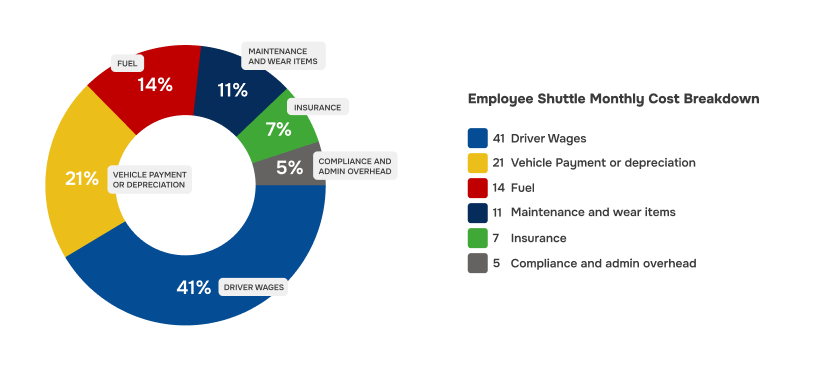
Each category affects cash flow differently. Reviewing them separately prevents surprises.
Vehicle payment or depreciation
For financed purchases, the monthly payment sets the baseline. For cash purchases, depreciation still matters since replacement timing depends on retained value.
Used employee shuttle buses follow predictable depreciation patterns tied to service life and condition. A well-maintained bus can retain 70-80% of its value after five to seven years, while depreciation for older, well-maintained units slows to less than 5% annually.
Understanding how mileage and age affect used bus pricing helps estimate monthly ownership cost accurately. Check out our complete guide on “How Much is Your Used Bus Worth?” for more information.
Monthly planning improves when you also understand how long used buses last under shuttle duty cycles.
Fuel expense
Fuel cost depends on route length, duty cycle, and vehicle type. The average fuel expense for a corporate-owned shuttle varies significantly based on vehicle type, fuel efficiency, and usage, but generally falls between $0.50 and $1.00 per mile. For a typical shuttle bus, annual fuel costs often range from $4,500 to over $6,000 per vehicle.
Employee shuttles often operate fixed routes tied to shift changes. Predictable routing improves fuel forecasting. Stop and go routes raise consumption. Highway focused routes reduce fuel use.
Tracking miles per day provides the fastest path to reliable fuel budgeting.
Driver wages
Driver cost represents one of the largest monthly expenses. Salary.com suggest that vorporate shuttle bus driver costs typically range from $20 to $30+ per hour for wages, or roughly $50,000–$59,000 annually for full-time employment.
You pay for driving time, standby time, benefits, and payroll overhead. Multi shift operations multiply cost quickly.
Some employers assign shuttle duty to existing staff. Others hire dedicated drivers. Each approach affects monthly cost differently. Budget planning works best when you account for full driver time rather than partial allocation.
Insurance
Insurance pricing varies and is based on vehicle size, passenger count, and coverage limits, with primary liability often ranging from $3,000 to over $15,000+ annually per bus, plus physical damage and umbrella policies. Key factors include driver records, mileage, route scope, and required limits, which can exceed $5M.
Employee transport buses fall under commercial insurance structures. Rates reflect exposure rather than vehicle value alone. One positive is that insurance stays consistent month to month, which helps planning once coverage starts.
Maintenance and wear items
Maintenance separates reliable shuttle programs from fragile ones.
Employee shuttles experience frequent braking, door cycles, suspension load, and idle time. Wear accumulates faster than personal vehicles.
Monthly maintenance planning covers routine service, tires, brakes, fluids, and inspections. Employers who follow a used bus inspection checklist before purchase often avoid early surprises. That checklist lives at /knowledge-center/blog/used-bus-inspection-checklist.
Spreading maintenance across months prevents budget spikes and protects uptime.
Compliance and administrative overhead
Employee transport brings compliance responsibility.
Driver qualification tracking, inspection records, and local regulations add administrative cost. These expenses stay modest per month but grow when ignored.
Many employers assign these tasks to operations or fleet managers. Time allocation still carries cost.
Example monthly cost structure for employee transport
Of course, your cost will vary depending on your state and industry. However, practical examples help set expectations.
A used mid size shuttle bus supporting two daily shift changes on a fixed route typically shows the following structure.
- Vehicle cost spread across service life
- Fuel tied to predictable mileage
- Driver wages aligned with scheduled hours
- Insurance paid monthly
- Maintenance budgeted evenly
- Administrative time tracked internally
Total monthly cost for a used mid-size shuttle bus on a two-shift, fixed-route schedule depends heavily on labor rates and mileage, but industry benchmarks suggest a wide range. Based on corporate shuttle rates and operating costs, you should likely budget between $3,000 and $8,000+ per month, per vehicle, depending on hours of service and driver wages.
What drives monthly cost higher or lower
Several factors shift cost meaningfully.
- Route length
- Number of daily runs
- Vehicle size
- Passenger capacity
- Local labor rates
- Maintenance discipline
Cost control starts with route efficiency and schedule consistency.
Employee transport value beyond cost
Monthly cost matters. Value matters too. Employee shuttle programs often support attendance reliability, retention, and workforce growth without parking strain. Many employers treat shuttle expense as operational infrastructure rather than transportation alone.
This framing aligns cost with productivity outcomes.
Planning tips for employers
- Start with route mapping
- Track daily mileage
- Budget maintenance monthly
- Account fully for driver time
- Review insurance early
- Plan replacement before urgency appears
Replacement planning improves when teams agree early on when to replace a bus instead of repairing it repeatedly. That guidance lives at /knowledge-center/blog/repair-or-replace-used-bus.
Where used buses fit best
Used buses support employee transport programs with predictable duty cycles.
Well maintained used inventory offers lower entry cost while supporting reliable service. Employers planning shuttle programs often benefit from buying from available inventory rather than waiting. That perspective lives at /knowledge-center/blog/used-buses-in-stock-vs-waiting.
Availability and timing affect selection and pricing.
What to review before committing
Before final decisions, review total monthly cost rather than purchase price alone.
- Ask how the bus fits your route
- Ask how maintenance history supports uptime
- Ask how replacement planning works
Clear answers support long term confidence.
What this means for employee transport planning
Employee shuttle transportation cost per month reflects operational discipline more than vehicle price.
When you plan monthly expense upfront, you gain control. Control supports growth, retention, and predictable service.
If employee transport plays a role in your operation, monthly cost planning belongs at the center of the decision.