 Excellent on Google from verified customers


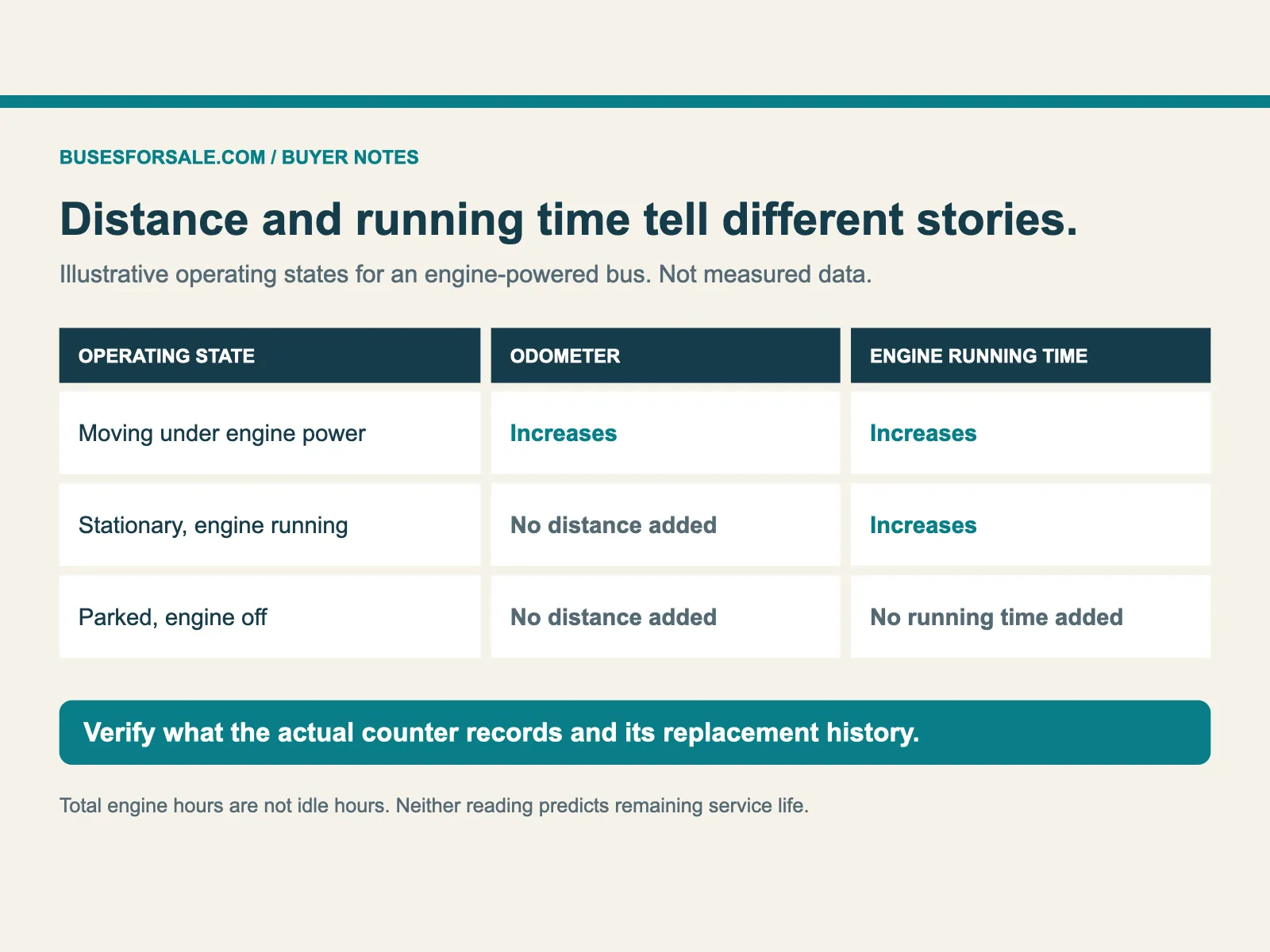
The odometer measures distance. Engine hours add operating time. Neither number tells you the condition of a bus on its own.
A bus can remain parked with its engine running while the odometer stays right where it was. No mystery there. The odometer measures distance, not how long the engine has been working.
That difference matters when you compare used buses. The lower-mileage listing may catch your eye first, but engine hours and maintenance records can raise questions the mileage alone never answers.
A familiar used-car habit is to sort the listings by miles and start at the top. With a working bus, we suggest keeping the records open beside the price.
Find out what each reading represents
Ask for the mileage and, where available, engine hours recorded on the same date. Ask where the hour reading came from and what it measures. Depending on the vehicle, the information may be available through its instrument display or diagnostic system; a qualified technician can establish what that particular bus records.
Confirm whether the engine, instrument cluster or engine control module has been replaced. The seller’s service records may help explain which equipment the readings describe. A replacement engine doesn’t make the rest of the bus new.
If hours are unavailable, record them as unknown. Don’t treat a blank field as zero or assume the bus has had an easy life.
Total engine hours also are not necessarily idle hours. If someone quotes an idle figure, ask how it was recorded rather than trying to derive it from an odometer reading.
Read the service history against the right schedule
Manufacturers may specify maintenance in more than one measure. Cummins’ 2021 B6.7 school-bus page presents maintenance information in miles, hours and months. That’s an example for a particular engine and application, not a schedule for every bus carrying a Cummins badge.
Ask your maintenance provider to identify the applicable guidance for the exact engine and configuration. Then compare the available dated service records with it. An odometer photograph cannot tell you whether the right service was performed at the right time.
Our fleet maintenance guide provides broader planning context. For service intervals on a bus you’re considering, the applicable manufacturer’s guidance takes precedence over a general checklist.
Use a mismatch to start a conversation
If two otherwise comparable buses show different hours for similar mileage, ask about their previous work, often called the duty cycle. That means the pattern of driving, stops and stationary running. Low-speed operation and stationary engine running can contribute to that difference. First establish that the readings cover comparable periods and have a documented history.
Avoid turning the relationship into a verdict. There is no universal hours-to-miles conversion that tells you how much life remains in a used bus. The counters cannot establish maintenance quality or explain every repair.
A bus with more recorded hours may come with a detailed service history. Another may show fewer hours but leave the history of its meter unresolved. That gives you different questions to investigate, not an automatic winner.
Keep the evidence beside the number
We suggest making this short record for each candidate. It keeps the missing information visible and gives your inspector something specific to follow up.
| Item | What to ask for |
|---|---|
| Mileage and engine hours | Readings, date and source of each reading |
| Counter history | Available records of engine, cluster or control-module replacement |
| Previous work | Description of routes, activity trips or other duty |
| Service history | Dated records identifying the vehicle and work performed |
| Maintenance reference | Guidance applicable to the exact engine and configuration |
| Unresolved questions | Missing information and who will check it |
If an oil-analysis history is available, give it to the technician reviewing the bus. A test result needs context too. Do not turn one sample into a promise about the engine’s future.
A qualified independent inspection should assess the bus itself and review discrepancies in the records. It can identify current concerns, though it can’t guarantee remaining service life. Ask the inspector to explain any limits on what could be checked.
Compare candidates with the same questions
Browse our available bus models and inventory, then ask BusesForSale.com about the available readings and records for the units you’re considering. Tell us what your maintenance provider needs to evaluate them.
Our aim is to make the purchase transparent and help you move through it promptly. We can help clarify what is documented and what still needs an answer. A lower number is easy to spot. Knowing what it represents takes a little more work.