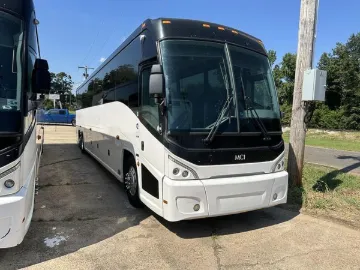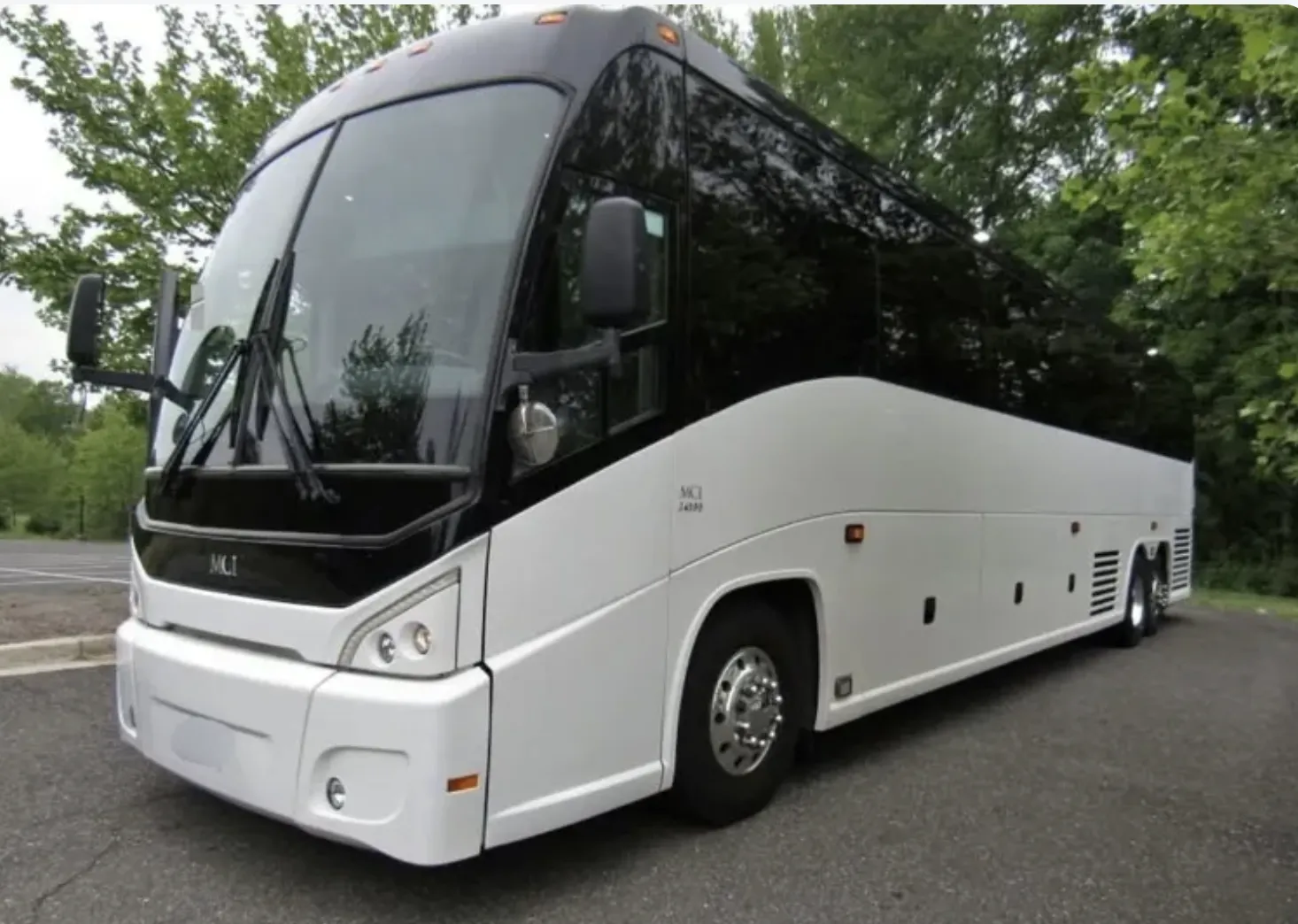
The MCI J4500 is North America's best-selling motorcoach — a 45-foot over-the-road coach seating 56 passengers, powered by a Cummins ISX12 diesel with an Allison B500 transmission. It's the standard fleet coach for charter operators, tour companies, and intercity carriers that need a proven ROI platform with broad service infrastructure. Used J4500 units from 2006 to 2017, listed at $50,000–$300,000+ depending on mileage, specification, and upfit level.
MCI J4500 Motorcoach: Complete Buyer's Guide
If you're buying a motorcoach for charter work, tour operations, or intercity service, you'll compare the MCI J4500 to a short list that typically includes the Prevost H3-45, the Van Hool CX45, and the Setra S417. The J4500 sits at the center of that market: it's not the most luxurious option (Prevost holds that position) and not the lowest entry price, but it has the widest service network in North America, the most predictable total cost of ownership data, and the deepest used market supply. For operators who need to get a coach on revenue routes quickly without betting on a manufacturer's dealer footprint, the J4500 is the default starting point.
This guide covers the J4500's full specification, key model-year differences, how it compares to the Prevost H3-45, what to inspect on a used unit, and where to find live inventory.
MCI J4500 Key Specifications
| Spec | Detail |
|---|---|
| Vehicle type | Over-the-road motorcoach (not a school bus type — no federal A/B/C/D classification applies) |
| Manufacturer | Motor Coach Industries (MCI) — Schaumburg, IL; owned by Variant Equity Advisors |
| Overall length | 45 ft |
| Passenger capacity | 56 passengers (standard); configurations vary by seat pitch and amenity spec |
| Engine | Cummins ISX12 diesel (12L, 400–450 hp) — rear-mounted, standard; Detroit Diesel DD13 available as a factory option on EPA 2010-compliant units (2010 model year onward) |
| Transmission | Allison B500 6-speed automatic |
| GVWR | Approximately 54,000–57,000 lbs (Class 8) |
| CDL required | Yes — CDL Class B (or A) with P endorsement; 56 passengers far exceeds CDL threshold |
| Fuel economy | ~7–10 mpg depending on load, speed, and terrain; ~10 mpg at 50 mph on flat highway |
| Underfloor luggage | Yes — large under-floor storage bays are standard |
| ADA compliance | Available — ADA-equipped J4500 with lift and securement positions |
| Typically used price range | $50,000–$300,000+ depending on year, mileage, and specification |
MCI J4500 Model Year Guide
The J4500 has been in continuous production since 2001, making it one of the longest-running motorcoach models in North America. Here's what the model year means for your purchase decision.
Pre-2010 units
A 2006 MCI J4500 in BusesForSale.com inventory lists at $50,000 with 532,000 miles — an entry-level price point for operators who need a serviceable coach on a tight budget. Pre-2010 units use earlier Cummins ISM or ISX engines without the full 2010 emissions package; simpler emissions equipment, but parts are aging. For a short-term revenue coach with limited operational expectations, these can be acceptable. For a primary revenue coach you're planning to hold for 5+ years, move to a post-2013 unit.
2010–2014 units (EPA 2010 transition)
Post-2010 J4500 units run the full EPA 2010 emissions package (DPF + SCR/DEF). Starting with this generation, MCI also offered the Detroit Diesel DD13 as a factory-optional alternative to the standard Cummins ISX12 — so a used J4500 from this era isn't guaranteed to have a Cummins under the hood, and it's worth confirming which engine a specific unit carries before you buy.
A 2014 MCI J4500 in inventory at 536,547 miles represents the high-mileage end of this generation — a unit like this requires careful evaluation but can serve as a secondary or backup coach at a competitive price. For primary revenue fleet use, target units with under 400,000 miles in this generation.
2015+ units (mature platform)
By 2015–2017, the J4500's emissions and electronic systems were fully refined. A 2017 MCI J4500 at 326,226 miles in current inventory represents a well-aged primary fleet coach — Cummins ISX12 at this mileage with documented service history is a known-quantity purchase. Target 250,000–400,000 miles for the best combination of price and remaining service life on a J4500 that you plan to keep in revenue service for 5–7 years.
MCI J4500 vs. Prevost H3-45: Which Coach Is Right for Your Operation?
MCI J4500 vs Prevost H3-45 comparison for charter operators:
| Criterion | MCI J4500 | Prevost H3-45 |
|---|---|---|
| Passenger capacity | 56 (standard) | 55–57 (standard) |
| Interior quality | Commercial-grade — solid, functional, operator-focused | Premium — higher perceived luxury, preferred for high-end charters |
| Service network | Broadest in North America — MCI dealers in 35+ markets | Strong but smaller network — concentrated in major cities |
| Used market pricing | Lower entry cost at equivalent year/mileage | Commands 15–25% premium over comparable J4500 |
| Charter day rate premium | Standard commercial rate | $200–$500/day premium on branded luxury charter work |
| Fuel economy | ~7–10 mpg | ~7–9 mpg (comparable) |
| Best for | Volume charter, tour, intercity — operators prioritizing TCO and serviceability | Premium charter, corporate, entertainment industry — operators who can pass premium to customers |
The J4500 wins on total cost of ownership if you're running 200+ operating days per year and need a coach that can be serviced anywhere in North America without waiting on a specialist. The Prevost H3-45 wins if your market will pay for the branding premium — corporate events, entertainment tours, and premium charter contracts where the vehicle's appearance drives the day rate. A 2018 Prevost H3-45 in BusesForSale.com inventory at 255,549 miles versus a 2017 J4500 at 326,226 miles: the Prevost commands a price premium at roughly comparable age, and earns it back if you're in a premium charter market.
What to Inspect on a Used MCI J4500
- Cummins ISX12 engine codes. A clean OBD scan is the most important single data point on a used J4500. Fault codes for EGR, DPF, turbo, or injectors should all be disclosed and priced into your offer. A documented zero-fault-code history on a 300,000-mile ISX12 is a meaningful quality signal.
- DPF and SCR condition (2010+ units). At high mileage, DPF cleaning history matters. A DPF that hasn't been professionally cleaned in 100,000+ miles may need a $2,000–$4,000 service before the bus is reliable on revenue routes.
- Undercarriage and frame rails. Inspect under the coach for frame cracks, fluid leaks at the rear engine cradle, and air bag condition on the rear suspension. A coach with leaking air bags will handle poorly and cost $1,500–$3,000 to restore.
- Interior condition and seat upholstery. At this price point, interior presentation directly affects your charter day rate. Budget $5,000–$15,000 for seat recover and interior refresh on a unit with 300,000+ miles if you're going into a premium charter market.
- HVAC system. The dual HVAC system (front and rear rooftop units) on the J4500 is reliable but expensive to replace — budget $8,000–$15,000 per unit if either needs replacement. Test both at full cooling capacity before you buy.
- MCI service history records. Unlike school buses that are often surplused by districts without detailed paperwork, many J4500 units come from larger charter operators with complete MCI service records. Request and review all records — a coach with a full MCI-dealer service history is worth a meaningful premium over a unit with gaps.
Browse MCI J4500 and Coach Bus Inventory
MCI J4500, Prevost H3-45, Van Hool CX45, Setra, and Volvo coach listings are available through the BusesForSale.com coach bus category — updated daily from charter operators, tour companies, and fleet sellers.
Coach buses
MCI J4500, Prevost H3-45, Van Hool, Setra, Volvo — all configurations. Updated daily.
Browse Coach Bus InventoryFrequently Asked Questions: MCI J4500 Motorcoach
How many passengers does an MCI J4500 hold?
The MCI J4500 seats 56 passengers in standard configuration on a 45-foot body. Configurations vary slightly based on seat pitch, lavatory placement, and ADA positioning — some operators specify 54 or 55 seats to allow extra legroom for premium charter work. It is not classified under the federal school bus Type A–D system; it is an over-the-road motorcoach.
How much does a used MCI J4500 cost?
Used MCI J4500 coaches range from $50,000 for high-mileage pre-2010 units to $300,000+ for late-model low-mileage examples. The most common purchase range for a primary revenue charter fleet coach is $80,000–$180,000 for a 2012–2017 J4500 with 250,000–400,000 miles and documented service history. A 2006 J4500 at 532,000 miles represents the entry-level price point at $50,000.
What engine does the MCI J4500 use?
Most MCI J4500 coaches use the Cummins ISX12 (12-liter, 400–450 hp) diesel engine with an Allison B500 6-speed automatic transmission — that's the standard powertrain. Earlier units (pre-2007) may carry the Cummins ISM. Starting with the EPA 2010-compliant generation, MCI also offered the Detroit Diesel DD13 as a factory option, so you'll find used J4500 units with a DD13 under the hood as well — check the specific unit rather than assuming Cummins. The ISX12 is one of the most well-supported heavy diesel engines in North America.
MCI J4500 or Prevost H3-45 — which is the better motorcoach?
The MCI J4500 has a lower total cost of ownership and the broadest service network in North America — it's the right choice for volume charter and tour operators who prioritize uptime and serviceability. The Prevost H3-45 commands a 15–25% purchase premium but earns it back in premium charter markets where interior presentation drives day rates. Buy the J4500 for TCO; buy the Prevost if your market will pay for it.
How many miles is too many on an MCI J4500?
The Cummins ISX12 is rated for well over 1,000,000 miles with proper maintenance — mileage alone is not a disqualifier on a J4500. A 2014 J4500 at 536,547 miles with complete MCI service records is a more defensible purchase than a 2016 unit at 280,000 miles with no paperwork. What matters is service history, DPF condition, engine code history, and frame inspection — not the odometer reading in isolation.