 Excellent on Google from verified customers


Key Takeaways
- Air conditioning on a used school bus comes in several setups, from a single rear unit on a mini bus to front, rear, and rooftop zones on a full-size Type C or Type D.
- Priced used school buses with A/C on BusesForSale.com currently run from about $9,900 for a Type A mini bus to $117,000 for a late-model Blue Bird Vision.
- An A/C system needs its own inspection, so you should test cool-down and check the compressor and condenser before you sign.
Why Air Conditioning Matters on a Used School Bus
School starts in early August in many districts, and the afternoon routes run during the hottest part of the day. That's when parents call the district or the bus operator worried about their kids, and the pressure to fix a hot bus lands on your desk.
A full-size school bus is a big metal box with a lot of glass. On a 45-minute route with 60 or 70 students on board, the cabin can heat up fast, even with every window down. A bus with air conditioning isn't just a comfort upgrade anymore. Air-conditioned school buses are now required in many districts, so A/C is often part of your contract. It's also part of how you protect student health, keep drivers focused, and meet the expectations of families and school boards.
Here's the good news. You don't have to buy new, because used school buses with air conditioning are easier to find than many buyers expect. The BusesForSale.com Knowledge Graph holds more than 150 school and activity bus listings whose descriptions mention air conditioning, from small Type A mini buses to 84-passenger rear-engine Type D models. That gives you real choice when you browse used school buses for sale with A/C already installed.
A/C also matters most for some riders. Many wheelchair-lift buses in our inventory list air conditioning as standard, because students with special needs are often more sensitive to heat (and they may spend more time on board during loading and securement). If you run special education routes, a cooled cabin is a practical requirement rather than an upgrade.
Where a bus came from tells you a lot, too. Many A/C-equipped listings come from Southern fleets, such as buses retired from daily service in Florida or built to Texas specifications. In other words, those buses were bought with heat in mind, and the A/C system was part of the original spec rather than a late add-on. That said, a hot-climate bus has worked its A/C hard, so the system still needs a careful check.
The bottom line is simple. If your routes run in warm months, an air-conditioned bus is worth putting at the top of your list, and the used market has enough supply to let you be picky about condition, capacity, and price.
How School Bus Air Conditioning Systems Work
It's tough to compare listings when they all say "front and rear A/C" but the systems behind that phrase can be quite different. Here's how to read what you're looking at so you can feel confident about what you're buying.
Most school bus A/C systems use an engine-driven compressor (the pump that pressurizes the refrigerant) to move cooling power to one or more evaporators. An evaporator is the unit inside the cabin that actually blows cold air. The condenser (the radiator-like part that dumps heat outside the bus) is usually mounted on the roof or on the side skirt below the windows, depending on the system and the body builder.
Common A/C configurations
Listings on BusesForSale.com describe several setups, and each one fits a different kind of route:
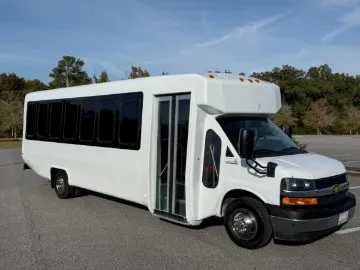
- Rear A/C only: A single rear unit is common on Type A mini buses, such as a 2010 Chevrolet 3500 Thomas Built 24-passenger bus that lists for $9,900.
- Front and rear A/C (dual A/C): This is the most common setup on full-size buses, with a driver-area unit plus a larger rear unit that covers the passenger cabin.
- Rooftop A/C: A roof-mounted unit keeps components out of road spray, and one 2015 International IC listing with 54,414 miles uses this design.
- Triple-zone A/C: Some large buses add a third zone for more even cooling, like a 2016 Blue Bird Vision with a Cummins 6.7L diesel.
Capacity and BTU ratings
Cooling power is measured in BTU (British Thermal Units, the amount of heat the system can remove per hour). Bigger buses need more BTU. A new 2026 Thomas activity bus on our site lists 126,000 BTU of air conditioning, which gives you a useful benchmark for a full-size, 72-child body. Used listings don't always state BTU, so it's fair to ask the seller for the system make and rating.
Factory vs. aftermarket systems
Some buses leave the factory with A/C, while others get it installed later by a dealer or fleet shop. Both can work well. One 2017 Blue Bird Vision listing, for example, notes freshly installed front and rear A/C units on a bus with only 34,200 miles. An aftermarket system isn't a red flag, but you'll want to know who installed it, when, and whether any warranty transfers to you.
Types of Air-Conditioned School Buses You Can Buy
It's hard to justify a 77-passenger bus for a route that carries 20 students. Matching the bus type to your routes keeps your costs down and your drivers happy, so here's how the main classes break down when A/C is on your must-have list.
School buses are grouped by type, based on chassis and size. Each type follows FMVSS (Federal Motor Vehicle Safety Standards, the federal crash and safety rules every school bus must meet), so a used school bus with air conditioning still has to meet the same safety standards as one without it.
- Type A (mini school bus): Built on a van chassis, these buses typically seat 14 to 30 passengers and often run gasoline engines with rear or dual A/C.
- Type C (conventional): The classic "dog nose" bus, with the engine in front of the driver, is the most common full-size choice and widely available with front and rear A/C.
- Type D (transit-style): These flat-front buses put the engine up front or in the rear, and they offer the highest capacity, sometimes 78 to 84 passengers.
- Activity bus and MFSAB: An MFSAB (Multi-Function School Activity Bus, a school-style bus without stop arms or flashing lights) is built for trips and events rather than home-to-school routes.
Full-size Type C examples
The Thomas Saf-T-Liner C2 is one of the most common A/C-equipped buses in our inventory. It's built on the Freightliner Business Class M2 chassis and is typically paired with a Cummins B6.7 diesel. A 2016 Thomas C2 77-passenger bus with front and rear A/C and 116,480 miles lists for $49,000, and a matching unit lists for $44,000. The IC Bus CE Series is another popular option, with several 2015 International CE 77-passenger buses with front and rear A/C coming out of Florida service.
Type A and special needs examples
Smaller buses are where A/C really shines for daycare routes, special education, and small private schools. You'll find a 2015 Chevrolet C4500 Thomas Built 24-passenger bus with A/C and seat belts listed at $18,000, plus late-model 2018 Chevy Collins 28-passenger buses with A/C listed from $55,000 to $58,000.
Note: Maximum seating capacity and vehicle specifications are subject to state and local regulations. For example, while Type C school buses physically accommodate up to 72–78 passengers, states like New Jersey cap Type C capacity at 54 passengers. Always verify your state's Department of Education or DOT regulations before purchasing.
How to Inspect the A/C on a Used School Bus
Nobody wants the stress of a broken A/C system on the first hot week of the school year. A listing that says "cold A/C" is a good start, but it's not proof, so here's the checklist our team recommends before you commit your budget.
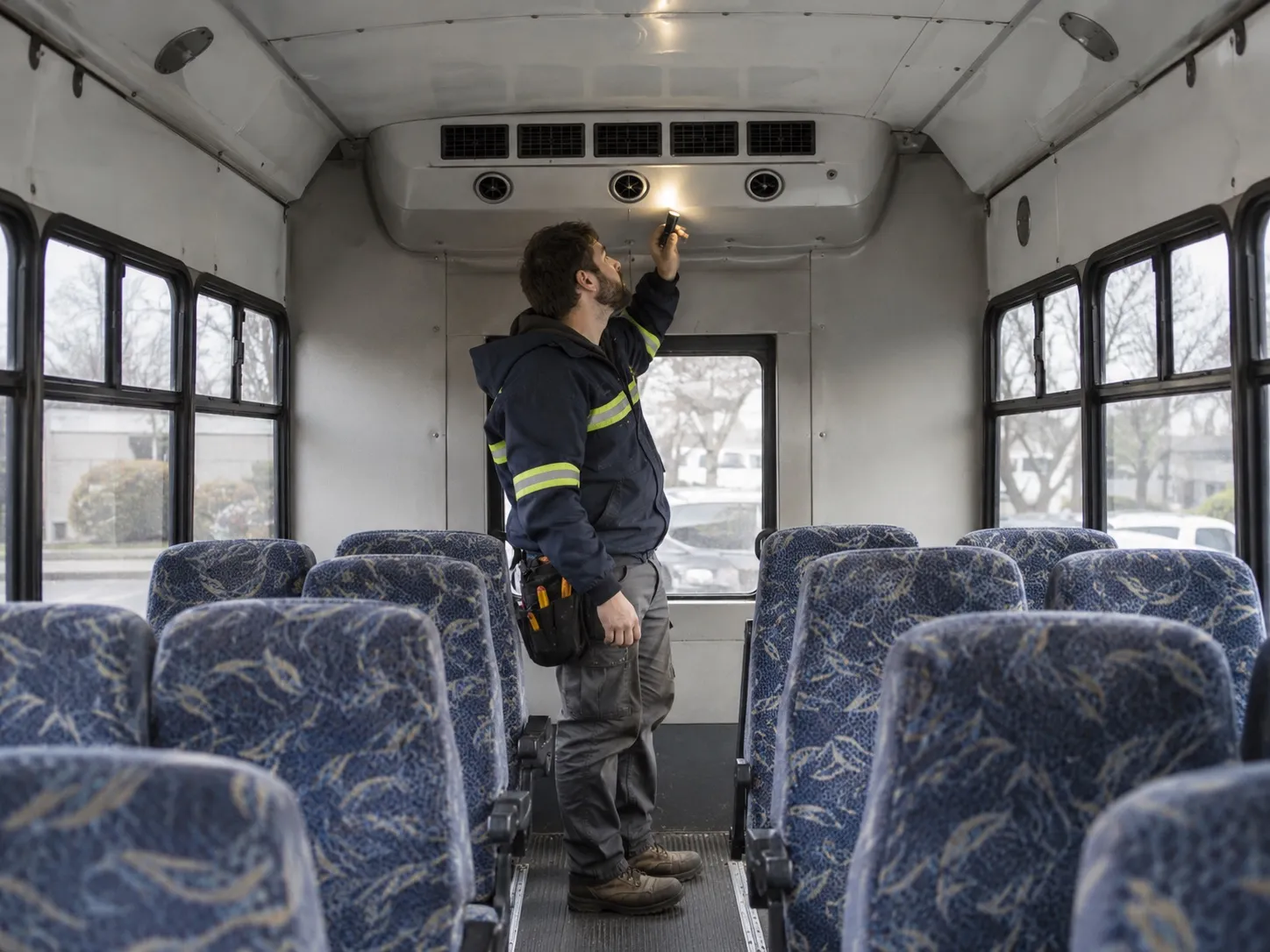
An A/C system has a lot of parts that wear out in hot climates: compressor clutches, belts, condenser fans, blower motors, and hoses. You don't need to be an HVAC technician to spot trouble. You just need a plan and about 30 minutes with the engine running.
- Run a cool-down test: Start the bus, set every zone to maximum, and time how long the cabin takes to feel cool at the rear seats, not just at the driver's seat.
- Check every evaporator: Walk the aisle and feel the airflow from each vent, because a dual system with one weak unit leaves half your riders hot.
- Listen to the compressor: A loud grinding or rapid clicking from the engine bay can point to a failing compressor clutch or low refrigerant charge.
- Inspect the condenser: Look at the roof or skirt unit for bent fins, road debris, oil stains, or damaged fans that block the heat from escaping.
- Look for leaks inside: Water stains on the ceiling, wet floor mats, or musty smells can mean a clogged drain line or a leaking evaporator.
Paperwork that protects your purchase
Ask the seller who installed the system, what refrigerant it uses, and whether any parts are still under warranty. If the bus comes from a large fleet, ask whether matching units share the same A/C setup, since that keeps your spare parts simple. You can also have an independent shop check pressures before purchase (a pre-purchase inspection usually costs far less than a single compressor).
If you're preparing for a state inspection after delivery, our guide on how to prepare your bus for inspection walks you through what inspectors check and how to avoid a failed first visit.
Pricing and Cost Considerations for A/C School Buses
Budget season puts real pressure on transportation directors and fleet operators, and your school board or contract will raise two questions: what does it cost up front, and what does it cost to run? Here's what the BusesForSale.com marketplace shows right now.
If you compare every used school bus for sale with A/C on BusesForSale.com, priced listings currently run from about $9,900 to $117,000. That's a wide range, and it reflects big differences in size, age, mileage, and spec. Here's how the listings break down:
| Bus type | Example listing | Mileage | List price |
|---|---|---|---|
| Type A mini (24P) | 2010 Chevrolet 3500 Thomas Built, rear A/C | 119,000 | $9,900 |
| Type C full-size | 2014 International CE | 160,400 | $12,500 |
| Type D flat nose (78P) | 2011 International, dual A/C, DT466 | 118,000 | $18,900 |
| Type D rear engine (84P) | 2016 Thomas RE Flat Nose | 202,000 | $24,900 |
| Type C full-size (77P) | 2016 Thomas C2, front and rear A/C | 116,480 | $49,000 |
| Type A NJ spec | 2021 Chevrolet 4500 NJ Spec Minotour | 80,311 | $79,900 |
| Type C NJ spec (54P) | 2022 International, front and rear A/C | 45,000 | $105,000 |
| Type D late model | 2020 Blue Bird Vision AC | Not listed | $117,000 |
Buying equipped vs. retrofitting
If you already own a bus without A/C, adding a system later is possible, but retrofit quotes vary widely by bus size, system type, and installer. In many cases, buying a bus that already has a working, documented system is the simpler path, because you skip the downtime and the install risk. Get written retrofit quotes before you assume either option is cheaper.
Operating costs to plan for
An A/C compressor draws power from the engine, so expect somewhat higher fuel use on hot days compared with the same bus running without A/C. Budget for routine service too, such as belts, filters, and periodic refrigerant checks. Your insurance carrier may also ask about the bus's value and use, so it helps to review the bus insurance types guide before you add units to your policy.
What Districts and Fleet Operators Ask Before Buying an A/C Bus
Replacing several buses before the fall term means your procurement timeline just got tight, and that's a stressful spot to be in. These are the questions transportation directors and fleet operators bring to our team most often.
Can we buy matching units for the fleet?
Yes, and it's often the smartest move. Several A/C listings on BusesForSale.com come in sets, such as multiple 2015 International CE 77-passenger buses from Florida or two matching 2016 Blue Bird Vision AC buses built to Texas spec. Matching units mean your mechanics stock one set of A/C parts, and your drivers learn one control layout. A fleet order of several units can also give you more room to negotiate on price and delivery.
Which spec does our state require?
Each state sets its own rules for school bus equipment, seating, and markings. If you're in New Jersey, for example, an NJ spec bus is built to that state's requirements. Check your state's rules first, then filter listings to match, so you don't buy a great bus that can't pass your inspection.
Will a used A/C bus fit our other programs?
Usually, yes. The same cooled cabin that helps your home-to-school routes also works for athletics, field trips, and summer school. If you need a bus mainly for trips, browse our activity buses category, where many units list A/C with under-floor luggage and tinted glass. For more help sizing buses to your programs, see how daycares and schools can choose the best buses.
Frequently Asked Questions About Used School Buses With Air Conditioning
Q: How much does a used school bus with air conditioning cost?
A: On BusesForSale.com, priced used school buses with A/C currently list from about $9,900 to $117,000. A small Type A mini bus with rear A/C sits at the low end, while a late-model full-size bus with front and rear A/C and low miles sits at the top. Mileage, model year, state spec (such as NJ spec), and seat belt equipment all move the price. You'll get the best value by deciding on capacity and spec first, then comparing condition across several matching listings.
Q: What does "front and rear A/C" mean on a school bus listing?
A: It means the bus has two cooling zones. A front unit cools the driver area and the first rows, while a larger rear unit (often called the main or passenger unit) handles the rest of the cabin. This dual setup is the most common configuration on full-size Type C buses like the Thomas Saf-T-Liner C2 and IC Bus CE Series. When you inspect the bus, test both zones separately, because one strong unit can hide a weak one. Ask the seller whether both units share one compressor or run separately.
Q: Is it better to buy a bus with A/C or add it later?
A: For most districts and fleet operators, buying a bus that already has a working, documented A/C system is the simpler choice. You avoid shop downtime, you can test the system before you pay, and you know what you're getting on day one. Retrofitting can make sense if you already own a bus in great mechanical shape, but quotes vary widely by bus size and system type. Get written quotes from at least two installers and compare them against equipped buses in your size class before you decide.
Q: Do air-conditioned school buses still meet federal safety standards?
A: Yes. Any school bus sold for student transport has to meet FMVSS (Federal Motor Vehicle Safety Standards), whether it has A/C or not. Factory A/C systems are designed around those standards. With aftermarket installs, ask for documentation showing who did the work and confirm that roof-mounted equipment didn't affect emergency exits or roof hatches. Your state may also have its own equipment rules, so confirm that the bus will pass your state inspection before you finalize the purchase.
Find Your Air-Conditioned School Bus Today
Your students deserve a cool ride, and your board or contract deserves a smart purchase. Browse used school buses for sale with air conditioning, or call our specialists at 877-287-7253 to find matching units that fit your routes, your state spec, and your budget.