 Excellent on Google from verified customers


The E-450 brings more carrying capacity. Whether that makes it the better fleet purchase depends on what you carry, where you carry it and which completed bus you're buying.
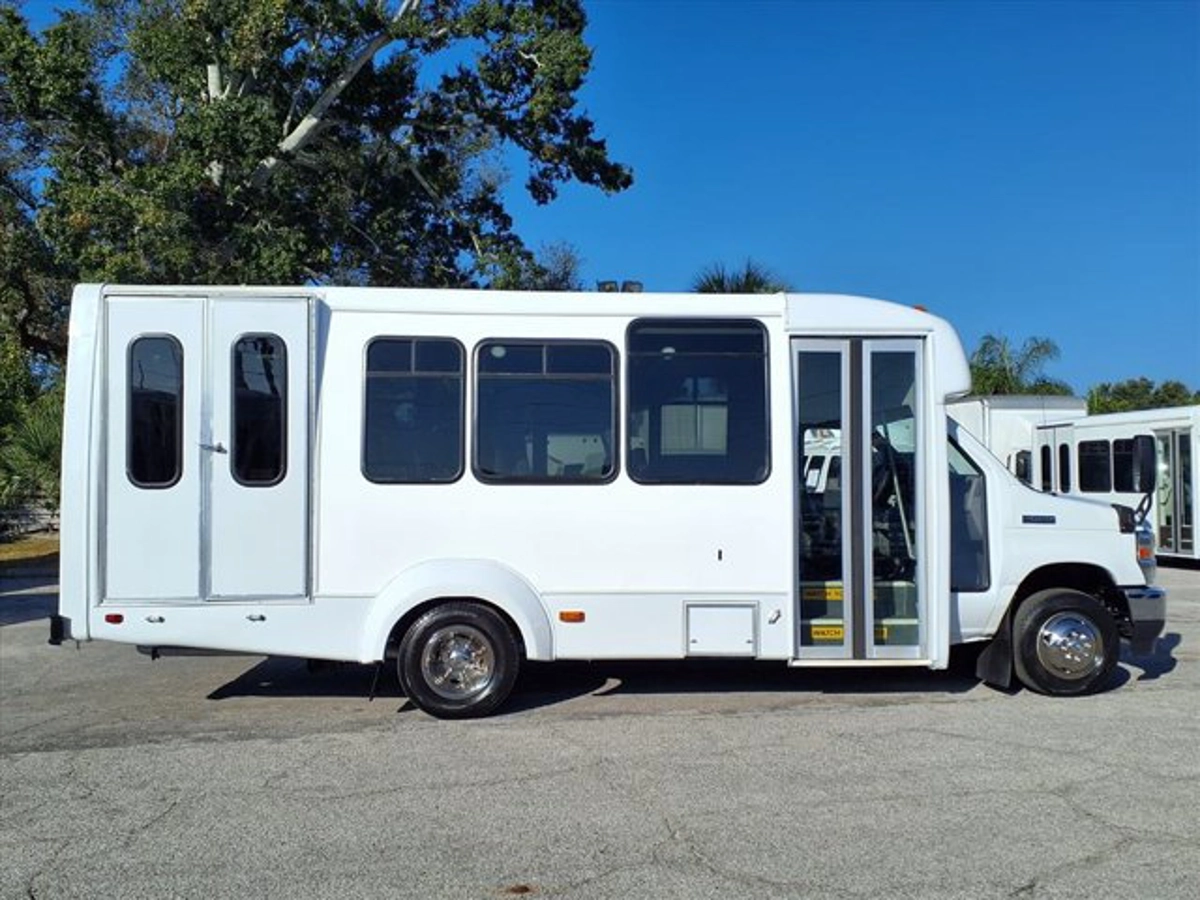
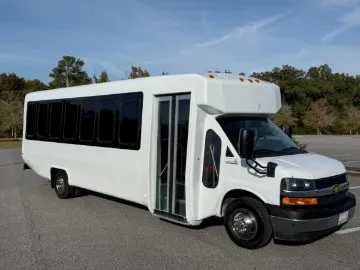
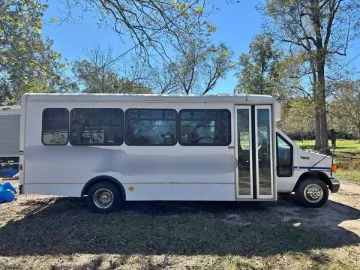
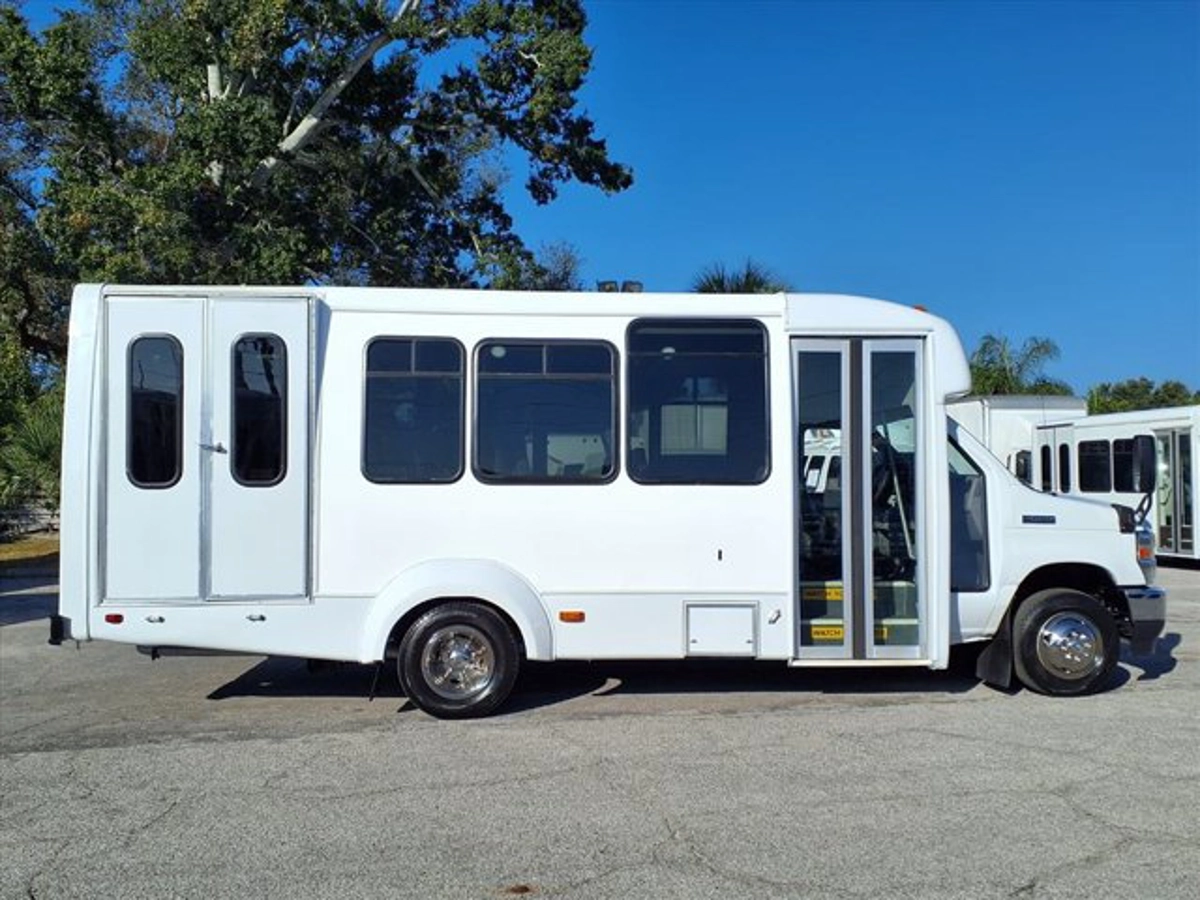
Park an E-350 shuttle beside an E-450 and the family resemblance can make the decision look simpler than it is. Similar Ford cab. Similar passenger door. Perhaps the same number of seats. One wears the heavier-duty badge, so that must be the one to buy for serious fleet work.
Sometimes it is. Sometimes you're paying for capacity your route never uses, while overlooking the better body or maintenance history of the E-350 beside it. A shorter wheelbase or body might suit your property better, too.
The E-450 deserves priority when passenger weight, luggage, accessibility equipment or a heavier body calls for its additional capacity. An E-350 remains a strong candidate when the completed bus comfortably meets the route's peak demands.
For operators buying several used buses, the aim is a fleet that covers its work, including when one bus is in the shop. This is a researched buying comparison, not a head-to-head road test.
The capacity difference is underneath
These shuttles start as a Ford cab and chassis, the frame and running gear underneath. A separate manufacturer adds the passenger body. That starting vehicle is called a cutaway.
Compare cutaway with cutaway. E-350 cargo-van specifications and stripped-chassis figures can lead this discussion in the wrong direction. Match chassis model year, engine, rear-wheel configuration and wheelbase. Record the body builder and body year separately. Wheelbase is the distance between the front and rear axles.
Ford's 2015 specifications give us a controlled example. These two dual-rear-wheel cutaways share a 158-inch wheelbase, 6.8-liter V10 and automatic transmission. The figures describe these historical configurations, not every used listing.
Two weight limits matter here. GVWR is the maximum allowed weight of the whole loaded vehicle. GAWR is the limit on one axle. The chassis payload below is the allowance left for the body, equipment, people and luggage, not a passenger-weight allowance.
| Specification | E-350 DRW Higher-GVWR package | E-450 DRW |
|---|---|---|
| Wheelbase | 158 in | 158 in |
| Engine / transmission | 6.8L V10 / automatic | 6.8L V10 / automatic |
| Gross vehicle weight rating (GVWR) | 12,500 lb | 14,500 lb |
| Rear gross axle weight rating (GAWR) | 8,500 lb | 9,600 lb |
| Base chassis weight before the body | 5,235 lb | 5,460 lb |
| Ford’s maximum payload allowance before the body | 7,265 lb | 9,040 lb |
Here, the E-450 gains 2,000 pounds of rated total weight. Its extra 225 pounds of chassis weight uses part of that allowance, leaving a 1,775-pound gain in published payload. Install two different bodies and the remaining passenger-and-baggage advantage changes again. Seats, lift, luggage compartments and passenger air conditioning all count.
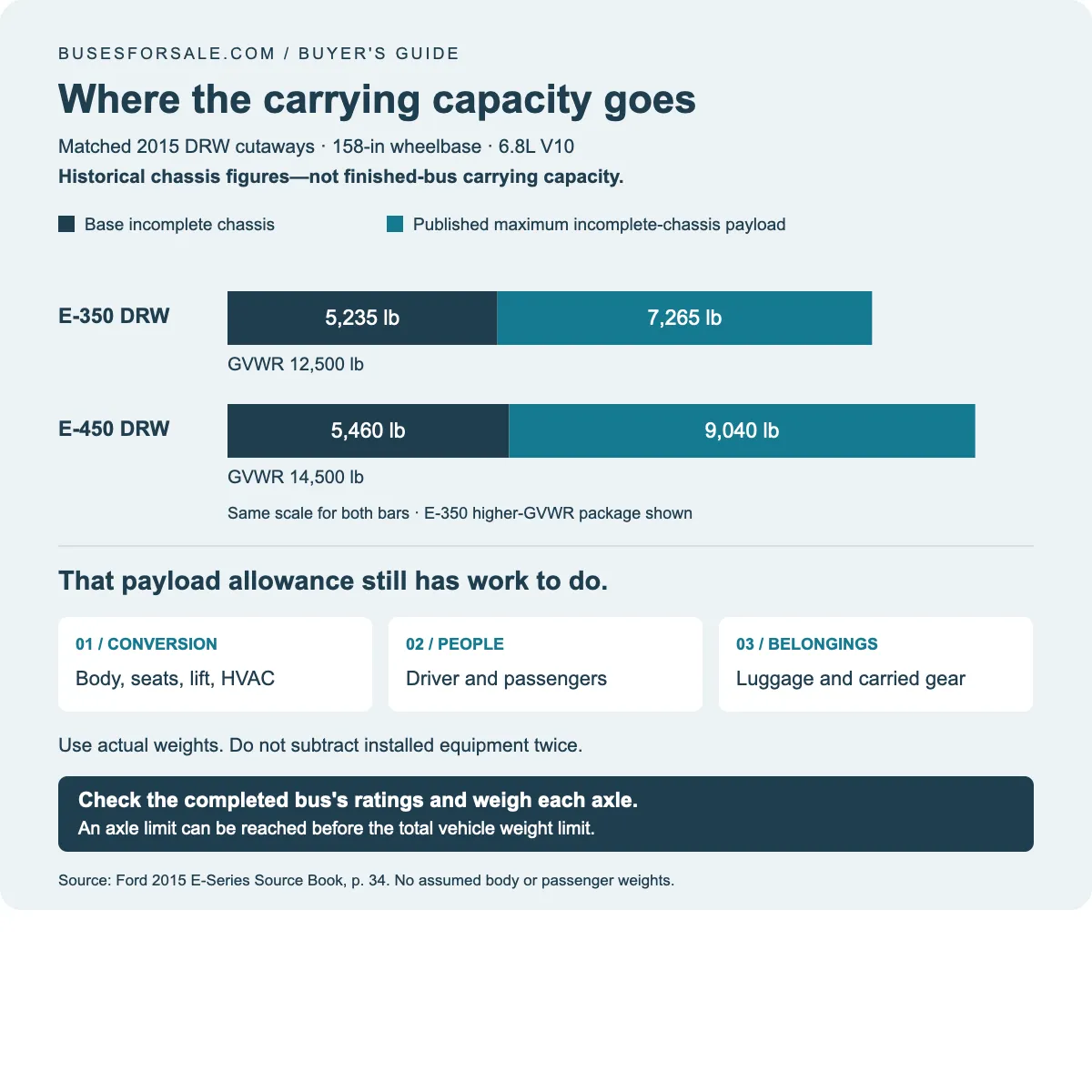
The completed bus's ratings and actual weight govern what it can carry. We suggest weighing it by axle, ready for service, then accounting for the intended people and bags. A rear axle can run out of capacity before the bus reaches its GVWR. Unused capacity at the front cannot be transferred by optimism.
Ford's 2016 tables show higher-rated rear springs and axle capacity on the E-450. That supports heavier loads; it does not prove the bus will stop sooner or last longer.
Engine years matter as much as model numbers
Now, you're probably not shopping for a bus based on its zero-to-sixty time. But getting onto the highway with a full load of passengers and luggage is another matter. An E-450 badge doesn't automatically buy more power. Ford moved to the 7.3-liter gasoline V8 for the 2021 E-Series. Ford has published different power ratings by year and engine setup, so check the specifications for the bus you're considering.
The newer 7.3-liter examples pair with a six-speed automatic. This gasoline engine is distinct from Ford's older 7.3-liter diesel. Match the engine and transmission before deciding that one model has a performance advantage.
The body builder gets the deciding vote
Moving into an E-450 doesn't give the driver a bigger office. Ford's 2016 sourcebook lists the same 42-inch cab headroom and 42.1-inch maximum legroom for the two DRW models. Seat condition, adjustment and the body conversion still influence a full shift behind the wheel.
Behind the cab, the badge tells you even less about the interior. Starcraft's Allstar brochure lists the same 93-inch interior width and 80-inch height across its E-350 and E-450 examples with a standard floor. It lists 75-inch height with a raised floor. These are dimensions within one body family, so check the actual build before assuming the heavier chassis provides a wider aisle or more headroom.
A longer body may allow more seating, luggage space or wheelchair positions. How the builder divides that space determines whether passengers benefit. Think of the third row in an SUV. Having a seat for everyone and having everyone happy to sit there for an hour are different things. An extra row in a shuttle deserves the same scrutiny. An airport luggage compartment might occupy space another operator needs for circulation in accessible service.
Can your riders board comfortably? Do the intended mobility devices fit the entrance, lift and securement layout? Is there useful room for people and their belongings? Starcraft makes its passenger capacities subject to final weight analysis.
The E-350 works when its configuration provides the accommodation you need. The E-450 becomes more useful when its additional capacity supports a better layout. A crowded E-450 is still a crowded bus.
Licensing also follows the vehicle and its use. In commercial service, a bus designed for 16 or more people, including the driver, requires a CDL with a passenger endorsement under federal guidance, even below the 26,001-pound weight threshold. Our CDL guide explains what to confirm with your state before buying.
Compare wheelbases before badges on the road
Ford's 2016 figures give the 158-inch-wheelbase E-350 DRW and E-450 the same 54.8-foot curb-to-curb turning diameter. At 176 inches, each is listed at 60.3 feet. The 138-inch E-350, in single- or dual-rear-wheel form, is listed at 48.6 feet.
That makes a short-wheelbase E-350 worth considering for restricted hotel forecourts or tight campus roads. It doesn't make every E-350 easier to maneuver than every E-450. It's the same question you'd ask before bringing a long-bed pickup home. Will it actually fit where you need to park it? On the bus, mirrors, body corners, rear overhang and any wheelbase extension still have to clear the property.
Ride quality needs a drive. The E-450's higher-rated rear springs warrant attention when comparing lightly loaded buses, but the rating can't tell you which bus passengers will find more comfortable. Tires, suspension condition, body installation and actual load belong in the comparison. Try the passenger seats as well as the driver's seat.
With matching engines, extra GVWR brings no extra horsepower. Acceleration and hill performance depend on the powertrain and the weight it's moving. A heavier rating alone gives us no basis for calling the E-450 faster or quieter.
We suggest a fully warmed drive with a representative load and passenger climate control operating. Check tracking, transmission behavior and comfort over the route's rougher sections. For stop-intensive work, pay particular attention to low-speed response and repeated maneuvering through the loading areas.
Plan support for the chassis and the body
Ford's commercial-service network can support either chassis, provided the intended shop can accommodate the completed bus's height, length and weight. Confirm the shop's facilities and scope before buying. A Ford sign outside doesn't establish that the workshop can handle every shuttle inside.
Doors, lifts, passenger heating and air conditioning and body electrical systems have their own manufacturers and parts supply. Body identification and diagrams belong alongside the Ford records. Local support for the actual equipment can decide which bus is easier to keep working.
Maintenance history must match the work. Ford's 2018 manual specifies transmission-fluid replacement at 150,000 miles under normal conditions, but 30,000 miles for the listed extensive-idling or low-speed commercial duty. That's Ford's 2018 schedule; check the one for your bus's year. “Serviced regularly” needs invoices and a route description behind it.
A newer bus still needs a pre-purchase inspection. Ford TSB 25-2572 addresses upper-engine ticking, rough running or misfires on some 2021–2025 7.3-liter E-Series vehicles, including diagnosis for possible camshaft or tappet wear. It establishes an inspection concern, not a failure rate.
Separately, recall 24S07 concerns certain 2021–2022 E-350 and E-450 vehicles and power-steering-line connections that can lose fluid and reduce steering and brake assistance. Check applicability and completion by VIN. Our recall-checking article explains why an old inspection invoice may not settle the question.
Buy the remaining bus rather than the odometer
The research doesn't establish that an E-450 will outlast a correctly specified E-350 on lighter work. Claims that either badge guarantees 300,000 or 500,000 miles aren't a fleet plan.
Mileage measures road use. Engine hours help reveal time spent idling, and lift cycles describe another kind of wear. Corrosion, water leaks and body deterioration can make continued service uneconomic while the engine still starts willingly. The FTA's historical useful-life research also identifies structure and operating environment as important life factors.
If the plan calls for four more years, calculate the additional route mileage and expected duty, then have the chassis and body assessed against that requirement. Price the immediate catch-up work and likely wear items. Keep a reserve for uncertain repairs, and decide what would trigger retirement, such as structural deterioration or equipment you can no longer support.
That gives you a working estimate for your budget. A clean, documented E-350 can be a stronger purchase than a tired E-450. A fresh engine cannot make a rotten floor an asset.
Cost matters across the fleet
There's no blanket fuel-economy or ownership-cost winner between these badges. Engine generation, body size, load and route make generalized MPG claims unhelpful. Compare actual records where available, then include necessary refurbishment and downtime in the calculation. Our guide to comparing delivered quotes helps put the purchase costs on the same basis.
Sharing parts and equipment across your fleet can change the result. An E-350 sharing your fleet's verified powertrain parts and body equipment may be easier to support than an unfamiliar E-450. The reverse is equally plausible. Matching Ford badges don't establish interchangeable parts.
A spare must cover the routes it may be asked to serve. A compact E-350 might fit a light route perfectly yet be unable to cover a heavier airport run or accessible service. An appropriately configured E-450 may justify its cost because it can cover more of your routes. Record which routes each completed bus can cover.
The fleet verdict
Hotel and airport fleets
A short-wheelbase E-350 with a suitably compact body can work well where smaller groups and their luggage fit, and the property has limited turning space. The E-450 becomes the stronger candidate when peak passengers and bags require its additional usable capacity. Empty luggage racks don't prove the loaded bus has room to spare.
Senior and accessible transport
Start with the layout. An E-350 can work when boarding, mobility-device space and loaded weights meet the need. More equipment or occupied wheelchair positions may favor an E-450. Our accessible-bus buying guide covers checking access and weight together.
Employee and campus fleets
A shorter E-350 is a strong candidate for smaller peak loads and restrictive routes. Higher sustained occupancy strengthens the E-450 case when the body converts that capacity into useful accommodation. Plan for the busiest departure, not average ridership.
Church, camp and community fleets
An E-350 can cover lighter groups well. Adult-heavy trips and equipment may favor the E-450. For longer journeys, seat spacing, luggage accommodation and the loaded drive settle the comfort question.
Mixed-duty operators
You may need a mixture. Use compact E-350s on lighter routes and higher-capacity E-450s where the loads or spare coverage justify them. Standardize equipment where it helps without forcing every route into the same bus.
The better purchase is the completed bus that meets your peak requirements, has local support and has enough credible working life left to make its price worthwhile.
Let's compare the buses for your route
Browse the models in our current bus inventory, then call BusesForSale.com at 877-287-7253 with the stock numbers you're considering.
Tell us about your route and busiest passenger load, luggage or lift requirements, and the services your spare needs to cover. Ask our team to help compare the candidates using available certification-label photos, floorplans and maintenance records.
We'll help keep the purchase moving with clear answers about each bus. Ask us to put the quoted work, delivery arrangements and unresolved questions in writing before you decide.