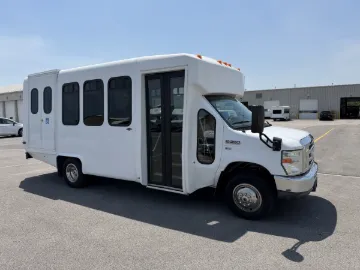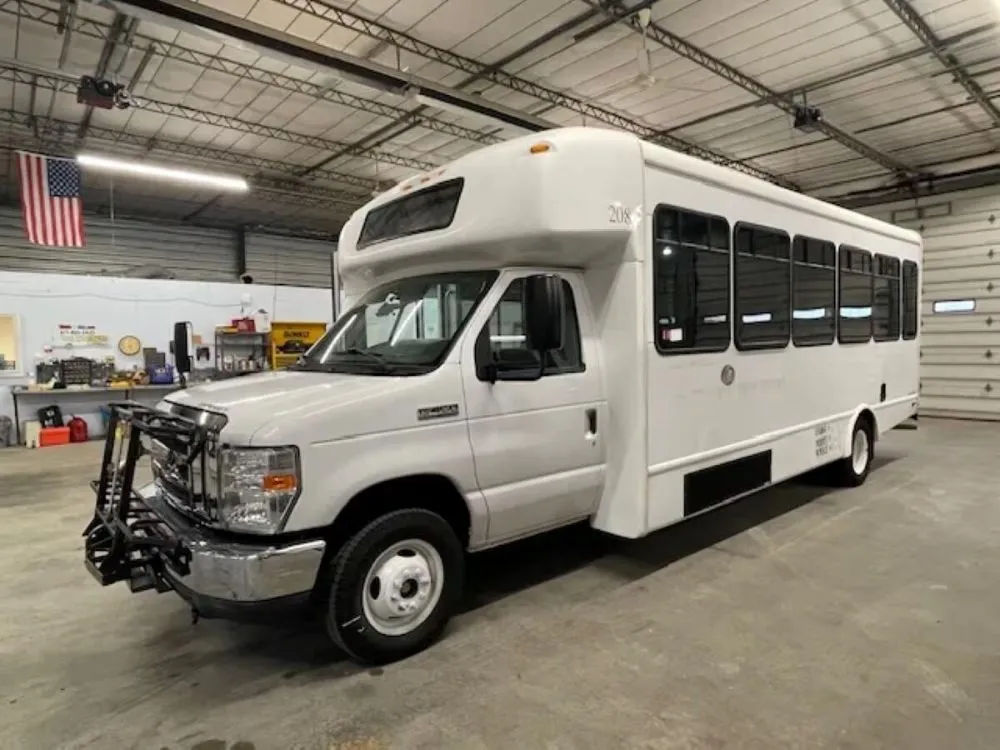
The best bus for a church depends on one number: how many people you're moving and who's driving. For most congregations under 15 passengers, a non-CDL Ford Transit or Ford E350 conversion is the right answer — your volunteers can drive it legally, it fits in a standard parking space, and used units run $12,000–$28,000. For larger Sunday services or outreach routes above 15 passengers, a Ford E450 or Chevrolet Express cutaway gives you more capacity while keeping operating costs manageable.
If you've already read the church bus buying guide and know what you need, this page answers the next question: which specific model should you actually buy? We've matched the most common church transportation use cases — Sunday service, senior outings, youth programs, and community outreach events — to the bus models that show up most reliably in BusesForSale.com inventory and hold their value over time.
Every recommendation below is grounded in real inventory data from the BusesForSale.com knowledge graph. Prices reflect used-market conditions in 2026; new-build pricing varies by body conversion upfitter. You're not buying a commercial vehicle — you're buying a tool for ministry, and that distinction changes every decision you'll make. A charter company optimizes for revenue per seat-mile. You're optimizing for something different: the Sunday morning volunteer who needs to feel confident driving it, the elderly member who needs a step that doesn't require a running start, and the treasurer who needs to justify the expenditure to the deacon board. That means your decision framework looks like this, in priority order: The right bus for Sunday service is not the same as the right bus for a senior outreach route. Use the matrix below to match your primary use case to a model recommendation, then read the detailed breakdown for each use case below the table. Church bus recommendations by use case: model, capacity, CDL requirement, and used price range: For most churches, Sunday morning transport is the use case that drives the purchase. If your volunteers are driving, the non-CDL threshold is non-negotiable. The Ford Transit 350 in a 12–14-passenger Collins or Eldorado conversion hits the sweet spot: it drives like a large van, parks in standard spaces, and doesn't require your volunteers to hold a commercial license. Used 2019–2022 units with 30,000–60,000 miles list between $22,000 and $38,000. If your congregation runs larger Sunday routes — 18 or more people — a Ford E450 Starcraft Allstar or Elkhart Coach gives you the capacity, but plan for CDL-licensed drivers and the insurance step-up that comes with it. If you're moving elderly members, people who use walkers, or members who use wheelchairs, you need an ADA-equipped vehicle. The Chevrolet G3500 platform and the Ford E450 cutaway both accommodate under-floor wheelchair lift systems cleanly. A compliant used unit from 2016–2020 with a functioning lift, Q'Straint or Sure-Lok securement, and kneeling suspension runs $24,000–$42,000. Budget $1,200–$2,000 for a lift inspection and recertification at purchase — not optional if your passengers' safety depends on it. For a full checklist of what to verify, see the guide to ADA-compliant buses. If you're transporting children — youth group, summer camp, school-of-ministry programs — most states require MFSAB (Multi-Function School Activity Bus) compliance, which means FMVSS-compliant seating, emergency exits, and body standards that a standard shuttle bus doesn't meet. The Ford Transit Starcraft MFSAB and Ford E350 Activity Bus both satisfy these requirements and stay under the non-CDL threshold at 12–15 passengers. A 2018 Ford Transit Starcraft MFSAB with 34,000 miles is an example of what's available — clean maintenance history at a workable price point. Check your state's requirements for child transport before you buy; the rules vary significantly. Outreach use — food drives, community events, mission trips — demands a different mindset. You need a bus that can handle irregular schedules, variable loads, and the occasional long-distance run to a retreat center. A used Ford E350 Starcraft Allstar from 2015–2019 in the $12,000–$22,000 range gives you the reliability and simplicity you need for intermittent use without the operating cost of a larger or newer unit. The 6.2L gasoline V8 is easy to service at any shop — an important consideration when you're two hours from your regular mechanic on a mission trip. If even one of your regular riders uses a wheelchair or has significant mobility limitations, an ADA-equipped bus isn't a nice-to-have — it's what allows that person to participate in the life of your congregation. Here's what the spec sheet actually means in practice. A power wheelchair lift is the standard on most ADA-equipped mini buses and shuttle buses. It deploys from the rear or side door, accommodates power wheelchairs and mobility scooters, and typically has a weight capacity of 600–800 lbs. A fold-out ramp is simpler mechanically but requires a lower floor height — more common on newer Transit-based builds than on E-Series cutaways. If you're buying used, always test the lift through a full cycle under load before you close the purchase. A lift that fails in service is a liability issue, not just an inconvenience. Q'Straint and Sure-Lok are the two dominant wheelchair securement systems. Both use a four-point tie-down and a lap/shoulder belt to secure the wheelchair and the passenger separately. A properly installed and maintained system is required for ADA compliance and for commercial insurance coverage. Verify that any used ADA bus you're considering has certified securement hardware — not third-party modifications — and that the belts and hardware are within the manufacturer's replacement interval. Kneeling suspension lowers the bus's entry step height by 2–4 inches when stationary, making boarding significantly easier for ambulatory passengers with limited mobility — not just wheelchair users. If you have older congregation members who struggle with high steps, look for this feature on any used unit you evaluate. Not every ADA-equipped bus has it, but it makes a meaningful difference on Sunday morning when 12 people need to board in under five minutes. The most accessible used options in BusesForSale.com inventory include the 2026 Chevrolet G3500 ADA Shuttle Bus (new build, diesel), the 2014 Ford E350 Goshen ADA Shuttle Bus (103,000 miles, established market price), and the 2018 Ford Starcraft ADA Shuttle Bus (7,229 miles — low-mileage example in the upper-mid price range). Browse the full ADA-equipped mini bus inventory for current availability. Churches are nonprofits, and most commercial lenders treat them differently than for-profit buyers. That's not always a disadvantage — but it means your financing path looks different from a charter company's. If your congregation has approved a capital expenditure, a cash purchase on a quality used bus in the $15,000–$28,000 range is often the cleanest path. You own it outright, there's no monthly payment hitting your operating budget, and the total cost of ownership is fully predictable. The risk is tying up capital that could serve other ministry needs — weigh that against the certainty of fixed transportation costs. Several lenders specialize in financing for religious organizations. Church Mutual, Stewardship Financial, and some regional credit unions offer vehicle financing to 501(c)(3) nonprofits at rates comparable to commercial lending. Terms of 36–60 months are typical on vehicle loans in the $15,000–$40,000 range. You'll need your EIN, your most recent board-approved budget, and a letter from your board authorizing the purchase — the same documentation a for-profit lender would require for a commercial auto loan. Your total first-year cost for a used church bus in the $18,000–$28,000 range typically runs: Total first-year cost of ownership: approximately $23,600–$39,800. Plan that number into your board presentation — it's a more honest figure than the sticker price alone. New conversion builds on a Ford Transit or E450 start at $55,000–$85,000 and come with a factory warranty and a clean maintenance history. For a congregation that will operate the vehicle for 10–15 years, the lower long-term maintenance cost can justify the higher purchase price. For a congregation buying its first bus, a quality used unit at $18,000–$28,000 lets you field-test whether the vehicle actually gets used before committing to a six-figure asset. Your personal auto policy will not cover a church bus carrying passengers. Commercial auto liability is required the moment you're transporting people — and for nonprofits, the stakes of getting this wrong are higher than for commercial operators, because a claim that exceeds your coverage doesn't just cost money. It can end your ministry's ability to provide transportation at all. A non-CDL 12–15 passenger church bus operated by volunteers for Sunday service and occasional events typically runs $1,800–$3,200 per year in commercial auto liability. If you add CDL operation (16+ passengers), that rises to $3,500–$5,500 per year. ADA-equipped buses require verification that your policy covers the lift system and securement hardware — some policies require a rider. For a full breakdown of coverage types and what determines your premium, see our bus insurance guide. Church Mutual Insurance Company and GuideOne Insurance both specialize in coverage for religious organizations and understand the operational realities of volunteer-driven transport. They may offer lower rates than general commercial auto insurers for the same coverage — worth getting a quote from both alongside any general commercial carrier you approach. BusesForSale.com lists church-ready mini buses, ADA-equipped shuttles, and activity buses updated daily from dealers and fleet sellers across the country. Browse both categories below — or read the full step-by-step church bus buying guide if you're still working through your decision criteria. Browse the full church bus inventory — Ford Transit, E350, E450, Chevrolet Express, and ADA-equipped units updated daily from dealers across the country. Non-CDL options, ADA-equipped units, 8–24 passengers. Starcraft, Collins, Elkhart, and Eldorado builds in stock. What is the best bus for a small church? For most small churches with volunteer drivers, the best option is a 12–14-passenger Ford Transit conversion (Collins or Eldorado body) or a Ford E350 cutaway. Both stay under the CDL threshold at 15 seats or fewer, run on gasoline engines that any shop can service, and are available used in the $15,000–$28,000 range. The Ford Transit is the easier vehicle for non-commercial drivers. How much does a used church bus cost? Used church buses range from $12,000 for older high-mileage gasoline units to $42,000 for late-model ADA-equipped builds. The most common purchase range for a congregation's first bus is $15,000–$28,000 — a 2015–2019 Ford E350 or E450 Starcraft with 70,000–120,000 miles. Budget an additional $3,000–$6,000 for first-year insurance, inspection, and maintenance reserve. Do you need a CDL to drive a church bus? Not if you stay under the CDL threshold: 15 seats or fewer and a GVWR under 26,001 lbs. Most churches specifically target this configuration so that volunteer drivers can legally operate the bus without a commercial license. If your bus seats 16 or more — including the driver — a CDL Class B is required regardless of whether the driver is paid or a volunteer. What church bus is best for transporting elderly members? For elderly members with limited mobility or wheelchair users, you need an ADA-equipped unit with a wheelchair lift, Q'Straint or Sure-Lok securement, and ideally kneeling suspension. The Chevrolet G3500 and Ford E450 cutaway are the most common platforms for this configuration. Budget $24,000–$42,000 for a used unit in good mechanical and accessibility condition. Always test the lift through a full cycle before purchase. Can a church bus be used for youth programs? Yes, but most states require MFSAB (Multi-Function School Activity Bus) compliance for transporting children under 18. An MFSAB meets FMVSS safety standards for student transport without requiring a full school bus body. The Ford Transit Starcraft MFSAB and Ford E350 Activity Bus both satisfy these requirements at 12–15 passengers, keeping you under the CDL threshold. Confirm your state's child-transport rules before purchase. How much does church bus insurance cost? Commercial auto liability for a non-CDL 12–15-passenger church bus operated by volunteers typically runs $1,800–$3,200 per year. CDL operations with 16+ passengers run $3,500–$5,500 annually. Church Mutual and GuideOne are the most common insurers for religious organizations and may offer lower rates than general commercial carriers. Your premium also depends on your state, driver history, and annual mileage. What Church Buyers Actually Need From a Bus
Best Church Bus by Use Case
Use case Recommended model Capacity CDL required? Typically used price Sunday service transport, volunteer drivers Ford Transit 350 (Collins or Eldorado conversion) 12–14 passengers No $18,000–$35,000 Sunday service, larger congregation (15–24 pax) Ford E450 Starcraft Allstar or Elkhart Coach 18–24 passengers Yes (16+ passengers) $20,000–$40,000 Senior member transport, mixed mobility Chevrolet G3500 or Ford E450 ADA-equipped 8–12 ambulatory + 2 wheelchair No (if ≤15 seats) $24,000–$42,000 Youth programs and summer camps Ford Transit Starcraft MFSAB or Ford E350 Activity Bus 12–15 passengers No $15,000–$32,000 Community outreach and food drives Ford E350 Starcraft Allstar or Chevrolet Starcraft 14–20 passengers No if ≤15 seats; Yes if 16+ $12,000–$28,000 Multi-purpose: Sunday + youth + events Ford E450 Elkhart Coach (flex-seating configuration) 14–21 passengers Depends on seat count $22,000–$38,000 Sunday service: the non-CDL priority
Senior member transport: accessibility is the specification
Youth programs and summer camps: safety compliance first
Community outreach and events: versatility over optimization
ADA Accessibility: What Every Church Needs to Know
Wheelchair lift vs. ramp: which one your passengers need
Securement systems
Kneeling suspension and step height
ADA model recommendations
Financing a Church Bus: What Your Options Actually Look Like
Cash purchase vs. financing: which path fits your congregation
Church-specific lenders
What to budget beyond the purchase price
New vs. used for church buyers
Church Bus Insurance: What You Need and What It Costs
What coverage a church bus needs
What it costs
Nonprofit and religious organization insurers
Find Your Church Bus in Live Inventory
Church buses
Mini buses
Frequently Asked Questions: Best Buses for Churches