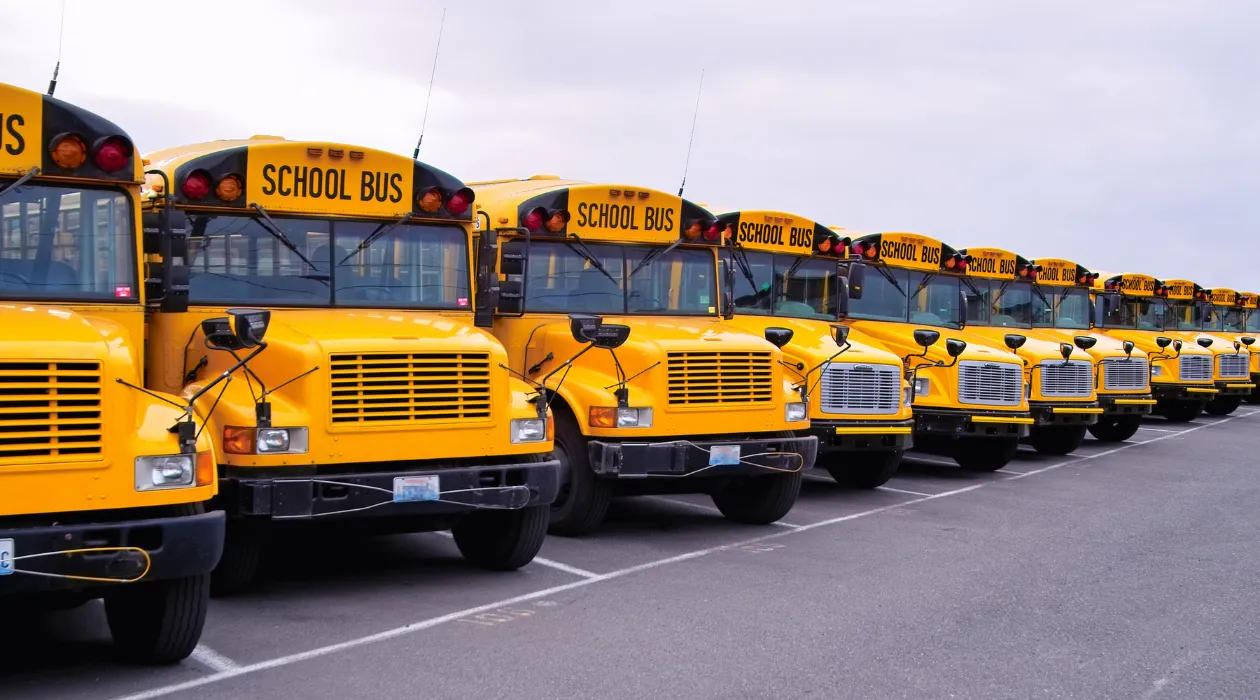
Districts and private operators don’t buy school buses for the name on the badge. They buy based on uptime, parts access, safety engineering, and the long-term cost of keeping the vehicle on the road. Blue Bird, Thomas Built, and IC Bus dominate the U.S. market because they deliver predictable performance and strong support networks, but the differences between them matter once you dig into daily use.
This guide breaks down how the three major OEMs compare across safety, powertrains, fuel economy, maintenance, parts access, pricing expectations, and long-term ownership considerations. It’s a tool to help people choose which brand may be right for them
Quick Overview: Where Each OEM Tends to Excel
Blue Bird
Strong drivetrain options, wide fuel diversity, well-known for durability, and one of the largest EV deployments in the country. Many districts pick Blue Bird for predictable parts supply and body longevity.
Thomas Built Buses
Backed by Daimler. Known for integrated safety systems, strong visibility, and efficient Cummins-focused powertrain setups. Good fit for fleets that want tight integration with telematics and safety suites.
IC Bus (Navistar)
Fleets often choose IC for ease of maintenance and integrated chassis/body design. Technicians like them because diagnostics and parts sourcing are straightforward across model years.
Model Lineup at a Glance
Blue Bird
- Vision (Type C)
- All American FE & RE (Type D)
- Micro Bird (Type A)
Thomas Built
- Saf-T-Liner C2 (Type C)
- Saf-T-Liner EFX & HDX (Type D)
- Minotour (Type A)
IC Bus
- CE Series (Type C)
- RE Series (Type D)
- AC/AE Series (Type A)
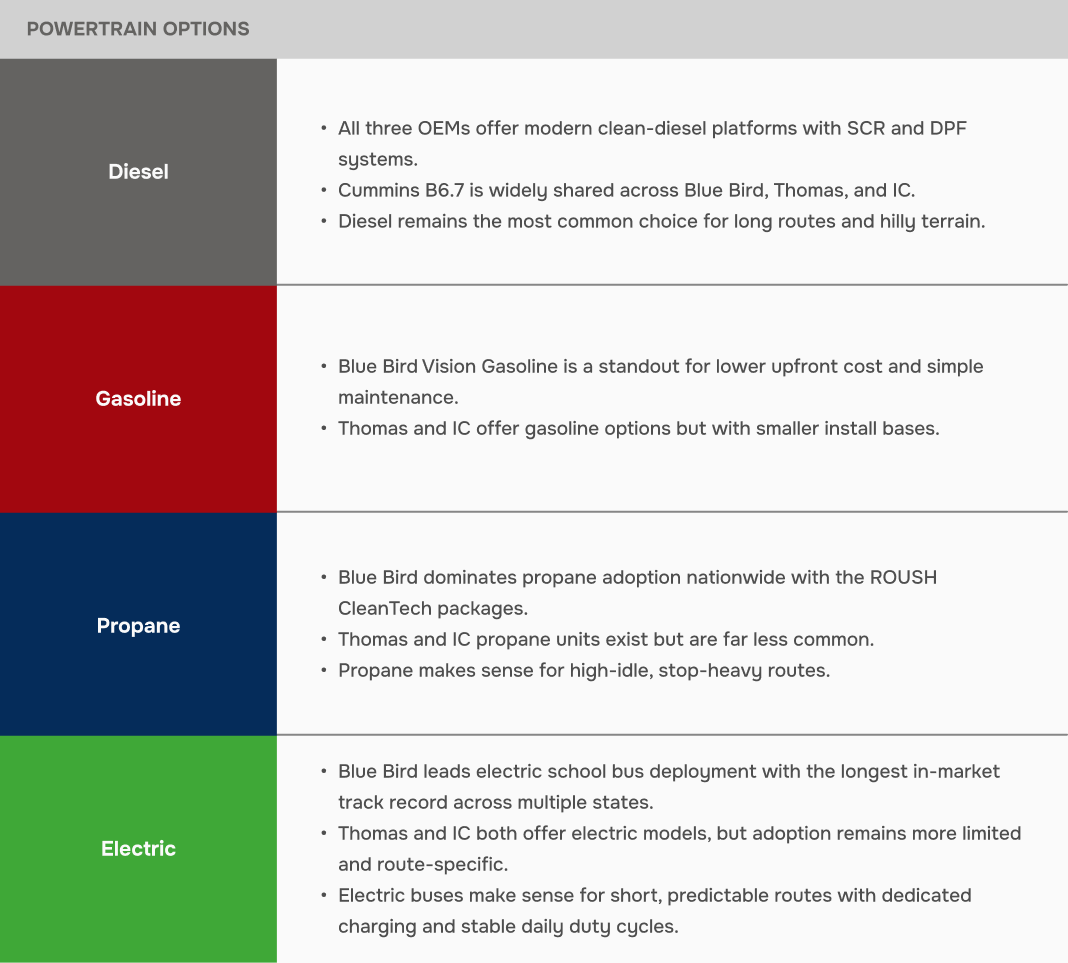
Operators report that infrastructure planning, and not the bus, remains the real bottleneck.
Safety Features by OEM
Thomas Built Buses
- Front visibility is a strength on the Saf-T-Liner C2, driven by the sloped hood and A-pillar design.
- Supports third-party camera systems including REI, Gatekeeper, and Seon, with strong integration through SafetySuite and Zonar.
- Collision mitigation options are available through Detroit Assurance in select configurations and markets.
- Lap-shoulder seat belts are offered across models where required or specified.
Blue Bird
- Visibility relies more heavily on mirror systems, with consistent sightlines across the Vision and All American platforms.
- Compatible with major camera providers including REI, Gatekeeper, and Seon.
- Collision mitigation is typically offered through partnerships with Bendix and Mobileye, depending on chassis and spec.
- Lap-shoulder seat belts are available and commonly specified in mandate states.
IC Bus
- Comparable mirror-based visibility to Blue Bird, with incremental improvements across newer CE Series builds.
- Supports the same major third-party camera systems used across the industry.
- Collision avoidance offerings are generally tied to Bendix and Mobileye partnerships.
- Lap-shoulder seat belts are available by configuration and policy requirement.
Seat Belt Policy Context
Eight states mandate seat belts on new school buses. In practice, adoption is driven more by operator policy and funding than by OEM capability, as all three manufacturers offer compliant restraint systems.
Fuel Economy & Driveability
Real-world fleet reports (School Bus Fleet, NAPT, district RFP disclosures):
Diesel
- 6.5–9 mpg depending on terrain, load, and route profile
- Type D RE buses typically run at the lower end of the range
Gas
- 4.5–6.5 mpg on Type C platforms
Propane
- Higher fuel consumption but lower fuel cost per mile
Electric
- 100–135 miles per charge depending on temperature
- Cold weather can reduce range by 20–40 percent (NREL data)
Maintenance & Parts Access
Blue Bird
Parts availability is strong nationwide, especially for Vision models. Diesel and propane systems are well understood by most technicians.
Thomas
Strong dealer networks in many states. C2 body parts can be more specialized due to unique framing and integration with Daimler systems.
IC Bus
Technicians often prefer IC because chassis, electrical, and body systems follow consistent patterns year over year.
For deeper fleet planning, check out our Complete Bus Fleet Maintenance Guide.
Cost Snapshots (Used Market)
Not exact pricing. Ranges reflect current used market trends:
Blue Bird Vision Type C
$35,000–$75,000 (diesel/gas/propane)
$90,000–$190,000 (electric)
Thomas C2
$40,000–$85,000 (diesel/gas)
$110,000–$200,000 (electric)
IC CE Series
$30,000–$70,000 (diesel/gas)
$95,000–$180,000 (electric)
Cost variables: engine hours, mileage, state spec, rust exposure, and seat configuration.
Long-Term Ownership: Where Each OEM Fits Best
Blue Bird
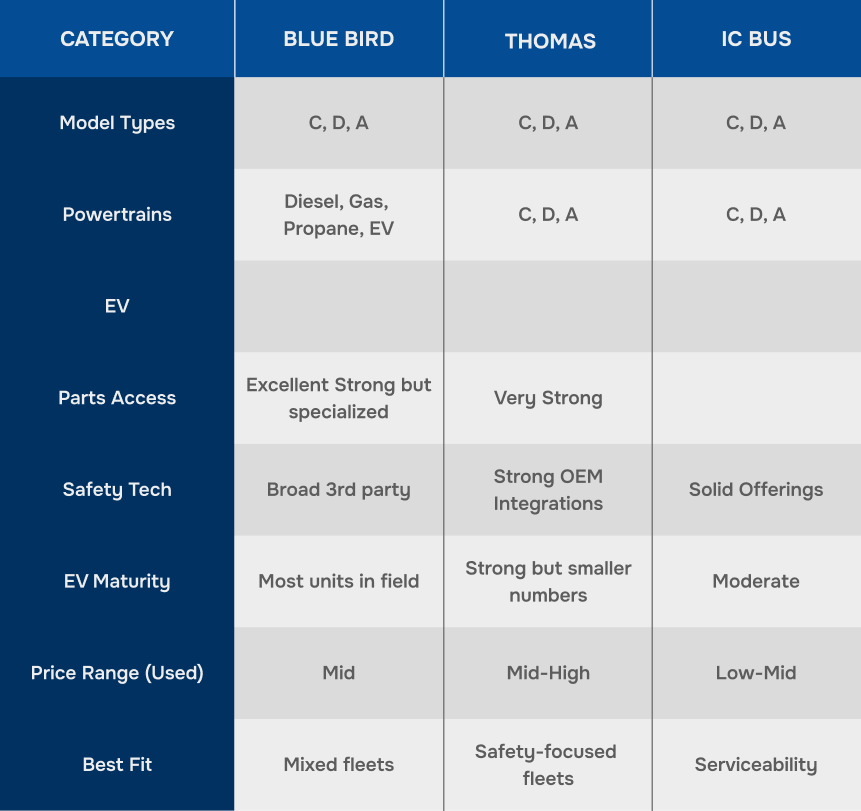
Best for fleets that value broad powertrain flexibility and high parts availability.
Thomas
Best for fleets that want strong visibility, safety integration, and factory-backed support networks.
IC Bus
Best for fleets that value serviceability, standardized diagnostics, and straightforward operator training.
Comparison Table
How to Choose: Operational Fit Over Brand
Instead of starting with the OEM, start with your operation:
- Hill climbing? Diesel Type D.
- Short urban loops? Gas or propane Type C.
- Light ridership? Type A.
- Sustainability mandates? Evaluate EV infrastructure, not just the bus.
- Driver availability? Non-CDL Type A or small Type C.
For more help choosing the right size, check out our 9 Types of School Buses Pocket Guide
Choosing the Right Bus
If you want the simplest takeaway, it’s this.
Blue Bird, Thomas, and IC are all strong platforms. The “right” bus is the one whose powertrain, maintenance profile, and parts network fit your daily realities, not the marketing brochure.For districts and contractors planning purchases, you can browse our used marketplace for Type A, C, and D inventory at any time. Or if you prefer a personalized touch, reach out and we can send you options customized to your needs.