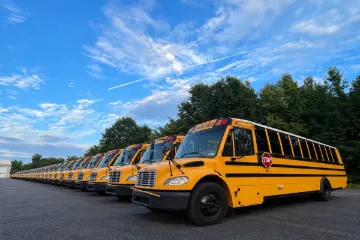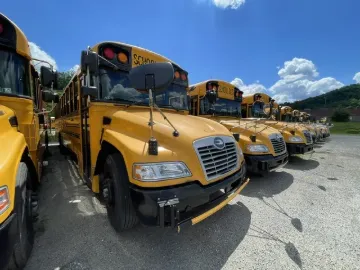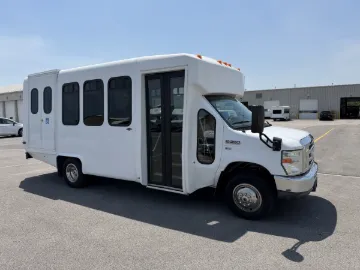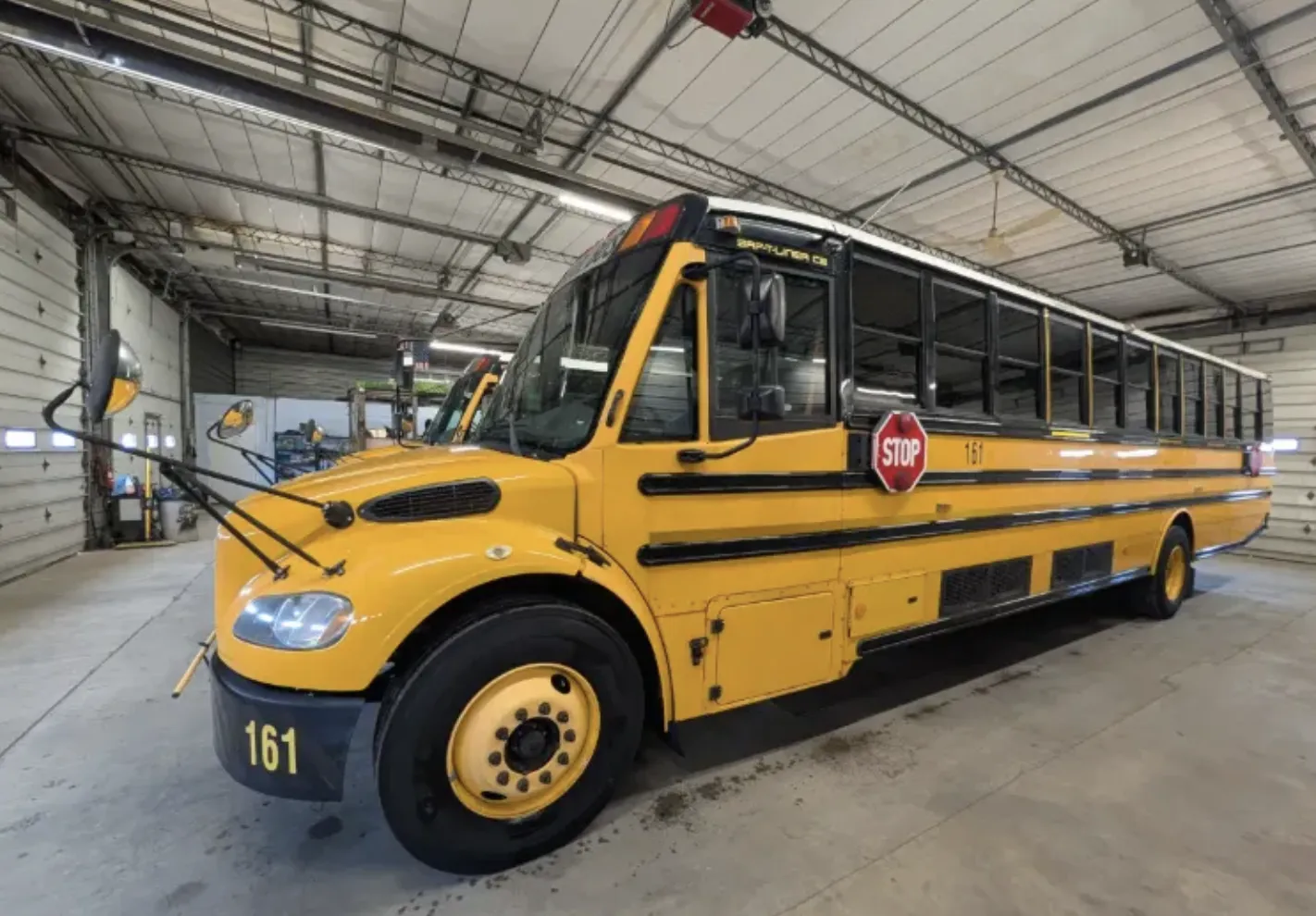
The Thomas Built Saf-T-Liner C2 is the most widely deployed Type C school bus in the United States. Freightliner Business Class M2 chassis with a Cummins B6.7 diesel engine and Allison automatic transmission; it seats 48–77 passengers depending on configuration. Used units from 2012–2018 list at $8,000–$49,000. It's the default fleet bus for school districts that prioritize Cummins engine serviceability and broad parts availability — and the most popular skoolie conversion platform by volume.
A note on capacity figures: the ranges in this guide are national ratings. States set their own limits, and New Jersey caps Type C and Type D at 54 passengers because the state requires 15 inches per student where the industry rates at 13. Confirm the rule where the bus will run.
Thomas Built Saf-T-Liner C2: Complete Buyer's Guide
If you're buying a used school bus for a district route, a special education program, or a skoolie conversion, there's a very good chance you'll end up evaluating a Thomas C2. Its combination of Freightliner chassis reliability, Cummins diesel powertrain, and the widest dealer and parts network in the school bus market makes it the default starting point for most buyers. This guide walks you through the specs, the model year differences that matter, the CDL requirements, what to inspect on a used unit, and how the C2 compares to the Blue Bird Vision — its closest competitor.
Thomas C2 Key Specifications
Thomas Built Saf-T-Liner C2 specification overview:
| Spec | Detail |
|---|---|
| Bus type | Type C conventional school bus (cab-forward, large hood ahead of driver) |
| Manufacturer | Thomas Built Buses (High Point, NC) — a Daimler subsidiary |
| Chassis | Freightliner Business Class M2 (most common); some units on Freightliner S2RV |
| Engine (standard) | Cummins ISB 6.7L diesel (most 2010+ units); earlier models ran Cummins ISB 5.9L |
| Transmission | Allison 2100 or 2500 Series automatic |
| Passenger capacity | 48–77 passengers (varies by body length and seat configuration) |
| GVWR | Approximately 29,000–33,000 lbs (Class 6–7) |
| CDL required | Yes — CDL Class B with P (passenger) and S (school bus) endorsements |
| Body lengths available | 23.5 ft (short, 48 pax) to 40 ft (full-size, 72–77 pax) |
| Fuel type | Diesel standard; propane, gasoline, and electric (Jouley) available on new builds |
| Typically used price | $8,000–$49,000 depending on year, mileage, and configuration |
Model Year Guide: What Changed and When
If you're buying a used C2, the model year matters primarily for emissions equipment, technology features, and parts compatibility. Here's what you need to know about the key generations.
Pre-2010 units (EGR era)
Units built before 2010 ran on the Cummins ISB 5.9L or early ISB 6.7L with exhaust gas recirculation (EGR) but without diesel particulate filters (DPF) or selective catalytic reduction (SCR/DEF). These units are the most popular skoolie conversion targets because they don't have the DEF system complexity that later models carry — if you're converting to a permanent live-aboard, you want to avoid diesel exhaust fluid maintenance in a remote location.
2010–2013 units (DPF transition)
These units introduced the EPA 2010 diesel emissions standard — DPF (diesel particulate filter) plus SCR (selective catalytic reduction, requiring DEF fluid). Maintenance complexity increases: DPFs require periodic regeneration and can clog if the bus isn't running long enough on each trip to complete passive regen. Short-route school bus operation is particularly hard on DPFs. When you're evaluating a 2010–2013 C2, ask specifically about DPF condition and regen history.
2014+ units (mature EPA 2010 platform)
By 2014, the emissions systems on the ISB 6.7L were well-refined and the reliability issues of the early DPF years had largely been resolved. A 2014–2018 C2 with 70,000–110,000 miles and documented service history is the sweet spot for district buyers who want a reliable used fleet bus without the risk of early-emission-system units.
Thomas C2 vs. Blue Bird Vision: How to Choose
Thomas C2 vs Blue Bird Vision comparison
| Criterion | Thomas C2 | Blue Bird Vision |
|---|---|---|
| Chassis | Freightliner Business Class M2 | Blue Bird proprietary |
| Engine options | Cummins ISB 6.7L (standard) | Cummins B6.7 or Ford 7.3L V8 |
| Dealer network | Wider national coverage — Freightliner dealers + Thomas dealers | Blue Bird dealer network, strongest in the Southeast |
| Resale value | Marginally higher in most US markets | Often, a lower initial purchase price on the used market |
| Parts availability | Excellent — Cummins and Freightliner parts are widely stocked | Good — Blue Bird proprietary chassis parts require dealer sourcing |
| Skoolie community preference | Slight edge — larger skoolie community familiarity | Popular in the Southeast, growing nationally |
| Best choice for | Districts outside Southeast; buyers prioritizing parts network | Districts in the Southeast, where the Blue Bird dealer is local |
Thomas C2 listings across model years and configurations — 48 to 77 passengers, diesel, short bus to full-size — are available through the BusesForSale.com school bus category. Skoolie-ready retired C2 units are listed in the skoolie conversions category. Thomas C2, Blue Bird Vision, IC Bus CE, Freightliner C2 — all Type C configurations updated daily. Retired C2 and IC Bus CE shells for conversion — diesel, various lengths, condition-graded listings. How many passengers does a Thomas C2 school bus hold? A Thomas C2 seats 48–77 passengers depending on body length and seat configuration. The most common district specification is 72 passengers on a full-size body; shorter "small bus" configurations seat 48–54. A 2016 Thomas C2 77-passenger unit with 116,480 miles is an example of a well-specified full-size unit available in the used market. How much does a used Thomas C2 school bus cost? Used Thomas C2 units range from $8,000 for high-mileage 2008–2011 units to $49,000 for low-mileage late-model units in excellent condition. The most common purchase range for a district-use unit is $12,000–$30,000 for a 2012–2016 model with 100,000–160,000 miles and a documented service history. Skoolie-targeted buyers typically focus on pre-2010 units at $8,000–$14,000. Is the Thomas C2 a good skoolie conversion bus? Yes — the Thomas C2 is the most popular skoolie conversion platform in the US by volume. The Cummins diesel engine is mechanically simple and well-documented; the doghouse engine cover provides accessible servicing; interior ceiling height runs 6+ ft on full-size bodies; and the used market supply is deep enough that you can be selective on price and condition. Pre-2010 units (no DPF/DEF system) are the most popular conversion targets. What engine does the Thomas C2 use? Most Thomas C2 units built from 2010 onward use the Cummins ISB 6.7L diesel engine paired with an Allison 2100 or 2500 Series automatic transmission. Pre-2010 units ran the Cummins ISB 5.9L. New builds also offer propane, gasoline, and the all-electric Jouley variant. For used fleet buyers, the ISB 6.7L diesel with Allison is the most reliable, best-supported powertrain combination. Thomas C2 or Blue Bird Vision — which should I buy? If you're outside the Southeast and prioritize parts network and resale value, buy the Thomas C2 — Freightliner and Cummins dealer coverage is broader nationally. If you're in the Southeast, where Blue Bird's dealer network is strongest, or if you find a Vision at a meaningfully lower price, the Vision is a solid alternative. Both are excellent buses; the decision usually comes down to your local dealer network and which brand your maintenance team already knows.What to Inspect on a Used Thomas C2
Browse Thomas C2 Inventory
School buses
Skoolie conversions
Frequently Asked Questions: Thomas C2 School Bus