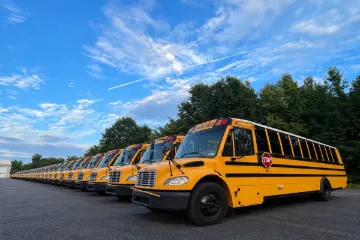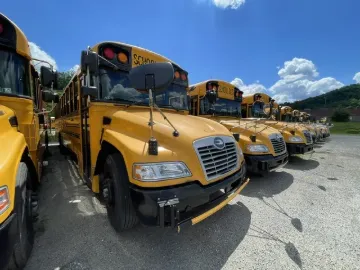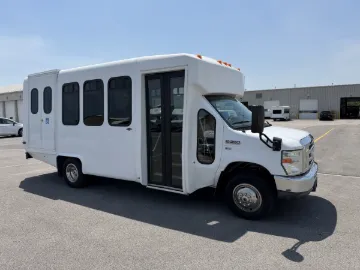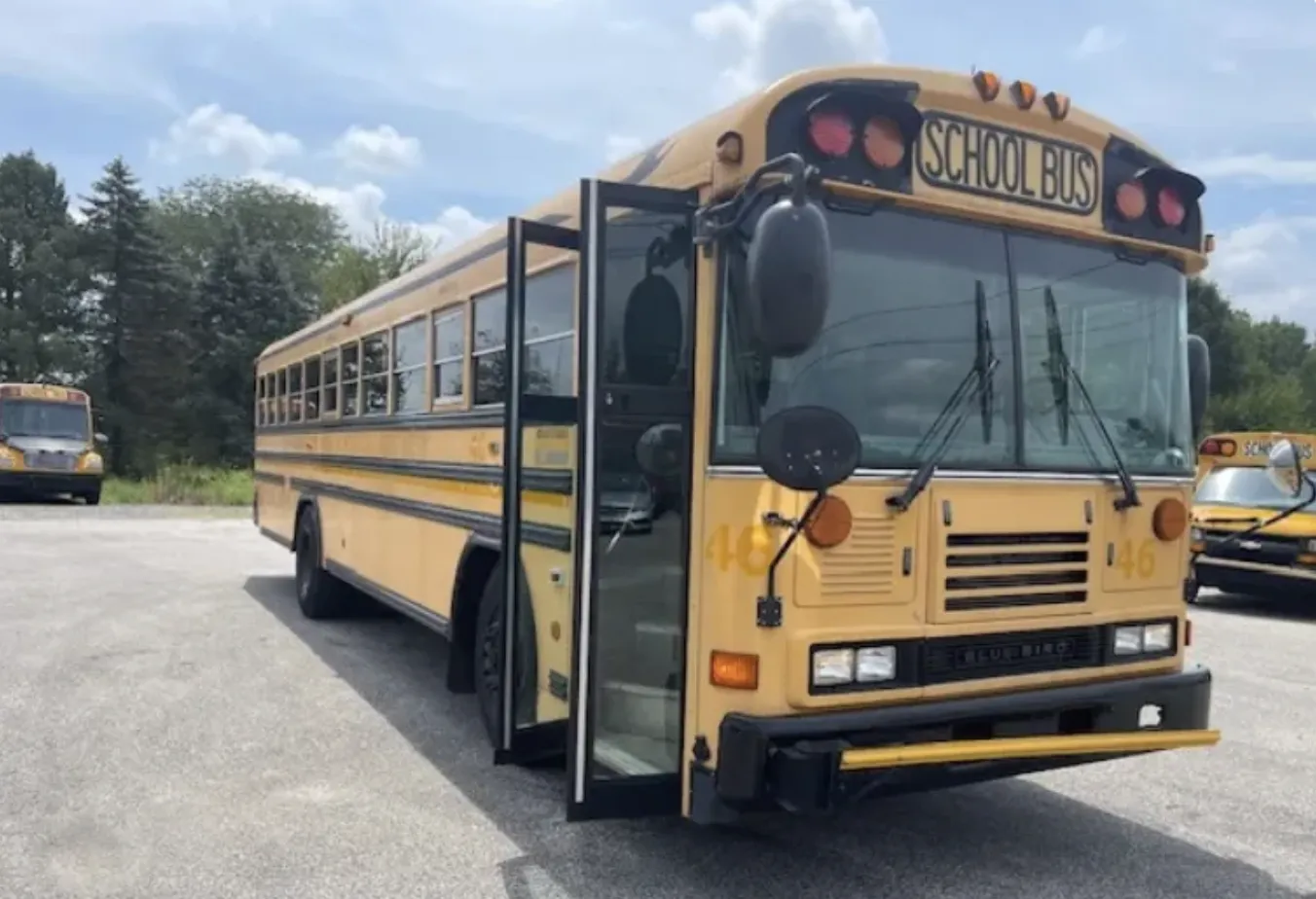
There are four federally recognized school bus types: Type A (van-body cutaway chassis, GVWR up to 21,500 lbs, commonly up to about 30 passengers though longer A-2 builds carry more), Type B (forward-engine conventional chassis, GVWR 10,001–19,500 lbs, 30–54 passengers), Type C (conventional cab-forward chassis, GVWR 19,501–33,000 lbs, 48–72 passengers), and Type D (transit-style flat-nose chassis, GVWR over 26,000 lbs, 54–90 passengers). Types A and B are the most common for daycares, small schools, and special education routes. Types C and D are the fleet workhorses for large school districts running high-capacity daily routes.
If you're buying a school bus — or deciding which type to put on a route — the Type A, B, C, D classification system is the framework every manufacturer, regulator, and fleet manager uses. It's not just a labeling convention: each type has a distinct chassis, body construction, GVWR class, passenger capacity range, and CDL requirement that directly affects your operating costs, driver licensing, and maintenance budget.
This guide defines each type clearly, shows you how they compare side by side, and connects each type to the models you'll actually find in BusesForSale.com inventory — so you can move from classification to purchase decision without guesswork.
A note on capacity figures: the ranges in this guide are national ratings. States set their own limits — New Jersey, for example, caps Type C and Type D at 54 passengers because the state requires 15 inches per student, while the industry standard is 13. Confirm the rule where the bus will run before finalizing a purchase.
School Bus Types A, B, C, D: Side-by-Side Comparison
The table below covers the specification dimensions that drive purchasing decisions for school districts, private schools, daycares, and fleet managers.
Comparison of school bus Types A, B, C, and D across key specification criteria
| Criterion | Type A | Type B | Type C | Type D |
|---|---|---|---|---|
| Body construction | Van-body conversion on cutaway chassis | Conventional body on forward-engine chassis; hood may be visible | Conventional cab-forward body on flat-nose chassis; large hood ahead of driver | Transit-style flat-nose bus body; engine rear- or front-mounted under the floor |
| Passenger capacity | Commonly up to about 30 passengers, though longer A-2 builds carry more | 30–54 passengers | 48–72 passengers | 54–90 passengers |
| GVWR class | A-1: up to 14,500 lbs; A-2: over 14,500 up to 21,500 lbs | 10,001–19,500 lbs (Class 4–5) | 19,501–33,000 lbs (Class 5–7) | Over 26,000 lbs (Class 6–8) |
| Typical length | 18–24 ft | 23–29 ft | 29–40 ft | 35–45 ft |
| CDL required? | A-1: generally no; A-2: yes (over 10,000 lbs + 16+ passengers) | Yes — Class B with P and S endorsements | Yes — Class B with P and S endorsements | Yes — Class B with P and S endorsements |
| Chassis / engine position | Ford E-Series, Chevrolet Express cutaway; engine forward | Dedicated school bus chassis; conventional hood | Dedicated school bus chassis; conventional hood ahead of driver | Rear- or front-mounted engine under floor; full-flat nose |
| Common manufacturers | Collins, Trans Tech, Micro Bird (Chevrolet), Thomas Minotour | Blue Bird All American, IC Bus CE (smaller configs) | Thomas Built Saf-T-Liner C2, Blue Bird Vision, IC Bus CE, Freightliner C2 | Blue Bird All American RE, IC Bus RE, Thomas Saf-T-Liner EFX |
| Typical use case | Daycares, small private schools, special education, rural low-volume routes | Medium districts, activity buses, special needs routes | Standard district routes — the most common type in US fleets | High-capacity urban district routes; large fleet operations |
| Typical used price range | $8,000–$28,000 | $12,000–$35,000 | $8,000–$50,000 | $15,000–$60,000 |
| Skoolie conversion potential | Low — short length limits livability | Moderate — mid-length with good ceiling height | High — most popular skoolie platform; good ceiling, accessible engine | Very high — maximum interior volume, flat floor ideal for conversion |
Type A School Bus: The Small-Bus Workhorse
A Type A school bus is built on a van-body cutaway chassis — think a Ford E-Series or Chevrolet Express with a purpose-built school bus body installed by a conversion company. If you're running a daycare, a small private school, or a special education program, it's the most accessible entry point you'll find: real school bus compliance without the full operational complexity of a large district fleet.
The federal classification splits Type A into two sub-types by GVWR (gross vehicle weight rating — the maximum loaded weight): Type A-1 runs up to 14,500 lbs; Type A-2 runs over 14,500 lbs up to 21,500 lbs. That GVWR line is separate from the CDL threshold, which in most states sits around 10,000 lbs GVWR combined with 16 or more passengers including the driver — so depending on your state's rules and your seating configuration, some A-1 units require a CDL Class B with passenger (P) and school bus (S) endorsements, and some don't. If your drivers don't have CDLs, you need to confirm your state's specific GVWR and passenger-count rules before you buy — the line between CDL and non-CDL varies by jurisdiction, and getting it wrong means your drivers aren't legal on day one.
Who buys Type A buses
Daycares, private schools with small enrollment, special education programs running individual routes, and rural districts with low-volume stops are the primary buyers. The 2024 Chevrolet Micro Bird G5 and the 2020 Chevy Thomas Minotour represent the current production options; in the used market, you'll find Type A units from Collins, Trans Tech, and Micro Bird at $8,000–$28,000 depending on age and condition. The guide to choosing the best bus for daycares and schools covers the compliance requirements for child transport in detail.
Type A and skoolie conversions
Type A buses are the least popular skoolie platform. The short body — 18–24 ft — limits your interior living space to the point where most converters find it impractical. If skoolie conversion is your goal, a Type C is where you should be looking instead.
Type B School Bus: The Mid-Size Conventional
A Type B school bus sits between the van-body Type A and the full conventional Type C. It uses a dedicated school bus chassis with the engine mounted under a visible conventional hood, but the bus body begins at or behind the front axle — so you get more usable interior length than a Type A at similar overall vehicle length, which matters when you're planning seating layouts for specific routes. Passenger capacity runs 30–54, and GVWR falls in the Class 4–5 range (10,001–19,500 lbs).
Type B buses require a CDL Class B with P and S endorsements regardless of passenger count — the GVWR puts them firmly in commercial vehicle territory. If you're a smaller district or organization looking to supplement your Type C fleet, a Type B gives you the flexibility to run lower-density routes without putting a 72-passenger bus on a stop that needs 35 seats.
Who buys Type B buses
Medium-sized school districts running supplemental routes, activity buses for sports and field trips, and special education programs that need more capacity than a Type A but don't require a full-size Type C. The Blue Bird All American in smaller configurations and certain IC Bus CE builds occupy this classification. Used Type B units in serviceable condition list from $12,000–$35,000.
Type C School Bus: The Standard Fleet Bus
Type C is the school bus most people picture when they hear the words "school bus." It's a conventional body-on-chassis design with the engine ahead of the driver under a large hood — the classic "cowl" configuration. It's the most common type in US school district fleets, the most widely available in the used market, and the most established platform for skoolie conversions.
Passenger capacity runs 48–72 on a GVWR of 19,501–33,000 lbs. All Type C buses require a CDL Class B with P and S endorsements. On the used market, a 2012–2016 Type C diesel unit with 140,000–180,000 miles typically lists in the $8,000–$15,000 range — one of the most cost-effective large-capacity transport options you'll find anywhere in the commercial vehicle market.
Thomas Built Saf-T-Liner C2
The Thomas Saf-T-Liner C2 is the most common Type C in BusesForSale.com's inventory. Built on the Freightliner Business Class M2 chassis with a Cummins B6.7 diesel, the C2 is the de facto standard for US school districts that prioritize reliability and parts availability. A 2016 Thomas C2 77-passenger with 116,480 miles lists at $49,000; used 2013–2018 C2 units with 50,000–100,000 miles run $12,800–$49,000 depending on specification and condition. If you're evaluating the Thomas C2 vs. the Blue Bird Vision for a district purchase, the C2's wider dealer network and Cummins engine availability typically give it the edge — especially if you're outside a major metro area where Blue Bird dealer coverage thins out.
Blue Bird Vision
The Blue Bird Vision is the primary competitor to the Thomas C2 in the Type C segment. It runs on the Blue Bird proprietary chassis with Cummins or Ford engine options and is particularly well-represented in Sun Belt states. The 2024 Blue Bird Vision and the 2017 Blue Bird Vision are both active in the BusesForSale.com inventory. If your district has already standardized on Blue Bird for parts and driver familiarity, the Vision is your natural fleet choice, and you can skip the comparison. If you're evaluating both, the resale performance tends to track local dealer coverage, and parts support more than brand itself; the Vision often carries a lower initial purchase price on equivalent-year used units, which matters when you're buying in volume.
IC Bus CE and Freightliner C2
The International IC Bus CE is the third major Type C platform, and if you're running routes in the Midwest or a large urban district, you're likely already familiar with it. The 2012–2019 IC Bus CE appears regularly in BusesForSale.com inventory at $8,000–$28,000. The Freightliner C2 (Thomas-built on a Freightliner chassis) shares much of its architecture with the Thomas C2 and is often grouped with it for parts and service purposes. Both the 2018 and 2021 Freightliner C2 units are represented in current inventory.
Type C and skoolie conversions
Type C is the dominant skoolie platform by volume. The combination of good standing ceiling height (6+ ft interior on full-size models), accessible doghouse engine cover for servicing, and widely available parts makes the 2000–2010 Type C diesel the first choice for most first-time converters. A 2010–2014 IC CE or Thomas C2 with 150,000–220,000 miles at $8,000–$14,000 gives you the structural shell most converters start with — everything you need and nothing you're paying for twice. See the skoolie conversions category for what's currently available.
Type D School Bus: The High-Capacity Transit-Style Bus
A Type D school bus uses a transit-style flat-nose body with the engine mounted either at the rear or under the floor at the front — there's no conventional hood ahead of the driver. The driver sits over or just behind the front axle, which maximizes interior length for a given overall vehicle length and gives you a wider front windshield view. Passenger capacity runs 54–90 on a GVWR that exceeds 26,000 lbs. All Type D buses require a CDL Class B with P and S endorsements.
The Type D is the bus of choice for large urban districts with high-density routes where you need to maximize passengers-per-trip as the primary operational metric. The Blue Bird All American RE (rear engine) and IC Bus RE are the most common Type D platforms. On the used market, a 2010–2016 Type D with 150,000–200,000 miles lists in the $15,000–$30,000 range; lower-mileage late-model units run $35,000–$60,000.
Type D and skoolie conversions
Type D buses — particularly the flat-nose transit-style models — offer the most interior volume of any school bus conversion platform. If you're planning a full-time live-aboard build, the flat floor (no doghouse engine cover to work around), maximum ceiling height, and full-length interior give you everything you need without compromise. The trade-off is driving complexity: the Type D handles differently from a conventional hood bus, so if you've never driven a flat-nose before, budget time to get comfortable with its turning radius before you're on a tight street. Used Type D units in good structural condition command a premium over equivalent-year Type C buses precisely because skoolie converters know what they're getting — and so do you.
Which School Bus Type Is Right for Your Operation?
The right type depends on three variables: how many passengers you're moving per trip, what your drivers are licensed to operate, and what your maintenance infrastructure can realistically support. Match your situation to one of the rows below — once you've identified your type, you'll have a defensible starting point for the purchase conversation with any seller or dealer.
| Your situation | Recommended type | Key reason |
|---|---|---|
| Daycare or private school, under 30 children, no CDL drivers | Type A-1 | GVWR and passenger count typically keep Type A-1 below the CDL threshold in most states; Collins or Micro Bird G5 from $8,000–$22,000 used |
| Small district or private school, 30–54 students, CDL drivers available | Type B or Type C (smaller config) | Type B gives mid-range capacity without running a half-empty full-size; Blue Bird All American in smaller builds from $12,000–$30,000 used |
| Standard district route, 48–72 students, CDL drivers | Type C | The most common type in US fleets; widest parts availability; Thomas C2, Blue Bird Vision, IC Bus CE all well-represented in used market from $8,000–$50,000 |
| Large urban district, 54–90 students, maximum capacity priority | Type D | Transit-style flat nose maximizes interior length; Blue Bird All American RE or IC Bus RE from $15,000–$60,000 used |
| Skoolie conversion, first build | Type C (short or standard) | Best combination of interior height, parts availability, and entry price; 2005–2012 diesel C2 or IC CE from $8,000–$14,000 |
| Skoolie conversion, full-time live-aboard | Type D | Maximum interior volume and flat floor; premium platform for serious builds, commands $5,000–$10,000 more than equivalent-year Type C |
Browse School Bus Inventory by Type
BusesForSale.com lists school buses across all four types — updated daily from school districts, fleet sellers, and dealers across the country. Type C inventory (Thomas C2, Blue Bird Vision, IC Bus CE, Freightliner C2) is the deepest; Type A and Type D units turn over regularly. Use the category page to filter by year, mileage, and capacity.
School buses — all types
Type A through D. Thomas C2, Blue Bird Vision, IC Bus CE, Freightliner C2, Micro Bird, and more — updated daily.
Browse School Bus InventorySkoolie conversions
Retired school buses ready for conversion — Type C and Type D shells, diesel engines, various lengths and conditions.
Browse Skoolie InventoryModel pages for Thomas C2 and Blue Bird Vision: Individual model pages for these two platforms are not yet live on BusesForSale.com — all Thomas C2 and Blue Bird Vision listings are accessible through the school bus category page. Dedicated model pages are flagged as a development priority.
Frequently Asked Questions: School Bus Types A, B, C, D
What is the difference between a Type A and a Type C school bus?
A Type A school bus is a van-body conversion on a cutaway chassis (Ford E-Series or Chevrolet Express), commonly seating up to about 30 passengers, though longer A-2 builds carry more — the smallest classified school bus. A Type C is a full conventional body-on-chassis with a large hood ahead of the driver, seating 48–72 passengers. Type A-1 units may be operable without a CDL in your state; all Type C units require a CDL Class B with P and S endorsements regardless of where you're operating.
What is the most common type of school bus?
Type C is by far the most common school bus type in the United States. The conventional cab-forward body with a large front hood — built by Thomas Built Buses (Saf-T-Liner C2), Blue Bird (Vision), and IC Bus (CE) — accounts for the majority of active school district fleets and the deepest used market inventory. If you're buying a used school bus without a specific type requirement, you'll find the most options in the Type C category.
Do all school bus types require a CDL?
Not all. Type A-1 buses (GVWR up to 14,500 lbs) may be operated without a CDL in most states when GVWR stays under roughly 10,000 lbs and passenger count stays under 16, including the driver — though you still need a school bus (S) endorsement in many jurisdictions. Type A-2, B, C, and D generally exceed that CDL threshold and require a CDL Class B with both the passenger (P) and school bus (S) endorsements. Always confirm your state's specific rules, as CDL thresholds and endorsement requirements vary.
What is the best school bus type for a daycare or small private school?
Type A-1 (GVWR up to 14,500 lbs) is the standard choice for daycares and small private schools. Staying under roughly 10,000 lbs GVWR and 16 passengers including the driver typically keeps you below the CDL threshold, letting staff with standard licenses operate the vehicle. Models like the Chevrolet Micro Bird G5 and Collins bus on a Ford E-Series chassis seat 12–30 children with FMVSS-compliant safety features at a used-market price of $8,000–$22,000. Confirm your state's MFSAB requirements before you buy — the rules for child transport vary significantly between states and can affect which models are compliant for your use.
Which school bus type is best for a skoolie conversion?
Type C is the most popular skoolie platform because of its combination of ceiling height (6+ ft interior), accessible engine via the doghouse cover, and the widest used-market supply at the lowest entry price. For a full-time live-aboard build where interior volume is the priority, a Type D flat-nose transit-style bus offers a larger flat floor and maximum interior length — at a $5,000–$10,000 premium over an equivalent-year Type C.
What is the difference between a Type C and Type D school bus?
A Type C school bus has a conventional hood ahead of the driver (engine forward, driver behind the cowl). A Type D has a flat-nose transit-style body with the engine at the rear or mounted under the floor — the driver sits over the front axle with no hood in front. Type D provides more interior length per foot of overall vehicle length and higher passenger capacity (54–90 vs. 48–72), but requires more driver skill to operate in tight spaces.