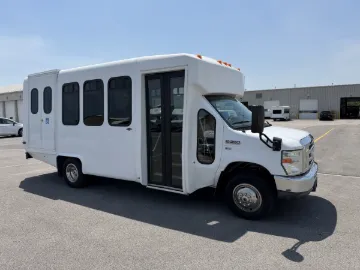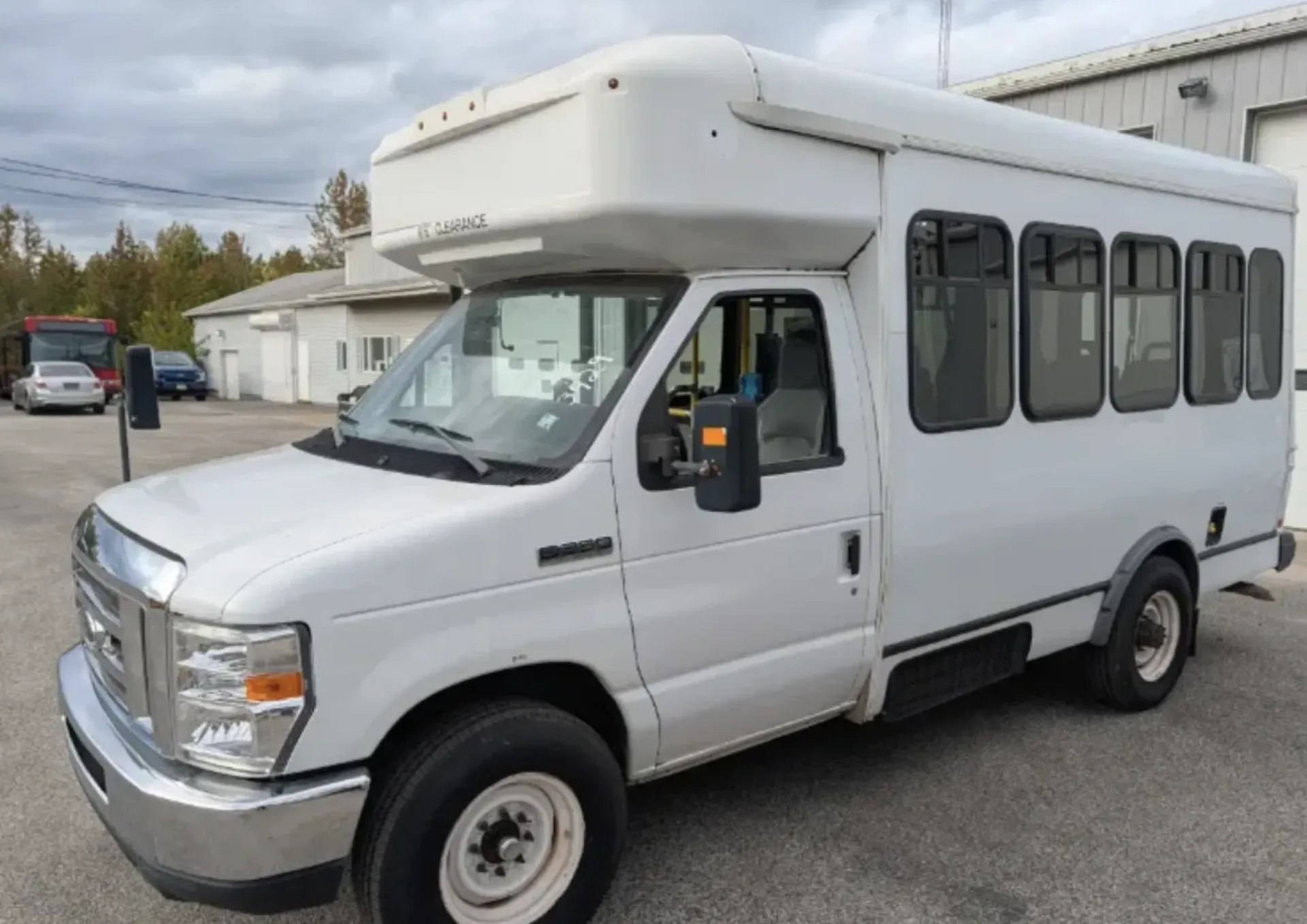
Mini buses and shuttle buses share the same chassis family but serve different jobs. Choose a mini bus if you need 8–24 seats, non-CDL operation, or a permanent-ownership vehicle for a church, daycare, or senior center. Choose a shuttle bus if you're running fixed high-frequency routes, need 25–40 seats, or operate commercially with CDL drivers. Budget, route type, and CDL availability are the three decision criteria that matter most.
If you've been comparing a mini bus vs a shuttle bus and can't work out which one fits your operation, you're not alone. The two vehicles look nearly identical on a dealer lot — same Ford E-Series or Chevrolet Express chassis, same body conversion builders, often the same price range. But the right choice depends on how you'll actually use the vehicle, who will drive it, and what your passengers need.
This guide breaks down the real differences: seating capacity, GVWR (the maximum loaded weight your vehicle is rated to carry), CDL requirements, interior configuration, typical used prices, and which buyer types each vehicle serves best. You'll find links to live inventory for both categories at the bottom.
Mini Bus vs Shuttle Bus: Side-by-Side Comparison
The table below covers the dimensions that drive most purchase decisions. Use it as your quick reference before digging into the use-case breakdown below.
| CRITERION | MINI BUS | SHUTTLE BUS |
|---|---|---|
| Typical passenger capacity | 8–24 passengers | 20–40 passengers |
| Chassis examples | Ford Transit, Ford E350/E450, Chevrolet Express G3500 | Ford E450, Ford F-600, Freightliner, International |
| Body conversion builders | Starcraft, Collins, Eldorado, Diamond Coach | Starcraft Allstar, Girardin, Grech, StarTrans, Glaval |
| GVWR range | 10,001–19,500 lbs (Class 3–5) | 14,001–33,000 lbs (Class 4–6) |
| CDL required? | No — if ≤15 seats (including the driver) and GVWR under 26,001 lbs | Yes — most shuttle buses carry 16+ passengers |
| Typically used price range | $10,000–$40,000 | $18,000–$75,000 |
| New build price range | $50,000–$85,000 | $65,000–$225,000 |
| ADA-equipped option available? | Yes — wheelchair lift, Q'Straint securement | Yes — typically on cutaway or purpose-built bodies |
| Luggage / underfloor storage | Limited — overhead or under-seat only | Often yes — dedicated underfloor bays on larger builds |
| Route type best suited to | Occasional trips, community transport, owned fleets | Fixed high-frequency routes, airport, and corporate shuttles |
| Typical ownership model | Owned — church, school, senior center, daycare | Owned or leased — commercial operator, fleet manager |
| Insurance cost (annual, used vehicle) | $1,800–$3,200 non-CDL; $3,500–$5,500 CDL | $3,500–$6,500 CDL commercial operation |
Which One Is Right for Your Operation?
The comparison table tells you the specs. This section tells you what those specs mean for your specific situation — because the right vehicle depends on who you're moving, how often, and who's doing the driving.
| YOUR SITUATION | RECOMMENDED | KEY REASON |
|---|---|---|
| Church or nonprofit, volunteer drivers, ≤15 passengers | Mini bus | Non-CDL threshold keeps volunteer drivers legal; Ford Transit or E350 at $12,000–$28,000 used fits most congregation budgets |
| Daycare or youth camp, staff drivers, child safety priority | Mini bus (MFSAB) | MFSAB (Multi-Function School Activity Bus) classification is available on mini bus chassis and meets most state child-transport standards without a full school bus body |
| Senior center or ADA facility, mixed ambulatory and wheelchair passengers | Mini bus (ADA-equipped) | Chevrolet G3500 and Ford E450 ADA builds accommodate 2 wheelchair positions plus ambulatory seating in a non-CDL footprint; used units run $24,000–$42,000 |
| Airport hotel, running fixed hourly routes with CDL staff | Shuttle bus | Higher passenger count (20–30) and luggage bay justify the CDL cost; a 2019–2022 Ford E450 Starcraft Allstar or Girardin at 50,000–90,000 miles lists $25,000–$45,000 |
| Corporate campus or employee shuttle, daily fixed routes | Shuttle bus | Fixed daily headcount justifies 25–35 capacity; Freightliner StarTrans and Ford F-600 Grech bodies offer the commercial durability high-cycle routes demand |
| Charter operator, occasional group trips under 24 pax | Mini bus | Lower operating cost, easier to park and position, and non-CDL eligibility at 15 seats or fewer (including the driver); upgrade to a shuttle bus once routes consistently exceed 24 passengers |
| Fleet manager, replacing aging 30+ seat vehicle on a budget | Shuttle bus | Used shuttle buses in the 2016–2020 range deliver the capacity your routes need at $20,000–$40,000 — lower entry cost than a new mini bus build of equivalent quality |
The CDL question is the real fork in the road
If your drivers can get a CDL — or already have one — a shuttle bus opens up more passenger capacity per dollar. If you're relying on volunteers, staff without commercial licensing, or want to avoid the cost and complexity of CDL compliance, a mini bus with 15 seats or fewer (including the driver) is the vehicle your operation needs. That single constraint drives more purchasing decisions than any spec comparison ever will.
Route frequency changes the math
If you're running occasional trips — Sunday services, field days, senior outings — the lower purchase price and simpler operating profile of a mini bus makes sense. If you're running 4–8 trips per day on a fixed route, you need the durability and capacity that a commercial-grade shuttle bus chassis delivers. A Ford E450 cutaway mini bus conversion was not built to run 200 cycles per week; a Freightliner StarTrans or Grech body on a Ford F-600 was.
Mini Bus: What You're Actually Getting
When you buy a mini bus, you're buying flexibility. The 8–15-passenger non-CDL sweet spot is the reason churches, daycares, and senior centers have been buying them for thirty years — it gives you real transport capacity without the driver licensing overhead that a larger vehicle demands.
On the used market, a 2014–2018 Ford E450 Starcraft with 90,000–120,000 miles sits in the $18,000–$28,000 range. For lighter-duty non-CDL use, a used Ford Transit-based Collins or Eldorado conversion from 2019–2022 runs $22,000–$38,000. If you need ADA accessibility — wheelchair lift, Q'Straint securement, kneeling suspension — expect to add $8,000–$15,000 to the base price; a compliant used unit from 2016–2020 typically lists $24,000–$42,000. See the full guide to ADA-compliant buses if accessibility is a hard requirement.
What a mini bus gives up: luggage bay capacity, passenger volume above 24, and the high-cycle commercial durability that a fleet-grade shuttle bus chassis is engineered for. If those things matter to your operation, you're looking at the wrong vehicle.
Shuttle Bus: What You're Actually Getting
A shuttle bus is a commercial transport tool. It's built for frequency — multiple runs per day, five days a week, year-round. The Freightliner StarTrans, the Ford E450 Starcraft Allstar, the Ford F-600 Grech — these are vehicles engineered for operators who need reliable high-capacity point-to-point transport and can't afford downtime.
On the used market, a 2018–2022 Ford E450 Starcraft Allstar with 50,000–90,000 miles lists between $25,000 and $45,000. Higher-end builds like the 2024 Ford F-600 Grech 28-passenger with 3,000 miles run $225,000 new — that's a commercial vehicle that earns its price back through daily revenue, not occasional use. Used 2019–2021 Ford Transit 350 Starlite units in the 12–15-passenger shuttle configuration run $49,000–$66,000 for low-mileage examples.
What a shuttle bus demands in return: CDL drivers for anything over 15 seats (including the driver's seat), commercial insurance at $3,500–$6,500 per year, and a maintenance budget that reflects higher-cycle usage. If your operation isn't running routes regularly enough to justify those costs, a mini bus serves you better. For operators who need the capacity and frequency, commercial bus insurance types and what they cost are worth reading before you buy — see our bus insurance guide.
Browse Live Inventory
Both categories are updated daily on BusesForSale.com. Use the buyer-type guidance above to decide which direction fits your operation, then browse available units below.
Mini buses
8–24 passengers. Non-CDL options available. Ford Transit, Ford E350/E450, Chevrolet Express. ADA-equipped units in stock.
Browse Mini Bus InventoryShuttle buses
20–40 passengers. Commercial-grade builds. Ford E450, Ford F-600, Freightliner, Starcraft Allstar, Grech, Girardin.
Browse Shuttle Bus InventoryFrequently Asked Questions: Mini Bus vs Shuttle Bus
What is the difference between a mini bus and a shuttle bus?
A mini bus typically seats 8–24 passengers on a van or light-duty cutaway chassis and is designed for ownership by churches, daycares, and community organizations — often without requiring a CDL. A shuttle bus seats 20–40 passengers, runs on a heavier commercial chassis, and is built for high-frequency fixed routes operated by CDL drivers.
Is a shuttle bus bigger than a mini bus?
Generally, yes, but there is overlap. Shuttle buses commonly run 20–40 passengers on Class 4–6 chassis and can reach 35–40 ft in length. Mini buses run 8–24 passengers on Class 3–5 chassis at 20–32 ft. A 24-passenger mini bus and a 20-passenger shuttle bus may share the same floor length — the distinction is chassis class, conversion builder, and intended use cycle.
Do you need a CDL to drive a shuttle bus?
Yes, for most shuttle buses. Any vehicle designed to transport 16 or more passengers — including the driver — requires a CDL Class B. Most shuttle buses exceed that threshold. If you need CDL-free operation, you must stay at 15 seats or fewer (including the driver) and under 26,001 lbs GVWR, which typically puts you in mini bus territory.
Which is cheaper: a mini bus or a shuttle bus?
Used mini buses start lower — around $10,000–$12,000 for older high-mileage units versus $18,000 for entry-level used shuttle buses. However, a well-specified 2018–2022 shuttle bus at $25,000–$45,000 often delivers more passenger capacity per dollar than a new mini bus build at $55,000–$85,000. The cheapest option on a per-seat basis is usually a used commercial shuttle bus.
Which is better for a church: a mini bus or a shuttle bus?
For most churches, a mini bus is the better fit. A 12–15-seat (including the driver) Ford Transit or E350 conversion keeps you under the CDL threshold, which means volunteer drivers can operate it legally. If your congregation regularly moves 20–30 people and you have CDL-licensed staff or are willing to hire them, a shuttle bus gives you more capacity per dollar.
Can a mini bus be used as a shuttle bus?
Yes, if your route and passenger load fit within mini bus capacity (8–24 seats). Many airport hotels and small corporate campuses run mini buses on fixed shuttle routes because the volumes don't justify a full shuttle bus. The constraint is cycle durability — if you're running 6+ trips a day, a commercial-grade shuttle bus chassis will outlast a mini bus conversion by several years.